Statcast says Ty France's roof-ball wasn't a homer. But maybe it was.

Ty France hit a ball in the ninth inning Saturday night that struck a roof cable at Milwaukee’s American Family Field. The Padres trailed 3-2 in the opener of the NL Division Series, and the ball had a chance to change everything.
The play was ruled an out. Milwaukee’s ground rules state that a fair ball striking the roof or anything attached to it is in play, so the ricochet off the cable didn’t save France.
Statcast, MLB’s publicly available data tool, says the debate is closed. Even without the cable, France’s ball would not have been a go-ahead home run. It would have been a flyout. A particularly crushing one, but a flyout nonetheless.
France hit the ball 105.3 mph with a 49-degree launch angle. Since Statcast began tracking balls in play like this in 2015, only two other players have produced that combination, and both were outs.
The Padres lost 3-2. The play didn’t decide the game alone, but it loomed large over a one-run defeat.

Yet the case of France’s non-homer might not be as conclusive as Statcast suggests. The public data says flyout, but there’s reason to wonder whether that’s the whole story.
WHAT STATCAST SAYS
Statcast’s public data is clear on the raw numbers: France hit the ball 105.3 mph with a 49-degree launch angle. Since 2015, only two other players have produced that exact combination, and both were outs.
A wider sample tells a similar story. In the Statcast era, there have been 37 fair balls between 105-106 mph and 48-50 degrees of launch angle. On average, they traveled 321 feet. Thirty-two of them were outs. Three were home runs, each barely clearing the fence at an average of 349 feet.
The two extra-base hits in that group are worth a closer look. Abraham Almonte’s 2017 triple was essentially an error — the outfielder lost the ball in the sun and it dropped next to him. Rafael Devers’ 2021 ball hit the roof in Tampa and was awarded a double under the ground rules there, which differ from Milwaukee’s.

In Milwaukee, a ball that strikes the roof or anything attached to it stays in play. That’s why France was ruled out despite the ricochet off the cable.
Given the exit velocity and launch angle, a home run was possible but not probable. The public data leans heavily toward an out.
But the public data isn’t the only data. Statcast is widely available, yet many teams run their own internal models for measuring ball flight — and those models may reach different conclusions. According to an analytics staffer with an American League club, speaking on condition of anonymity, that appears to be the case.
THE NUMBERS AND THE RULES
France’s ball left the bat at 105.3 mph with a 49-degree launch angle. In the Statcast era, that exact combination has been done twice by other players — and both were outs. That sample is too small to settle anything, so the wider data helps.

Since Statcast began tracking in 2015, there have been 37 fair balls between 105 and 106 mph with a launch angle between 48 and 50 degrees. On average, they traveled 321 feet. Thirty-two were outs. Two were extra-base hits. Three were homers — and each barely cleared the fence, averaging 349 feet.
The two extra-base hits are worth noting. One, a triple by Abraham Almonte in 2017, was essentially an error: the outfielder lost the ball in the sun. The other belongs to Rafael Devers, who hit a ball off the roof in Tampa in 2021. Under the ground rules there, certain roof hits are awarded doubles, so Devers took second base.
Milwaukee’s rules are different. In American Family Field, a fair ball that strikes the roof or anything attached to it stays in play. That’s why France was ruled out despite the ricochet off the cable.
So given the exit velocity and launch angle, a home run was possible — but not a great one. The public data leans heavily toward a flyout, though the source notes that conclusion is not 100 percent conclusive. The numbers say out more often than not, but they don’t say it every time.
THE INTERNAL MODELS MAY DISAGREE

But Statcast is public data. Teams don't have to settle for it.
Many clubs run internal models for measuring ball flight, proprietary systems that can incorporate stadium-specific atmospheric data, spin decay, and other variables that the public tool doesn't fully capture. It's entirely possible those private models reach a different conclusion than the one MLB's public numbers suggest.
According to an analytics staffer with an American League club, speaking on condition of anonymity because they are not authorized to speak publicly, that appears to be the case.
The source did not specify which teams hold that view, nor what their internal models actually conclude. The specifics of those proprietary conclusions are not confirmed — only that at least one AL analytics staffer indicated they may differ from Statcast's reading.
The implication is worth sitting with: the public Statcast ruling might not match what some teams' own data would say about France's ninth-inning drive. If a club's model accounts for the exact conditions at American Family Field on Saturday night — the air, the spin, the ball's trajectory before it met the cable — a different verdict is plausible.

That doesn't mean the Padres were robbed. It means the debate isn't as closed as the public numbers suggest. The teams with the most sophisticated tracking won't publish their answer, and fans are left with a 105.3 mph, 49-degree launch angle that Statcast says dies before the wall — but that privately, at least one club believes could have gone out.
WHAT TO WATCH NEXT
The Padres lost the opener of the NL Division Series to the Brewers, 3-2, on Saturday night. That much is confirmed.
What comes next in the series, however, is not. The source does not give the date or time of the next game, and no other upcoming games or decisions are mentioned.
The debate over France's non-homer may linger, but it likely won't be resolved with new data. Teams' internal models are not public, and no further information is expected to be released.
What is clear: the ground rules at American Field remain in effect for any future batted balls that strike the roof or attached objects. Those rules, which kept France's drive in play and resulted in the out, will apply again if a similar situation arises.
Whether any team will publicly challenge the Statcast ruling is also not confirmed. The Padres have not indicated they will push back, and the analytics staffer who suggested internal models may disagree did so anonymously, without specifying which clubs hold that view.
So the series moves forward with the public record intact: a 105.3 mph, 49-degree launch angle that Statcast says would have been a flyout. The private models, whatever they conclude, stay private.
Advertisement
You may also like

Clemson 4-star WR commit Jamarin Simmons out for rest of senior season
Clemson 4-star wide receiver commit Jamarin Simmons confirmed with Rivals on Tuesday morning that he is out for the rest of his senior season.…

Kentucky QB commit Jake Nawrot explodes for seven TDs in 71-0 rout
Jake Nawrot put together one of the best games of his high school career last Friday, and the numbers back it up. The senior…

IMG Academy barely survives St. James 44-42; Nov. 13 showdown looms
IMG Academy (6-0) remains No. 1 in the Rivals High School Football Composite Top 25 after barely getting by The St. James Academy 44-42…
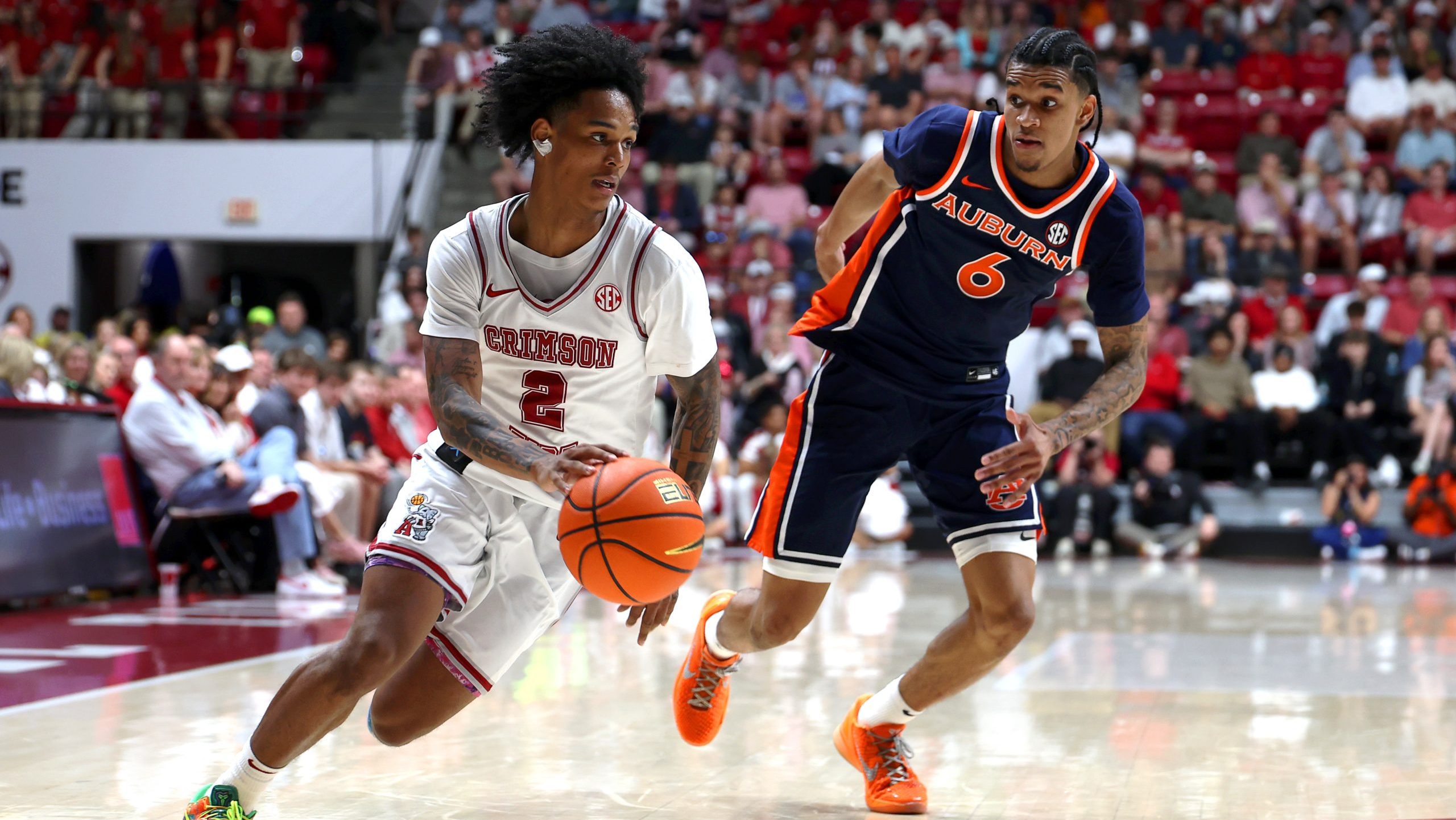
Aden Holloway reinstated at Alabama but suspended through Nov. 9
Aden Holloway is officially back on the Alabama basketball roster, according to www.saturdaydownsouth.com. His 2026-27 debut, however, will be delayed due to a suspension.…

Polynesian Bowl means family for 2028 WR Malachi Lee, a top-70 recruit
Malachi Lee said yes to the Polynesian Bowl for reasons that go far beyond the game itself. The 2028 Top247 wide receiver, who plays…

Tennessee listed on 'wrong side' of CFP bubble, per Heather Dinich
ESPN’s Heather Dinich released her latest CFP Bubble Watch on Tuesday morning, according to www.saturdaydownsouth.com, and Tennessee landed on the “wrong side” of the…