The fingerprint left at the Night Stalker's last crime scene that named him
The door was unlocked.
That was the detail the record leaves open, and the one that mattered.
On August 24, 1985, in the San Francisco suburb of Lake Forest, a 29-year-old man was killed.
He was the final murder attributed to the intruder the media had dubbed the "Night Stalker."
The source does not name the victim.
The record states only his age, and that he was the last to die before the attacker's identity was established.
The exact circumstances of the murder are not detailed.
What is documented is what investigators found at the scene: a fingerprint.
A single, unassuming mark.
It was not a confession. It was not a witness.
It was a loop of ridges pressed into a surface, left behind by a hand that had been there.
The fingerprint was identified through the state's automated fingerprint system.
That was the break.
After more than a year of home-invasion attacks, rapes, and murders across Los Angeles and the Bay Area, a drifter from El Paso, Texas, had a name attached to the mark.
What did that fingerprint mean?
Who left it?
How long had he been doing this?
Those questions would require evidence.
The record holds the match, and little else about that last night.
The victim was 29 years old.
He was the last one.
And then the fingerprint spoke.
A YEAR OF TERROR
It began in June 1984, in Los Angeles.
It ended in August 1985, in the San Francisco Bay Area.
In between, a series of home-invasion attacks, rapes, and murders spanned both regions.
The attacker typically entered homes at night.
He came through unlocked doors or windows.
He often shot or bludgeoned his victims.
At least 13 people were killed.
Numerous others were sexually assaulted or beaten.
The dead included elderly couples.
They included young adults.
They included a 9-year-old girl, killed in a San Francisco hotel.
The record does not name most of the victims.
The record does not give an exact number of attacks beyond "at least 13 killed."
What the record does show is fear.
Residents of Southern California changed their habits.
They bought security measures.
They locked doors that had stayed open.
They slept with lights on.
Detectives Gil Carrillo and Frank Salerno of the Los Angeles County Sheriff's Department coordinated with local police.

The investigation was hampered.
There was no clear pattern.
The attacks spanned different neighborhoods.
The victims did not share a profile.
Old couples. Young adults. A child in a hotel.
It did not fit.
It was a year of terror.
It was a year of confusion.
It was a year of waiting for the next knock.
The public's fear was heightened by media coverage.
A face was widely circulated after a photo was released.
But before that photo, there was only the unknown.
One attacker.
Many doors.
No pattern.
That would require evidence.
THE FINGERPRINT AND THE CAP
A fingerprint at the final murder scene in Lake Forest broke the case.
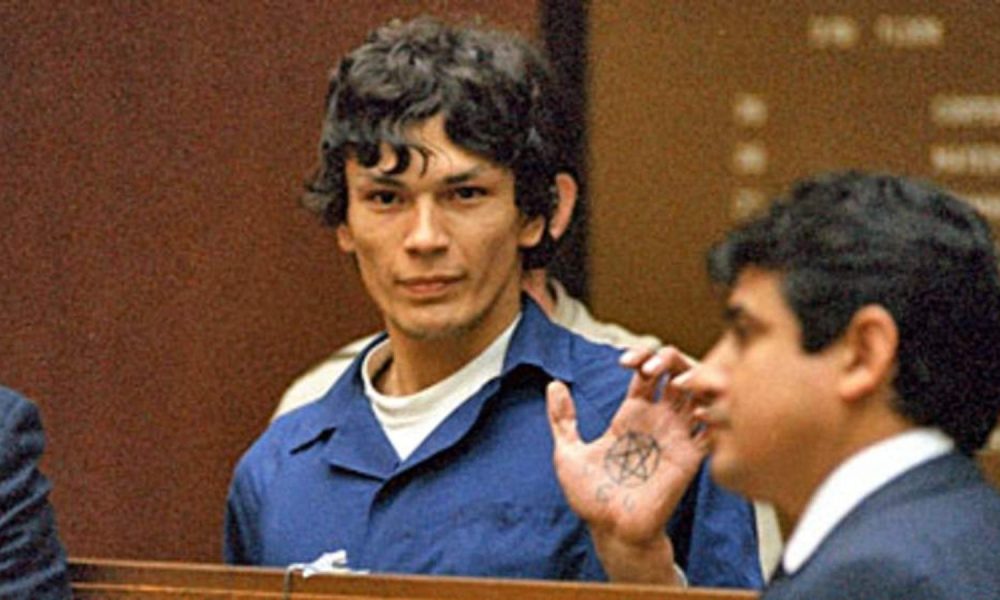
The state's automated fingerprint system matched it to Richard Ramirez, a drifter with a prior criminal record in Texas.
The system did the work the months of dead ends could not.
One mark.
One name.
The record does not detail how the fingerprint was lifted, and the source does not say.
A distinctive baseball cap and a watch were also found at a crime scene.
They were traced to Ramirez.
The exact scene where the cap and watch were found is not specified.
Ballistic evidence tied him to earlier attacks.
Witness descriptions did the same.
The pieces lined up the way they never had before.
Ramirez's photo was released.
His face was widely circulated.
Public fear sharpened into something else: recognition.
People knew what he looked like now.
That would bring him down.
Not the fingerprint alone.
Not the cap.
But the face in every newspaper, every broadcast, every storefront.
The investigation had a name, an image, and a trail of evidence.
It had what it had lacked for a year.
A direction.
THE MOB AND THE TRIAL
On August 31, 1985, residents of East Los Angeles recognized Ramirez and chased him down until police arrived.

He was captured by a mob, not by a detective's handcuffs.
The record does not elaborate on the exact role of the mob in the capture.
It states only that they held him until officers took over.
Ramirez was charged with 13 counts of murder, 5 counts of attempted murder, 11 counts of sexual assault, and 14 counts of burglary.
The trial began in 1988 in Los Angeles.
The prosecutor presented fingerprints, ballistics, and testimony from surviving victims.
He built the case on what the record could prove.
The defense attorney argued the evidence was circumstantial.
He argued that Ramirez had been misidentified.
The jury deliberated for several weeks.
On September 20, 1989, they convicted Ramirez on all counts.
Judge Michael Tynan sentenced him to death on November 7, 1989.
The victims' families spoke publicly during the trial, describing their losses and demanding justice.
Their specific testimony is not detailed in the source.
What remains is the weight of what they said, not the words themselves.
Ramirez's wife, Doreen Lioy, a magazine editor who had corresponded with him in prison, attended the trial.
She later married him in 1996.
The trial gave the families a verdict.
It gave them a sentence.
It did not give them back what was taken.
The conviction was documented.
The death sentence was documented.
The families' grief was not a matter for the record.
AND THE STORY STILL ISN'T OVER
He died on June 7, 2013, at San Quentin State Prison.
The cause was complications from B-cell lymphoma, according to the California Department of Corrections and Rehabilitation.
He had spent years on death row. His execution was never carried out.
His wife, Doreen Lioy, who married him in 1996 while he was imprisoned, has largely remained out of the public eye since his death.
The families have continued to speak about the case.
Some expressed relief at his death.
Others noted that his death brought no closure.
The record does not detail the specific reactions of individual family members. It does not establish the current legal status of any related motions or appeals.
It is a documented fact that the fingerprint match was a turning point in forensic investigation.
It is also a fact that the case remains one of the most infamous serial murder investigations in California history.
Documentaries were made. Books were written.
Families sometimes objected to the continued public fascination.
What did the death sentence change for them?
What did the death change?
What does any verdict change, when the door was already broken open?
That would require evidence.
The conviction was documented. The death was documented.
The grief was not a matter for the record.
Advertisement
You may also like
The cell phone logs that placed Adnan Syed in Leakin Park — and the alibi witness his lawyer never called
She was on the ground below. Hae Min Lee, an 18-year-old senior at Woodlawn High School in Baltimore County, Maryland, disappeared on January 13,…

The notebook Brian Laundrie carried into the swamp that named the killer of Gabby Petito
The notebook was found in the swamp, near the remains, on October 20, 2021. Brian Laundrie’s body was discovered in the Carlton Reserve in…
A 15-year-old boy stepped out to meet a contractor. His mother never saw him again.
She watched him walk out. December 11, 1978, and Robert Piest was leaving his shift at the pharmacy in Des Plaines, Illinois. He was…
The mother who spent 47 years searching a moor for her son's body
She walked the same ground for 47 years. Winnie Johnson went back to Saddleworth Moor, again and again, looking for her son. Her son…

Caylee Anthony's grandmother reported her missing 31 days after she was last seen
Caylee Marie Anthony was two years old. Her family last saw her in mid-June 2008, in Orlando, Florida. On July 15, 2008, her maternal…
The radio and binoculars that led police to the Clutter killers
The Sunday bell did not ring for the Clutter family. On the morning of November 16, 1959, neighbors and friends came to River Valley…