Michael Peterson guilty of second-degree murder in 2003 staircase death; conviction later overturned

Just before 2:40 a.m. on December 9, 2001, novelist Michael Peterson called emergency services from his home in Durham, North Carolina, reporting that his wife, Kathleen Peterson, had fallen down the stairs. Paramedics and police arrived to find Kathleen, a 48-year-old telecommunications executive at Nortel Networks, unresponsive in a pool of blood at the base of the staircase. She was pronounced dead at the scene.
At first, the death looked like an accident. But first responders noted the volume of blood and the nature of her injuries, which included multiple lacerations to the back of her head. The initial assumption of an accidental fall quickly gave way to a homicide investigation.

Michael Peterson, a novelist and former newspaper columnist, had been married to Kathleen for four years. The couple’s children—including Kathleen’s daughters from a previous marriage and Michael’s adopted sons—were present in the home that night, though no one reported witnessing the fall.
Police treated the scene as suspicious from early on. The amount of blood was far greater than typical for a simple fall, and the lacerations on Kathleen’s head were inconsistent with a single impact. Investigators found blood spatter on the back of her head and on the staircase walls. Prosecution experts later argued this pattern was consistent with a beating from a blunt weapon—specifically, a blowpoke, a metal fireplace tool found in the home. The blowpoke, however, was never definitively linked to the injuries, and no weapon was ever recovered.
The prosecution theorized that Michael Peterson had beaten his wife in a rage, possibly over financial troubles or his secret homosexuality, though motive was never established in court. The defense countered that Kathleen’s injuries were consistent with an accidental fall, possibly complicated by alcohol and a prescription muscle relaxant found in her system.
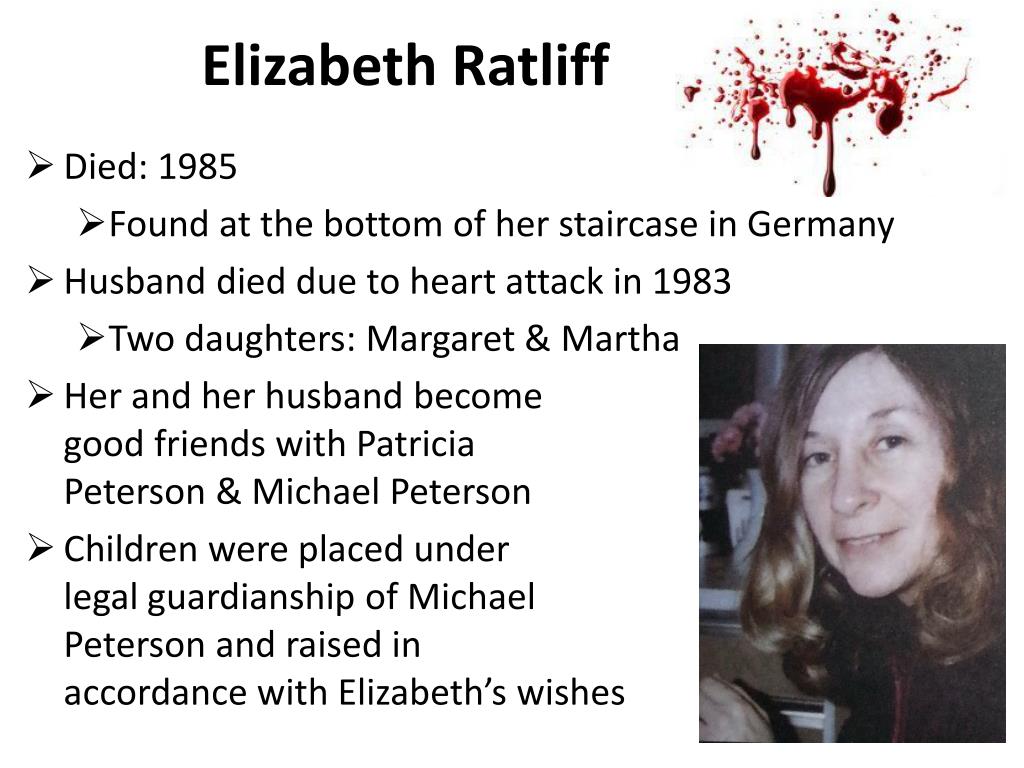
A major turning point came when investigators reopened the 1985 death of Elizabeth Ratliff, a family friend who had died in Germany under similar circumstances—found at the bottom of a staircase. Michael Peterson was never charged in that death, but an autopsy in North Carolina ruled it a homicide, and the prosecution introduced this evidence to suggest a pattern of behavior.

The case took another turn when it was revealed that a key blood-spatter expert had misrepresented his credentials, damaging the state’s case. The defense also pointed out that the blowpoke was missing from the home, suggesting it had been removed.
Michael Peterson was charged with first-degree murder in 2002. The trial began in June 2003 and lasted several months, drawing national media attention. The prosecution argued that Peterson had killed his wife in a fit of rage, while the defense maintained that Kathleen had fallen accidentally after drinking wine and taking Valium.

In October 2003, the jury found Peterson guilty of second-degree murder, a lesser charge than first-degree. He was sentenced to life in prison without the possibility of parole.
The conviction was overturned in 2011 when a judge ruled that the lead prosecutor had withheld evidence—specifically, that a key witness had given testimony that was later recanted and that the prosecution had failed to disclose information about the blood-spatter expert’s background. Peterson was released on bail in 2011 while awaiting retrial.
In 2017, Michael Peterson entered an Alford plea—a plea in which a defendant does not admit guilt but acknowledges that the prosecution has enough evidence to convict—to a charge of voluntary manslaughter. He was sentenced to time served and released. He has maintained his innocence throughout.
The case was the subject of the 2018 documentary series "The Staircase," which had followed the original trial and appeals. Kathleen Peterson’s daughters have publicly stated they believe Michael Peterson was responsible for her death. The 1985 death of Elizabeth Ratliff was never prosecuted, and her family has expressed mixed views on whether Peterson was involved.
What remains unknown: the weapon was never recovered, and the exact manner of Kathleen Peterson’s death—accident or homicide—has never been conclusively settled in a way that satisfies all parties. Peterson has lived in Durham since his release, and his legal saga has become a touchstone in discussions of forensic evidence and prosecutorial misconduct.
Advertisement
You may also like

Casey Anthony Acquitted of Murder in 2011 Death of Daughter Caylee
On July 15, 2008, the maternal grandmother of two-year-old Caylee Anthony called 911 to report the child missing. The child had last been seen…

Amanda Knox acquitted by Italy's highest court after a years-long legal battle over Meredith Kercher's murder
On November 2, 2007, police in Perugia, Italy, were called to a cottage shared by four exchange students. A mobile phone belonging to Meredith…

Elizabeth Smart found alive nine months after 2002 Utah kidnapping; captor convicted in 2010
On the morning of June 5, 2002, the Smart family of Salt Lake City, Utah, discovered that their 14-year-old daughter, Elizabeth, was missing from…

Van der Sloot admits killing Natalee Holloway in 2023 plea, is serving time in Peru
In a U.S. federal courtroom in Alabama in 2023, Joran van der Sloot pleaded guilty to extortion and wire fraud charges. As part of…

Jury convicts Scott Peterson of first-degree murder in deaths of wife Laci and unborn son
On November 12, 2004, a jury in Redwood City, California, delivered a verdict that would close one chapter in a case that had gripped…

FBI says Laundrie's notebook admits killing Gabby Petito; case closed
On September 11, 2021, Gabby Petito's mother filed a missing person report. The 22-year-old from Long Island, New York, had not returned from a…