The torso victim's sister spoke once — and the one detail she revealed
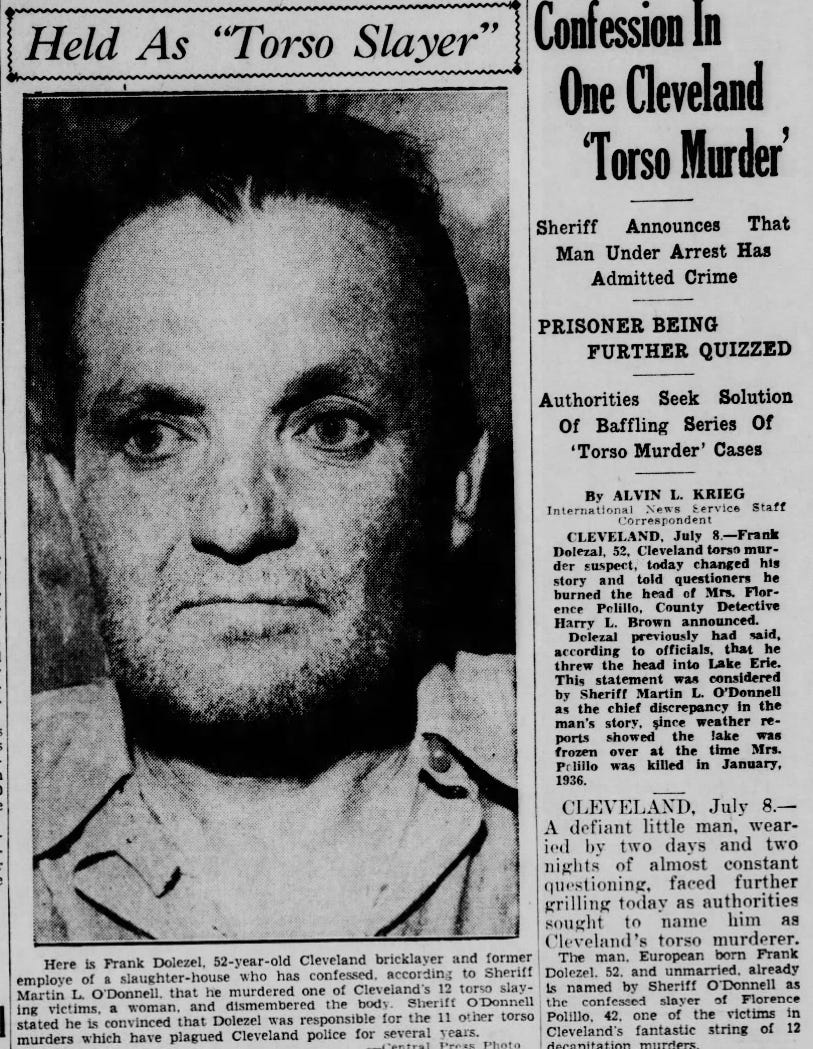
She spoke once. That is all the record gives her.
Among the dozen or more victims of the Cleveland Torso Murderer, most were transients with no local relatives. One sister spoke publicly, and her name was not widely reported.
Her one public statement is the only known family testimony in the case. The detail she revealed is the focus of this article.
The victim she mourned was identified only as "the Tattooed Man." Later, he was identified as an unnamed sailor. His family never came forward publicly.
The sister's words are documented. The context is not.
Who was she? Which victim did she claim? What one detail did she choose to reveal?
The record does not say. Her name is not established. The victim's identity is not established. The exact content of her statement is not established.
That would require evidence.
Most victims were never identified, and their families never learned their fate. She was the exception who spoke. One statement, no name attached, no confirmation of who she meant.
The case spans 1934 to 1938. At least twelve murders and dismemberments in and around Cleveland. Bodies found decapitated, often dismembered, some parts never recovered.
She is a voice in that silence. A single sentence, maybe less.
The record holds her words but not her name. It holds her grief but not her face. It holds her claim but not the proof.
She was on the ground below.
THE FIRST BODY, 1934
The first body was found on September 5, 1934, on a beach near the East 9th Street pier, according to the case summary.
It was a man, decapitated.
The case summary describes the victims as typically male drifters, though two women were also killed.
Bodies were found decapitated and often dismembered.
Some parts were never recovered.
The case spanned 1934 to 1938.
At least twelve murders and dismemberments occurred in and around Cleveland, primarily in the impoverished Kingsbury Run shantytown.
The exact number of victims varies by source.
Not all victims were identified.
The final confirmed victim was found in August 1938.
That is the frame the record gives: a beach, a shantytown, a sequence of cut bodies.
Most of the dead were transients.
Transients had no local relatives to claim them.
No relatives to speak.
The sister of one victim spoke once, and the record holds her words but not her name.
It holds her grief but not her face.
It holds her claim but not the proof.
The man she mourned was identified only as the Tattooed Man.
Later identified as an unnamed sailor.
Her name was not widely reported.
The case summary does not establish who he was beyond that.
It does not establish who cut him.
It does not establish where his missing parts went.
That would require evidence the record does not contain.
THE INVESTIGATION AND THE RAID
Eliot Ness, then Safety Director of Cleveland, personally directed the investigation, according to the case summary.
He walked the same ground where the bodies were found, and he pushed his men through the same shantytowns.
The methodical nature of the dismemberment led investigators to believe the killer had anatomical knowledge, possibly medical training, the case summary states.
A surgeon's hand, they thought. Or a butcher's.
Someone who knew where the joints gave way, who knew how to make a body come apart cleanly.
The transients made it almost impossible to build a case.
Most victims were never identified, the case summary notes, and so there were no names to chase, no families to question, no trails leading back to a life.
In 1939, Ness ordered a massive raid on Kingsbury Run, burning the shantytown to displace the population and, he hoped, flush out the killer.
The raid was controversial, the case summary says.
It produced no suspect.
No specific weapon was ever recovered.
The killer's identity remains unknown.
That is what the record establishes, and it is also what it fails to establish.
Ness burned the homes of the living to find the man who had taken the dead.
He displaced the last witnesses who might have seen something.
He did not find the killer.
He did not find the weapon.
He did not find the missing parts.
The shantytown went up in smoke, and with it went any chance that the men who lived there would talk.
The investigation made bold moves.
It yielded nothing.
THE CONFESSION AND THE DEATH
In 1939, a homeless man was arrested after a tip.
He confessed to killing one of the victims.
He later recanted, claiming the confession was coerced.
The case summary records the confession.
It also records the recantation.
What it does not record is proof.
No physical evidence linked him to the crime.
He died in jail of a heart attack on August 24, 1939, before trial.
There was no trial.
No indictment was ever returned against anyone else.
The only prosecution attempt ended with a man dying in a cell, his guilt neither proven nor disproven.
The confession's validity is not established.
His guilt is not established.
He was never convicted.
Eliot Ness later wrote about the case in his memoirs.
He expressed frustration that the killer was never caught.
The safety director who burned down Kingsbury Run could not burn away the questions.
Did the man mean his confession?
Did someone else put the words in his mouth?
Did the killer simply watch as the investigation collapsed?
That would require evidence.
The record offers none.
AND THE STORY STILL ISN'T OVER
The case remains officially unsolved.
No one was ever charged with the murders, according to the case summary.
Most victims were never identified.
Their families, where they existed, never learned their fate.
The sister's one public statement stands as the rare family voice in the record.
Her name is not recorded.
The victim she mourned is not named in coverage.
That is what the record establishes, and that is where it stops.
The case has been the subject of numerous books and documentaries.
No new evidence has emerged to identify the killer, the case summary states.
Eliot Ness left Cleveland in 1942.
He died in 1957.
He wrote about the case in his memoirs, expressing frustration that the killer was never caught.
The frustration outlived him.
The sister's words were spoken once and then the silence returned.
Not because she was the only family member.
But because she was the only one who spoke.
Most victims were transients with no local relatives.
Their names went unclaimed, their bodies unmarked.
The Tattooed Man's family never came forward publicly.
The mother of one young victim was not named in coverage.
The sister's identity is not established.
The killer's identity is not established.
Any future development is not established.
That would require evidence.
The record offers none.
She was a voice in a case full of silence.
It is still the only one.
Advertisement
You may also like

NBA League Pass student deal: 40% off, but is it the best stream?
The 40% off is real. The fine print is a different beast entirely. Students are being handed the keys to the kingdom — every…

NBA fans' data at risk as league tracks everything you do
Your phone knows where you sit. Your wallet knows what you buy. And the NBA—the league you cheer for every single night—has been quietly…

NBA's Colorado Privacy Statement Hides a Shocking Data Sale Clause
The NBA's own privacy page just admitted it — they're selling your data, and Colorado residents are the first to see the fine print.…
The 18-year-old athlete whose family says the legal system forgot
January 13, 1999, was a school day. Hae Min Lee, an 18-year-old senior at Woodlawn High School, did not come home that evening. Her…
The detective's rogue-LAPD theory that never got a courtroom test
The SUV stopped at a red light at Wilshire Boulevard and South Fairfax Avenue. It was shortly after midnight on March 9, 1997. A…
Her wedding rings on the nightstand — and the truck leaving
The wedding rings sat on the nightstand. The purse and phone were still inside the home. Shanann Watts, 34, was gone. It was the…