The 12-year-old who took Tylenol for a cold — and the family who demanded answers
A 12-year-old girl in Elk Grove Village took Extra-Strength Tylenol for a cold.
She died that same day, September 29, 1982.
She was the first of seven deaths in the Chicago area.
The same day, a 27-year-old postal worker in Arlington Heights died after taking Tylenol.
Investigators later determined the capsules had been laced with potassium cyanide.
The cyanide was inserted after the bottles left Johnson & Johnson and were placed on store shelves.
Not during manufacturing.
Not at the factory.
At the retail level, somewhere between the shelf and the hand.
A theory circulating online links the poisonings to a single extortionist.
That is a theory.
The documented record does not confirm who inserted the cyanide.
Who inserted the cyanide is not established by the record.
The girl took a cold remedy.
It was an ordinary act.
It is an ordinary act.
She was on the ground below.
SEVEN DEATHS, ONE BOTTLE
The first victim was a 12-year-old girl who took Extra-Strength Tylenol for a cold on September 29, 1982.
She died that same day in Elk Grove Village.
Her parents later spoke publicly about her death.
That same day, 27-year-old Adam Janus of Arlington Heights died after taking Tylenol.
He was a postal worker.
Within days, his brother Stanley Janus and sister-in-law Theresa Janus took capsules from the same bottle.
They were grieving Adam’s death.
They died too.
Three more deaths followed: a woman in Elmhurst, a woman in Chicago, a woman in Winfield.
One death became two.
Two became seven.
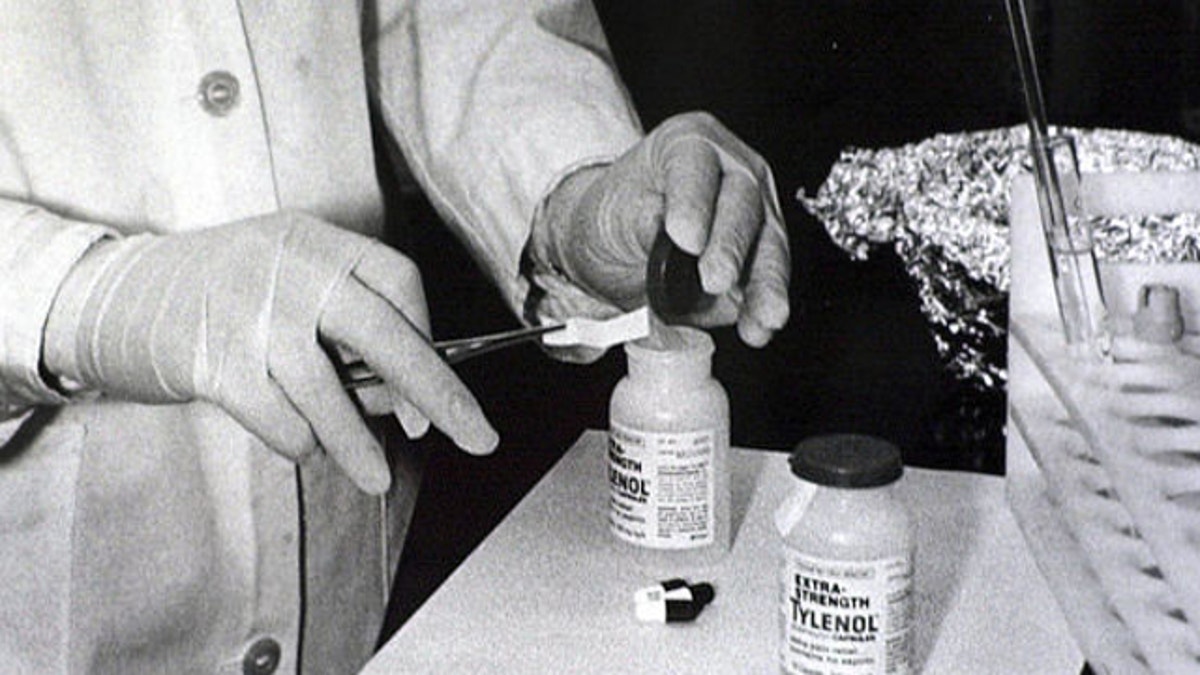
All of them had taken Extra-Strength Tylenol capsules.
Investigators determined the cyanide had been inserted into the capsules after the bottles left the manufacturer.
The bottles had already been placed on store shelves.
The bottles came from different batches.
They had been purchased from different stores in the Chicago area.
The exact store locations and purchase details for each bottle are not in the record.
Not because they were never sought.
But because the record does not contain them.
What remains is the sequence: a cold remedy, a family gathering, a bottle passed in grief.
It is a timeline.
It is also a list of ordinary people.
THE EXTORTION LETTER
The letter arrived at Johnson & Johnson with a demand: $1 million to stop the killings.

It was 1982, and the man who sent it was James Lewis.
Prosecutors say Lewis wrote the extortion letter.
He was identified as a suspect in the Tylenol murders.
He was never charged with them.
In federal court in 1983, Lewis was convicted solely on the extortion charge.
He was sentenced to 10 years in prison.
He was released in 1995 after serving his sentence.
The case against him for murder never advanced.
In 2009, the FBI executed a search warrant at Lewis's home in Cambridge, Massachusetts.
They collected DNA samples and other items.
No arrest followed.
The case was reopened and closed multiple times over the decades.
It was reopened. It was closed. It was reopened again.
That would require evidence.
What the record does not establish: the content of the extortion letter beyond the $1 million demand.
What the record does not establish: Lewis's role in the poisonings.
He maintained his innocence regarding the poisonings until his death in 2023.
The extortion conviction stood. The murder charge never came.
Lewis was a suspect. He was a convicted extortionist. He was never a convicted killer.
The families were left with a letter, a demand, and a man who served his time.
The frustration is in the gap: a suspect with a motive, but no murder charge.
Why did the evidence never lead further?
The record does not say.
THE FAMILIES' DEMANDS
The parents of the 12-year-old spoke publicly about their daughter.
They described a child who took Tylenol for a cold.
They demanded to know how a common remedy could kill her.
The parents of Adam and Stanley Janus also spoke to the media.
They had lost two sons and a daughter-in-law in the same week.
Stanley and Theresa Janus left behind a young child.
The families became the public face of the tragedy.
They were not experts in toxicology or criminal procedure.
They were people who wanted answers.
They asked who had done this.
They asked why their loved ones had been chosen.
They asked what would happen next.
The record does not answer them.
The families filed civil lawsuits against Johnson & Johnson.
The company settled the claims out of court.
The specific terms of those settlements are not in the record.
The names of the 12-year-old's parents are not in the record either.
What is in the record is the company's response.
Johnson & Johnson recalled 31 million bottles of Tylenol.
The recall was widely praised as a model of corporate responsibility.
It was a responsible act.
It was also a response to a catastrophe.
The families kept speaking.
They spoke on anniversaries.
They spoke to reporters who came to their doors.
They asked the same questions.
The questions remain unanswered.
That would require evidence.
AND THE STORY STILL ISN'T OVER
The Tylenol murders remain officially unsolved.
No one was ever charged with the poisonings.
James Lewis died in 2023.
He had maintained his innocence regarding the poisonings until the end.
The record does not establish whether any new investigation is currently active.
What the record does establish is the aftermath.
The case forced a change in how America buys medicine.
The FDA introduced tamper-evident packaging requirements in 1982 and 1983.
Those requirements remain in effect today.
The families kept speaking.

On anniversaries of the deaths, they returned to the same questions.
The parents of the 12-year-old victim spoke publicly about their daughter.
The parents of Adam and Stanley Janus also spoke to the media.
They asked the same questions.
The questions remain unanswered.
That would require evidence.
The case is considered one of the most famous unsolved crimes in American history.
It is a famous case.
It is also a closed one, in the sense that no charges ever followed.
The families demanded answers.
They received none from the record.
They received a recall of 31 million bottles.
They received new packaging rules.
They received a conviction — but only for extortion, against a man never charged with murder.
What they did not receive was a resolution.
The story still isn't over.
Not because the case is active.
But because the families are still here.
They asked the same questions.
The questions remain unanswered.
That would require evidence.
Advertisement
You may also like

The 1976 Sacramento rapes that led to a 40-year hunt for a serial predator
It began with reports of a man who slipped through bedroom windows in the Sacramento area of California. The first rapes were reported in…

The Mississippi murder trial where a witness pointed at two men — and the jury still walked them free
The courtroom in Sumner, Mississippi, was quiet. Moses Wright stood and raised his arm. He pointed at Roy Bryant. He pointed at J.W. Milam.…

The fiber evidence that linked a photographer to two river murders — and the trial that hinged on it
The officers were on a bridge over the Chattahoochee River when they heard the splash. It was May 22, 1981, and they saw a…
The jailhouse confession that cracked the Manson case — and the witness who changed everything
Somewhere in the Los Angeles County jail, a woman named Susan Atkins started talking. She was jailed on unrelated charges, a member of the…
Why the defense said Muhammad wasn't at the scene — and the jury still convicted
The Chevrolet Caprice was parked at a rest stop near Myersville, Maryland, when police arrested two men sleeping inside. In the trunk, officers found…
The dog kennel video that shattered a lawyer's alibi in the Murdaugh murders
It begins with a dog kennel. Investigators obtained cellphone video from the kennel on the Murdaugh family’s hunting estate in Colleton County, South Carolina.…