The 1974 cluster of missing women that drew police to Ted Bundy's trail
Her bed was made. Her nightgown was gone.
In early 1974, a University of Washington student named Lynda Ann Healy vanished from her Seattle room. A roommate reported her missing after finding the bed made but the nightgown absent, according to the case file.
She was one of several that year. Young women, mostly college students, were going missing across Washington state.
Police initially treated each case separately. But a pattern emerged: the women were similar in age and appearance, and they vanished without a trace.
The families pushed for answers. They spoke publicly, urging police to connect the cases.
Lynda Ann Healy's family was among them. They wanted someone to see the whole picture, to ask why these women kept disappearing.
Not because the cases were identical in every detail. But because the silence after each disappearance felt the same.
Was there a single suspect? A common thread the police were missing? A reason these particular women were chosen?
That would require evidence.
At this point in the record, no single suspect is identified. The case file does not establish that anyone was named in connection with these disappearances yet.
The families were left with questions and a made bed.
THE CLUSTER
Spring came, and the list lengthened.
A student at Evergreen State College vanished. A student at Central Washington State College vanished. A student at Oregon State University vanished. A woman disappeared from Burien, Washington.
A University of Washington student also vanished near her campus.
The case file records each disappearance separately. Names, dates, last known locations. It does not record a single suspect.
Then came July. Two women disappeared from Lake Sammamish State Park on the same day.
A witness later reported seeing a man with his arm in a sling asking for help loading a boat. The record does not confirm that man as anyone in particular. It is a description, nothing more.
Detective Robert Keppel of the King County Sheriff's Office tracked these disappearances. According to the case file, he linked them through patterns: age, appearance, method.
The women were similar. The circumstances were similar. The method, the file suggests, was similar.
That would require evidence. At this point, the pattern was a working theory.
The families of the victims, including Healy's, testified or gave statements. They kept the cases in public view. They named their daughters. They asked the questions no one could answer.
The list grew. The dread settled in.
Each name was a person. Each person had a family. Each family had a made bed that stayed empty.
THE VOLKSWAGEN
By 1975, the trail had moved to Utah.
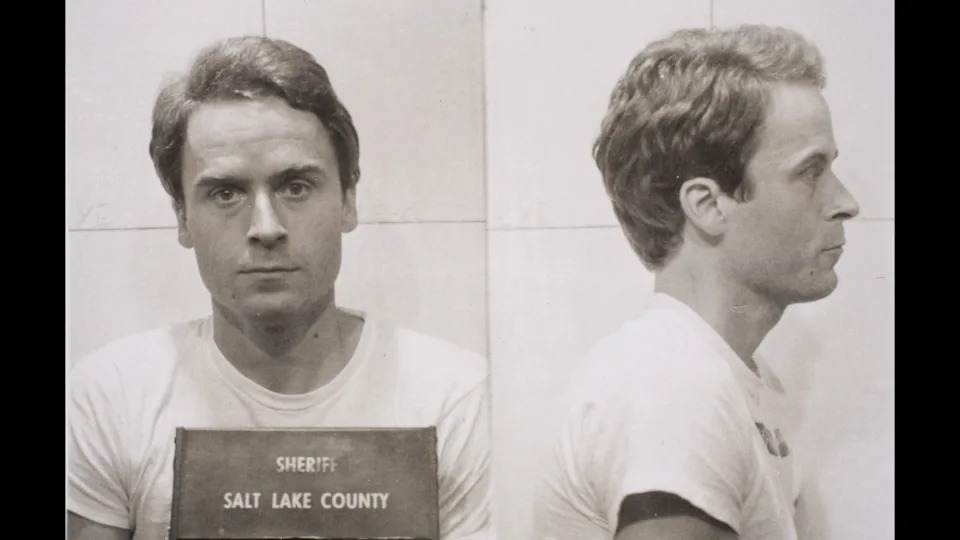
Ted Bundy was arrested there for possession of burglary tools, the case file states.
Evidence from that arrest connected him to the disappearance of a young woman who had vanished from Aspen, Colorado.
Her name was Caryn Campbell. The record does not specify the exact nature of the evidence tying Bundy to the Washington disappearances.
That link would require evidence. The file does not provide it.
What the record does specify is the car.

Bundy's Volkswagen Beetle became a key piece of evidence in the investigation, according to the case file.
The Beetle was searched. The Beetle was examined. The Beetle was the object police kept returning to.
Not because it was unusual. Because it was his.
Then, in 1977, Bundy escaped from a Colorado courthouse.
He fled to Florida.
In Florida, the case shifted again.
He was linked to the murders of two Florida State University students, the file states.
The link came through bite mark evidence on one of the victims.
Forensic odontologist Dr. Richard Souviron testified to that evidence.
One mark. One expert. One connection that held.
The cluster of disappearances had become a concrete suspect.
The concrete suspect had become a fugitive.
The fugitive had become a defendant.
What the record does not establish is how, precisely, the Beetle or the Utah arrest connected Bundy to the young women missing from Washington.
That remains open. That would require evidence. The file does not supply it.
The families kept asking their questions. The questions kept pointing west.
THE TRIAL
The trial in Tallahassee came in 1979, for the murders of two Florida State University students.
Bundy was convicted. He was sentenced to death.
The prosecution was led by State Attorney Larry Simpson.
A separate trial followed for the murder of a 12-year-old girl in Lake City, Florida.
Assistant State Attorney Jerry Blair handled that case.
Bundy was convicted again. Again, the sentence was death.
His defense attorneys included John Henry Browne in Washington and Edward Harvey in Florida.
The trial judge was Edward Cowart.
The families of the two students sat through the proceedings.
They heard the evidence. They heard the verdict.
What they did not hear was a full accounting.
Bundy was on death row when he gave interviews and made statements implicating himself in additional murders.
He named states. He named methods.
The full extent of his crimes is not established.

He was not convicted for all the 1974 disappearances.
That cluster in Washington remained outside the Florida courtrooms.
The families of those missing women kept their own questions.
They had asked for years. The record did not answer them then.
It does not answer them now.
Bundy was convicted in Florida. That is what the file states.
What the file does not state is how many others there were.
That remains open.
That would require evidence.
AND THE STORY STILL ISN'T OVER
He was executed in the electric chair at Florida State Prison on January 24, 1989.
The file states that date plainly, and it does not state how many others there were.
That remains open.
That would require evidence.
The families of his victims have spoken publicly over the years about their losses and the impact of the case.
They have told what the record does not resolve.
The full number of victims is not established in the record.
Elizabeth Kloepfer, Bundy's former girlfriend, wrote a memoir, "The Phantom Prince," detailing her relationship with him.
She wrote what she knew.
The record does not establish all that he did.
The lead detective in Washington later wrote about the case and consulted on the Green River Killer investigation.
He carried the pattern forward.
The case remains one of the most studied in American criminal history, with ongoing public interest in the victims and their families.
It is studied because it is documented.
It is studied because it is not fully documented.
What was the count?
What was the confession?
What was the truth of the cluster that drew police attention?
That would require evidence.
The families asked the same questions.
They asked them in public, in testimony, in statements the case file records.
One plain sentence lands alone: the execution ended the case, not the questions.
Advertisement
You may also like
Caylee Anthony's grandmother reported her missing 31 days after she was last seen
Caylee Marie Anthony was two years old. Her family last saw her in mid-June 2008, in Orlando, Florida. On July 15, 2008, her maternal…
The radio and binoculars that led police to the Clutter killers
The Sunday bell did not ring for the Clutter family. On the morning of November 16, 1959, neighbors and friends came to River Valley…
Twelve-year-old Polly Klaas was at a slumber party. Then a stranger came through the window.
The pillowcases came down over their heads in the dark. It was 10:30 p.m. on October 1, 1993, in Petaluma, California. Three girls were…
The Amityville son who confessed to killing his family
The bar door swung open before the call was made. A neighbour reported that Ronald DeFeo Jr., then 23, had burst into a local…
The Green Beret doctor's pajama fibers that unraveled his story in 1979
The pajama fibers were under Colette MacDonald's body. They were in her wounds too. The fibers came from a pajama top belonging to her…
A video on Paul's phone at 8:44 p.m. — and the alibi that could not hold
The video was recorded on Paul Murdaugh's phone at 8:44 p.m. on June 7, 2021. It was recorded at the family's Moselle estate. The…