The 1997 Versace murder case: how the FBI's manhunt ended with a suicide, not a trial
The steps of Casa Casuarina were still wet with the morning's humidity.
At approximately 8:45 a.m. on July 15, 1997, Gianni Versace was shot on those steps.
He was returning from a walk to a newsstand on Ocean Drive.
A public street, a routine errand, a moment of ordinary life.
The shooter fled on foot.
Then by bicycle.
Versace was pronounced dead at Jackson Memorial Hospital.
The identity of the shooter is not yet established in this section.
What is established: two gunshots, a body on the marble, a city in shock.
The man who fired the weapon was gone before the first witness could scream.
He left behind the shell casings, the silence, the broken morning.
Not because the record is silent.
But because this section of the story has not yet reached the man's name.
The investigation would take days.
The manhunt would take longer.
For now, there is only the scene: the steps, the newsstand, the bicycle tracks heading away.
A designer who dressed the world lay on his own threshold.
The sun was already high over Miami Beach.
It was 8:45 a.m., and the day had just begun to end.
THE FUGITIVE
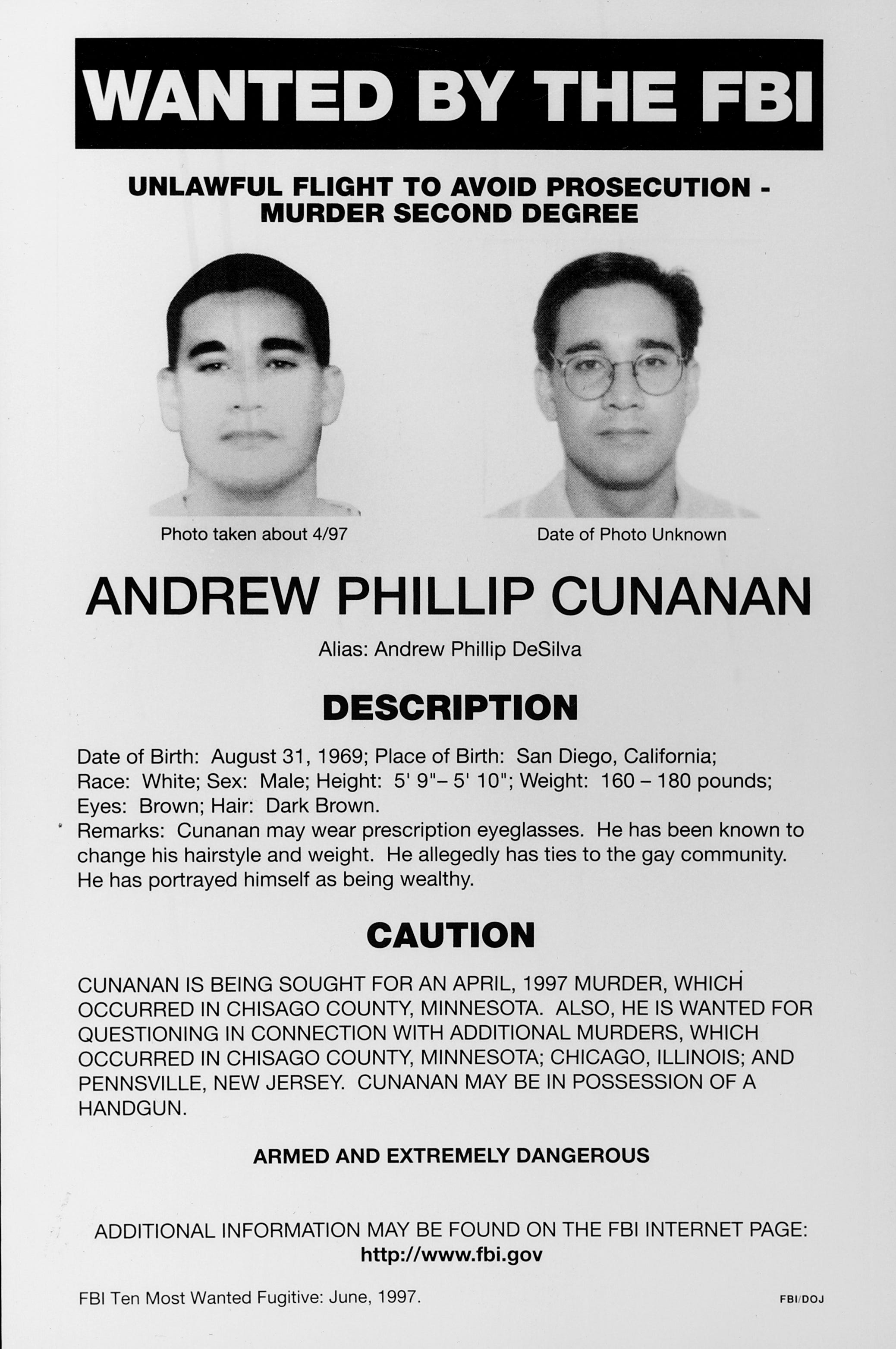
The shooter was later identified as Andrew Cunanan, a 27-year-old from San Diego.
He was already on the FBI's Ten Most Wanted list.
He was wanted for four prior murders in Minnesota, Illinois, and New Jersey.
The manhunt was not new. It had been closing in for weeks.
His mother, Mary Ann Cunanan, spoke publicly during the manhunt.
She pleaded for her son to surrender.
The lead investigator was a detective sergeant with the Miami Beach Police Department.
The FBI was heavily involved.
Cunanan was already a fugitive when he reached Miami Beach.
The exact timeline of his movements before the shooting is not in the record.
It is not established where he stayed the night before, or how he arrived at Casa Casuarina.
What is known is that he was there at 8:45 a.m.
Then he fled on foot, then by bicycle.
The net was wide. It was also slow.
Four murders had already occurred, and the criticism of the FBI's handling of the earlier cases was mounting.
His mother was not the only one asking him to stop.
The whole country was looking for him.
He was on the front page of every paper.
He was on television every night.
A man with a name, a face, and a trail of bodies.
And he was still walking free.
THE EVIDENCE
Witnesses placed him at the scene.
Surveillance footage gave him a face.
The identification was not a guess; it was a record.
The murder weapon, a .40-caliber pistol, was found on the houseboat where Cunanan died eight days later.
That same pistol had fired the shots.
The autopsy confirmed Versace died from two gunshot wounds to the head and neck.
The medical examiner performed that autopsy, and his findings were part of the documented record.
The evidence against Cunanan was strong.
It was strong enough that the case might have gone to trial.
No trial ever began.
Because Cunanan was never captured alive, he was never charged, tried, or convicted for the Versace murder.
The exact chain of custody of the weapon is not detailed in the source.
That detail is not established.

What is established is the weapon's location after his death.
What is established is the identification from witnesses and footage.
There were also questions about the FBI's handling of the earlier murders.
The killing of Lee Miglin in Chicago drew particular criticism.
Some believed the investigation could have led to Cunanan's capture earlier.
That belief is a theory.
The record does not establish that a different outcome was possible.
It only establishes what happened: a man identified, a weapon found, an autopsy performed.
And a case that ended without a courtroom.
The evidence was there.
The trial was not.
THE HOUSEBOAT
The houseboat was called the Blue Horizon.
On July 23, 1997, eight days after the murder, Andrew Cunanan died by suicide aboard it in Miami Beach.
He shot himself with the same .40-caliber pistol used in the Versace murder.
The weapon was found with him.
He was never captured alive.
Because he was never captured alive, he was never charged with the Versace murder.
He was never tried for it.
He was never convicted of it.
No prosecutors were assigned to a trial.
No defense attorneys were assigned to a trial.
No judge was assigned to a trial.
The record does not establish that any of them ever existed for this case.
The case was closed without any court proceedings.
There was no opening statement.
There was no cross-examination.
There was no verdict.
There was only the gun, the houseboat, and the silence after the shot.
A separate trial did occur for the earlier murder of Lee Miglin in Chicago.
No one was charged in that case either, because Cunanan was dead.
The evidence was there.
The trial was not.
AND THE STORY STILL ISN'T OVER
The case is closed.
No further legal proceedings are pending; the record shows a suicide, not a trial.
Gianni Versace's body was returned to Italy.
He was buried at the family cemetery in Moltrasio, near Lake Como.
His company continued under his sister Donatella and his brother Santo.
The houseboat where Cunanan died was later sold at auction.
Casa Casuarina has since been operated as a boutique hotel.
The steps are still there.
The mansion still stands on Ocean Drive.
Guests sleep where a designer once lived.
The boat that held the end of the manhunt belongs to someone else now.
The case is closed.
Not because a jury decided. Because there was no jury.
No prosecutors were assigned. No defence was prepared. No judge ever took the bench.
The evidence was gathered, the weapon was found, the autopsy was performed.
That would require a trial.
It is a documented suicide. It is also a story that lingers in places and objects.
The cemetery in Moltrasio holds the body.
The company carries the name.
The hotel rents the rooms.
The auction record holds the boat.
And the case is closed.
Advertisement
You may also like
In Casey Anthony trial, the trunk evidence that split the courtroom
The trunk of the car was opened in a garage in Orlando, and the air that came out had a smell that witnesses later…
The pharmacy receipt that tied John Wayne Gacy to Robert Piest's vanishing
The pharmacy receipt was found in John Wayne Gacy's home. It was found after Robert Piest, a teenager, was last seen at a pharmacy…
The 8:44 p.m. video on Paul's phone that placed Alex Murdaugh at the kennels
The phone was in Paul Murdaugh’s hand, or near it, at 8:44 p.m. on June 7, 2021. The video it recorded captured voices. Investigators…
Why the BTK killer's floppy disk question sealed his fate — and the trial that followed
The question came in the middle of a taunting exchange, years after the silence ended. In 2004, Dennis Rader resumed sending letters to Wichita…
The cell phone video that put Alex Murdaugh at the kennels — and shattered his alibi
On June 7, 2021, Paul Murdaugh and his mother, Maggie, were found shot to death at the family's hunting estate, Moselle, near Islandton, South…
FBI says Laundrie's notebook admitted to Petito's killing — yet full contents never released
A notebook was found near Brian Laundrie’s remains in Myakkahatchee Creek Environmental Park, Florida, on October 20, 2021. A gun was found nearby, and…