The Army veteran with sniper training who turned a modified Caprice into a killing machine
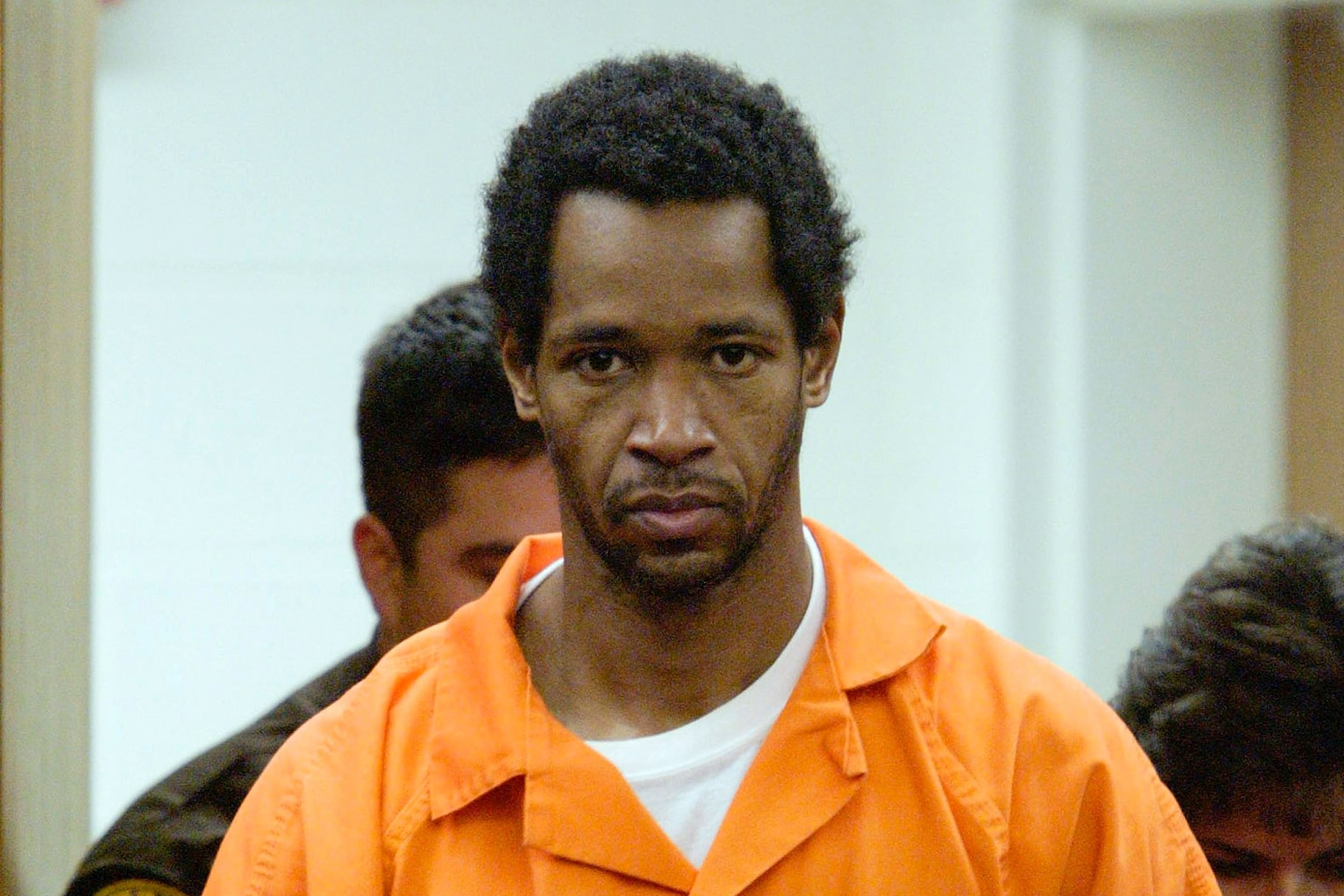
The white Chevrolet Caprice sat in the dark at a rest stop off Interstate 70 near Myersville, Maryland.
It was October 24, 2002, and the car had been parked there long enough that police officers were now approaching it.
Inside, two men were sleeping.
John Allen Muhammad, 41, an Army veteran with sniper training.
Lee Boyd Malvo, 17, a teenager from Jamaica.
Also inside the car: a Bushmaster XM-15 .223-caliber rifle, later matched to the shootings.
The car was modified.
What exactly was modified on the Caprice is not specified in the record.
The record only describes it as a "modified Chevrolet Caprice."
How did a car become the center of a regional terror?
How did a rifle become the thing that linked ten killings and three woundings across three states?
How did two men sleeping at a rest stop become the answer to a month of fear?
The answer starts with a witness.
A witness at a shooting in Ashland, Virginia, had reported seeing a white Caprice.
That report shifted the investigation to that vehicle.
It was a tip, then a car, then a rifle.
The rifle was found inside the Caprice, and ballistics linked it to the shootings.
The two men were arrested.
The car was evidence.
The rifle was evidence.
The men were suspects, then defendants, then convicted.
The Caprice was the place where they were found.
It was also the place from which the shootings had been carried out.
Not because the record says so directly.
But because the record places the rifle in the car, and the car at the shootings.
What remains unspecified is the modification.
That would require evidence.
THE SOLDIER AND THE TEENAGER
John Allen Muhammad was 41 years old, an Army veteran with sniper training.
Lee Boyd Malvo was a Jamaican-born teenager, 17 at the time of the shootings.
The two had been traveling together for months before the attacks.
Investigators found that Muhammad acted as a father figure to Malvo.
The exact nature of Muhammad's military service is not in the record.
The details of his sniper training are not in the record either.
That would require evidence.
The first killing came on October 2, outside a grocery store in Wheaton, Maryland.
A man was loading a car.
He was shot once, and he died.
Over the next three weeks, ten people were killed and three wounded.
The shootings spanned Maryland, Virginia, and the District of Columbia.
They appeared random.
People were mowing lawns, pumping gas, walking into stores.
The region shut down in fear.
Schools closed.
Drivers crouched behind their cars at gas stations.
The mentor and the teenager were moving through it all.
Muhammad had the training.
Malvo had the youth.
They had the car, and the rifle, and months of travel behind them.
What made the older man turn his skill into this?
What made the younger one follow?
What passed between them in the long days on the road?
That would require evidence.
The record shows two men, a rifle, and a modified Caprice.
It shows the car at the shootings.
It shows the rifle in the car.
It does not show the moment the mentor became the killer.
It does not show the moment the teenager became his weapon.
Those moments are not established.
The shootings continued until October 22, when a bus driver was killed in Aspen Hill, Maryland.
That was the last one.
Then the car was found, and the two men were sleeping inside.
THE HUNT AND THE TIP
Chief Charles Moose of the Montgomery County Police Department led the investigation, with the FBI and the Bureau of Alcohol, Tobacco, Firearms and Explosives providing support.
The shootings were first treated as unrelated incidents.
Then ballistics linked them to a single Bushmaster XM-15 .223-caliber rifle.
A witness at a shooting in Ashland, Virginia, reported seeing a white Chevrolet Caprice.
That shifted the focus to the vehicle.
On October 24, a tipster called the police tip line.
The tip led officers to the Caprice at a rest stop off Interstate 70 near Myersville, Maryland.
They found two men sleeping inside.
John Allen Muhammad, 41, and Lee Boyd Malvo, 17, were arrested there.
Also inside: the Bushmaster rifle, later matched to the shootings.
A laptop computer was recovered.
A map with a shooting location marked was recovered.
The hunt had ended.
The horror was confirmed.
The identity of the tipster is not disclosed in the record.
That fact is not established.
What is established is the car, the rifle, the map, and the two men sleeping.
The investigation had moved from random terror to a single vehicle.
It had moved from a theory to a place.
It had moved to a rest stop on an interstate.
The two men were not running.
They were sleeping.
TWO MEN, ONE RIFLE
The prosecution argued that Muhammad was the mastermind.
That argument came from the Commonwealth's Attorney in Prince William County, Virginia.
Muhammad stood trial there in 2003.
He was charged with capital murder in connection with a killing at a gas station in Manassas.
The jury heard the case against the older man, the Army veteran with sniper training.
Muhammad was convicted on November 17, 2003.
He was sentenced to death on March 9, 2004.
Malvo was tried separately.
He stood trial in Chesapeake, Virginia, in 2003.
Malvo was tried as an adult.
He was convicted of capital murder in connection with a killing in Falls Church.
The sentence was life without parole.
Not death.
Because Malvo was a juvenile at the time of the crimes, the death penalty was off the table.
Mastermind and follower.
That was the legal distinction the two trials drew.
One man planned; the other man followed.
One man received death; the other received life.
The defense's specific arguments are not detailed in the record.
What remains is the weight of that difference.
A 41-year-old veteran who led.
A 17-year-old who followed.
The record shows the convictions.
It shows the sentences.
It does not show what happened inside the car, or inside the minds, in the months before the rest stop.
That would require evidence the record does not provide.
AND THE STORY STILL ISN'T OVER
Muhammad was executed by lethal injection on November 10, 2009, in Virginia.
Malvo remains in prison, serving life without parole.
In 2017, Malvo's lawyers argued his sentence should be reconsidered in light of a U.S. Supreme Court ruling on juvenile sentencing.
His sentence was upheld.
Any future legal actions for Malvo are not in the record.
That would require evidence the case file does not provide.
The attacks remain a defining event in the history of the Washington, D.C. area.
Schools closed. People crouched behind cars at gas stations.
The victims' families have continued to speak publicly about the case.
They speak of the ordinary moments—loading a car, mowing a lawn, pumping gas, walking into a store.
The region has largely moved on.
It is a closed case legally.
It is not a closed case in memory.
The rifle is matched. The car is impounded. The sentences are served.
What happened inside the car, or inside the minds, in the months before the rest stop—that remains unshown.
That would require evidence the record does not provide.
Advertisement
You may also like
The .35 caliber Marlin rifle that silenced six beds in Amityville
The call came on November 13, 1974. Police were sent to 112 Ocean Avenue in Amityville, New York, after the DeFeo family failed to…
The notebook found with Brian Laundrie's remains that changed the Petito case
Gabby Petito, 22, and her fiancé Brian Laundrie set off on a cross-country van trip through national parks in the western United States. The…
The deleted file on a floppy disk that led police to the BTK killer
A floppy disk arrived at a local television station in 2004. It came from the killer known as BTK, who had taunted police and…
The notebook found beside a gun in a Florida swamp that ended a manhunt
On October 20, 2021, Brian Laundrie’s remains were found in the Carlton Reserve in Florida. Beside him: a backpack, a notebook, and a gun.…
The 2013 DNA match that tied DeSalvo to Mary Sullivan — but never reached a courtroom
In 2013, DNA from the scene of Mary Sullivan's murder was tested. It was compared to Albert DeSalvo's remains, which had been exhumed. The…
The 14-year-old's stepmother whose 2005 report started the Epstein case
In 2005, a Florida mother walked into Palm Beach police headquarters. She was not the girl's biological mother. She was the stepmother, and the…