The axle number on a Ryder truck that led FBI agents to a rental clerk and a suspect
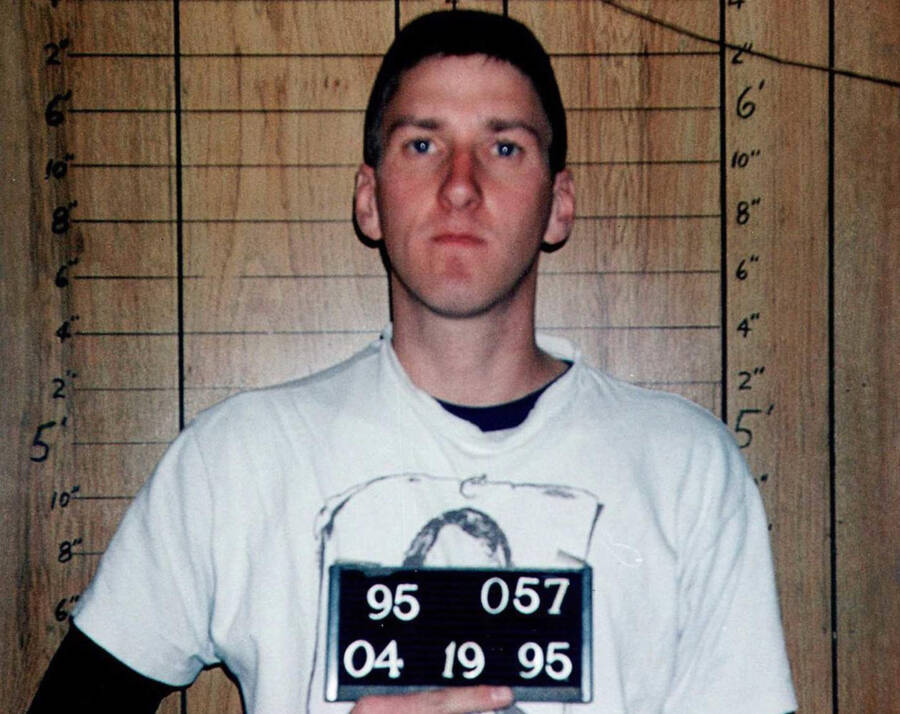
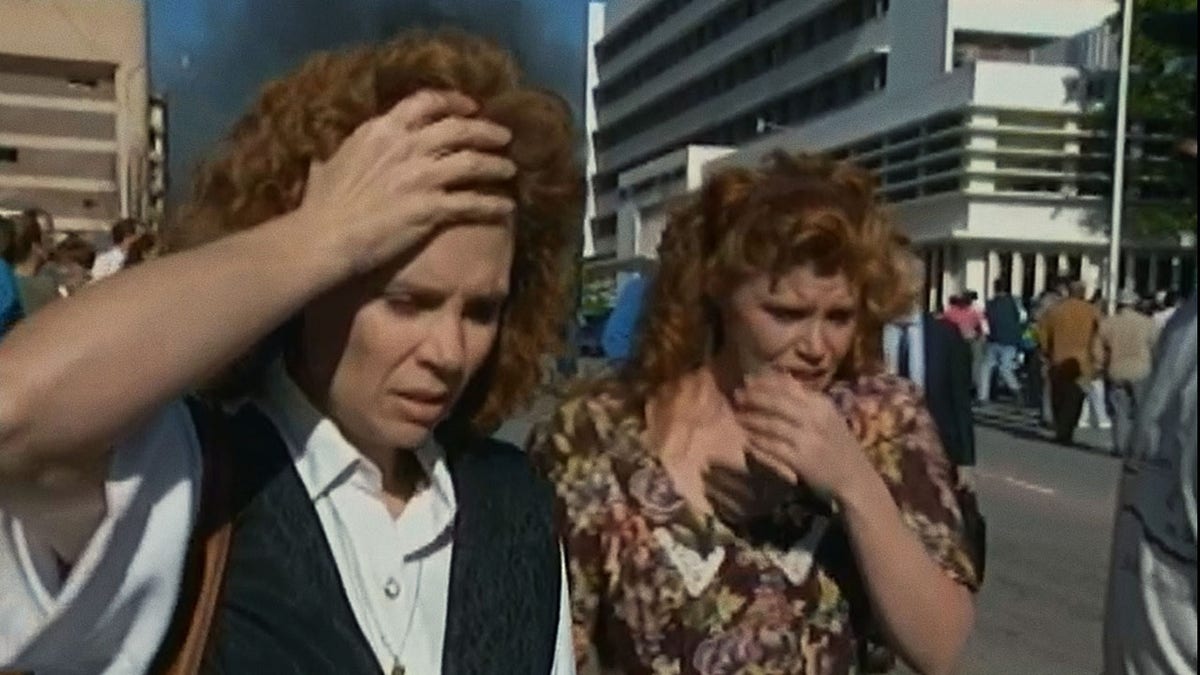
At 9:02 a.m. on April 19, 1995, a truck bomb exploded outside the Alfred P. Murrah Federal Building in Oklahoma City, Oklahoma.
The blast destroyed the front of the nine-story building.
It killed 168 people, including 19 children in a day-care center.
It injured more than 680 others.
Within hours, the FBI took charge of the scene.
Among the debris, investigators found a truck axle with a number on it.
That number was the first thread.
The exact condition of the axle, and how it was recovered, is not in the record.
Not because the detail was hidden. Because the record does not say.
What the record does say: the axle number would be traced to a Ryder rental agency in Junction City, Kansas.
A single metal object, dug out of the rubble, pointing toward a name on a rental form.
Rented under the name "Robert Kling."
The name was false. The axle was real.
How does a number on a twisted piece of metal lead anywhere?
It leads to a clerk who remembered a face.
It leads to a sketch, and to a motel clerk who recognized it.
It leads to a man already in custody on a gun charge, pulled over for driving without a license plate.
But that comes later.
At the scene, there was only the axle.
A number stamped into steel, holding the weight of the investigation's first step.
She was not there. The axle was.
It sat in the wreckage, silent, until someone thought to look.
THE RENTAL CLERK AND THE SKETCH
The axle led to Junction City, Kansas.
It led to a Ryder rental agency, where the truck had been rented under the name "Robert Kling."
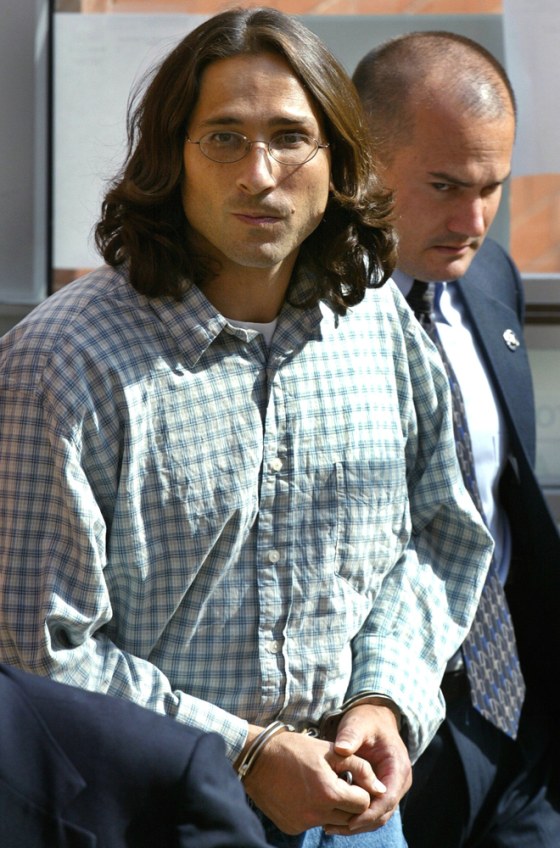
The rental clerk, Eldon Elliott, gave a description.
That description became a composite sketch.
A motel clerk in Junction City, Lea McGown, looked at the sketch.
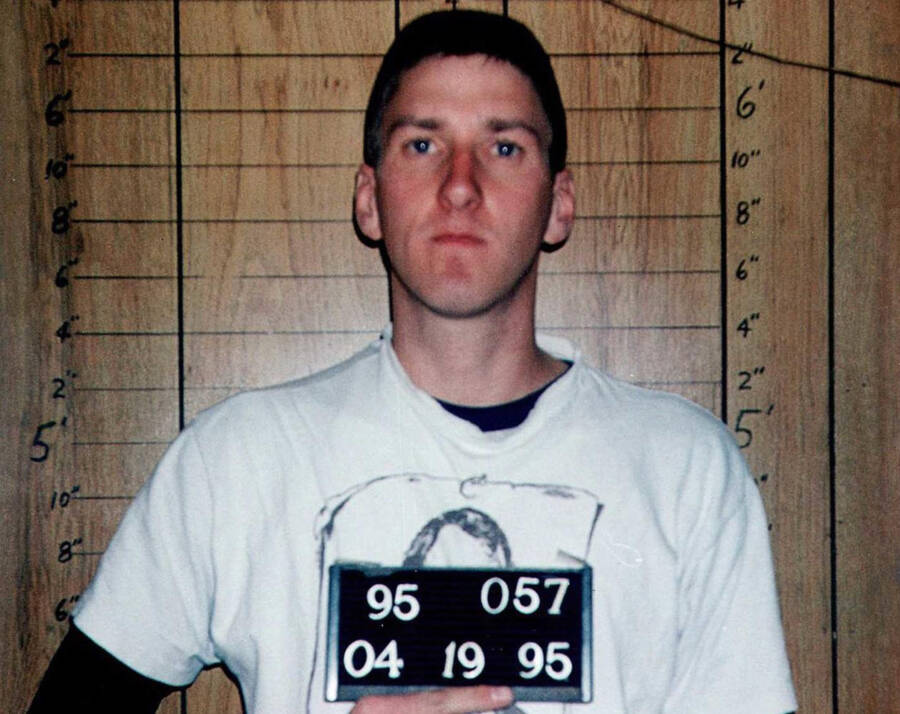
She identified Timothy McVeigh.
The FBI had a name before they had a suspect in custody.
McVeigh was already in jail.
He had been stopped by Oklahoma Highway Patrol Trooper Charlie Hanger for driving without a license plate.
Hanger arrested him for carrying a concealed weapon.
Hanger did not know he had the bombing suspect.
The turning point was quieter.
The FBI matched McVeigh's fingerprints to the rental agreement.
That was the match.
It was not the first path the FBI took.
Early on, agents focused on Middle Eastern suspects.
That was a mistake.
A prison inmate named David Paul Hammer was briefly suspected.
He was cleared.
The exact time between the axle trace and the fingerprint match is not in the record.
What is in the record is the sequence.
Axle. Rental clerk. Sketch. Motel clerk. Fingerprints.
The investigation corrected itself.
It followed the steel, then the paper, then the print.
The print held the name.
THE TROOPER'S ARREST
He was already in custody.
On April 19, 1995, just ninety minutes after the blast, Oklahoma Highway Patrol Trooper Charlie Hanger pulled over a Mercury Marquis for driving without a license plate.
Hanger arrested the driver, Timothy McVeigh, for carrying a concealed weapon.
He did not know he had stopped the bombing suspect.
The FBI matched McVeigh’s fingerprints to the Ryder rental agreement days later, and the arrest turned into the capture.
It was a mistake that became a turning point.
The investigation had its own mistakes to answer for.
The FBI initially focused on Middle Eastern suspects, a theory the record does not support.
A prison inmate named David Paul Hammer was briefly suspected, then cleared.
And the FBI lab mishandled evidence.
A forensic expert from inside the lab, Dr. Frederick Whitehurst, later testified about the mishandling.
The specific details of that mishandling are not in the record beyond his testimony.
The criticism led to reforms in forensic procedures.
The investigation also relied on Michael Fortier.
Fortier had known of the plot, the evidence showed, and he failed to warn authorities.
He pleaded guilty to failing to warn and to lying to investigators.
He was not charged with the bombing itself.
He testified for the prosecution.
The case turned on testimony and on a trooper's routine stop.
It turned on a missing license plate.
It turned on fingerprints on a rental form.
It did not turn on the lab's errors, which came to light later.
Hanger made the arrest at 10:20 a.m.
McVeigh was in jail, held on a gun charge, while the FBI searched for him.
They found him there.
TWO STORIES OF THE SAME FACTS
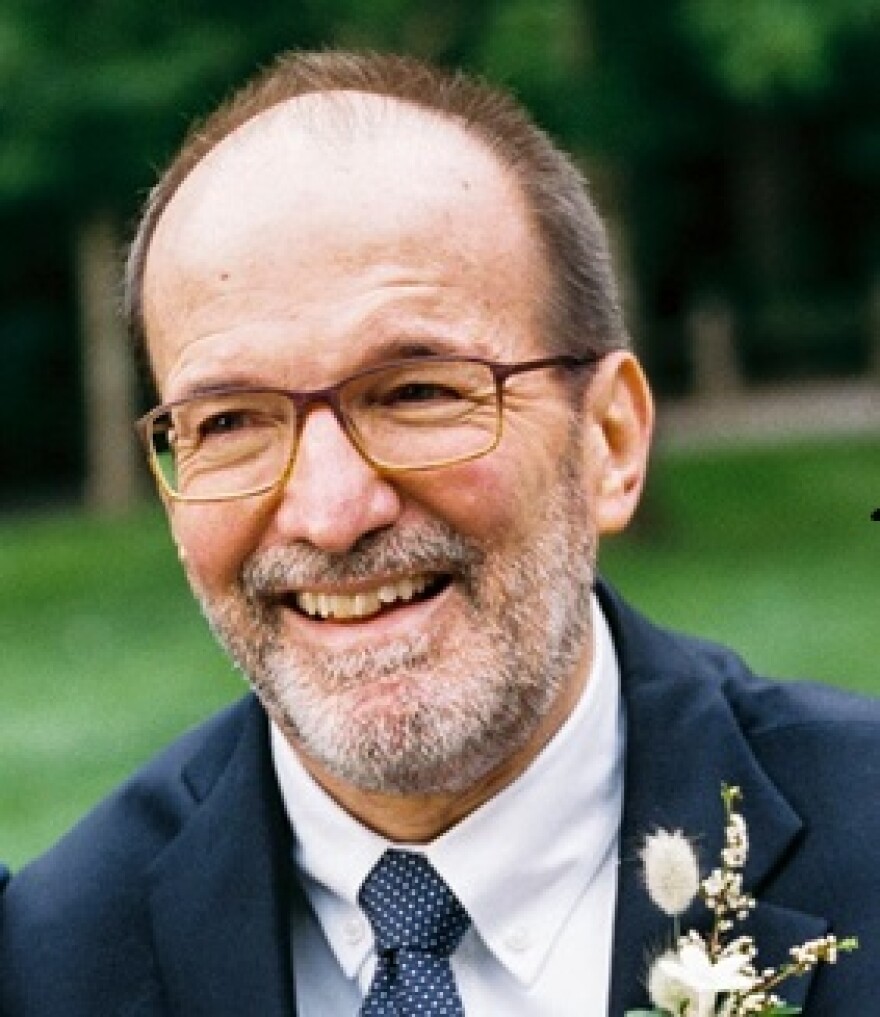
Timothy McVeigh was tried in federal court in Denver, Colorado, before Judge Richard Matsch.
He was charged with 11 counts of conspiracy and murder.
The prosecution's case rested on the axle trace, the fingerprint match, and the testimony of Michael Fortier.
Fortier pleaded guilty to failing to warn authorities and to lying to investigators.
He was not charged with the bombing itself.
He was sentenced to 12 years in prison.
McVeigh was convicted on all counts in June 1997.
He was sentenced to death.
Terry Nichols was tried separately.
He was convicted of conspiracy and involuntary manslaughter.
He was sentenced to life in prison without the possibility of parole.
Two men, two trials, two verdicts from the same blast.
The axle led to the clerk.
The clerk led to the sketch.
The sketch led to the jail cell.
The fingerprint matched the rental agreement.
That was the documented path.
What the record does not establish is the specific arguments made by McVeigh's defense attorneys.
No detailed account of their strategy survives in this record.
No full presentation of their case is laid out here.
Only the convictions are certain.
Only the sentences are final.
Fortier walked out of prison in 2006.
Nichols remains in federal prison.
McVeigh was executed by lethal injection on June 11, 2001, at the federal prison in Terre Haute, Indiana.

One jury heard the evidence and chose death.
Another jury heard the evidence and chose life.
The same facts, two different endings.
That is what the record shows.
Anything broader about the investigation, any wider theory, remains outside what the record establishes.
AND THE STORY STILL ISN'T OVER
The appeals failed.
McVeigh was executed by lethal injection on June 11, 2001, at the federal prison in Terre Haute, Indiana.
Nichols’s conviction was upheld on appeal.
A state trial later convicted him of 161 counts of first-degree murder.
He received a life sentence.
Fortier was released from prison in 2006.
The site of the bombing is now the Oklahoma City National Memorial.
It honors the 168 victims.
The FBI lab’s handling of evidence in the case led to reforms in forensic procedures.
That is what the record shows.
No current legal proceedings are in the record.
No pending motions are in the record.
For McVeigh, the story ended in Terre Haute.
For Nichols, it continues in a federal prison cell.
For Fortier, it ended with release.
For the 168, it is a memorial.
For the FBI, it is a lesson in procedure.
The mistakes were real.
The turning points were real.
What remains is the record itself.
Advertisement
You may also like
The friend's call that sent police to the Watts home — and the phone left behind
On the morning of August 13, 2018, in Frederick, Colorado, Shanann Watts, 15 weeks pregnant, was supposed to be at a doctor's appointment. She…
A concrete anchor found near Laci Peterson's body — and the one detail that still haunts her family
A concrete anchor was pulled from San Francisco Bay in April 2003, near the place where Laci Peterson's body washed ashore. It matched a…
The day care center inside the Murrah Building held 19 children when the bomb hit
The morning of April 19, 1995, began with the ordinary mechanics of a workday. Parents pulled into the drop-off lane outside the Alfred P.…

The Florida mother's 2005 report that started it all — how one stepdaughter's massage led to a 14-year saga
A mother called Palm Beach police in 2005. Her stepdaughter was 14. An older girl had recruited the teenager, the mother said, to give…
The bloody glove on O.J. Simpson's estate that changed everything — but the jury never saw it that way
The glove was found on the morning of June 13, 1994. Detective Fuhrman of the LAPD went to Simpson's estate on Rockingham Avenue. He…
The duct tape on Laci Peterson's body that split a jury's theory
The duct tape was on Laci Peterson's body when she was found. That single object carried the weight of two opposing stories. The prosecution…