The basement blood that matched Ayla Reynolds — and the window police couldn't explain

🚨 THE WINDOW THAT WOULDN'T OPEN FROM OUTSIDE…
The window was open, her father said, and the blanket was gone.
Ayla Reynolds was two years old.
She was reported missing on December 17, 2011, from her father's home in Waterville, Maine.
Justin DiPietro told police he found that window open the morning she disappeared.
He also said the child's blanket was missing.
Investigators found no signs of forced entry at the home.
No signs that anyone broke in.
No signs that anyone pried the frame or shattered the glass.
The window DiPietro said was open was reportedly difficult to open from the outside.
Difficult to reach.
Difficult to lift.
Difficult to explain.
So how does a two-year-old vanish through a window that won't open from outside?
How does a blanket leave with her?
That would require someone inside.
That would require someone who knew the window.
That would require evidence.
The record does not establish who opened the window.
It does not establish whether it was opened at all.
What the record does establish is blood.
Blood found in the basement of the home.
Testing confirmed it matched Ayla's DNA, according to the testing.
Her father said it came from a nosebleed.
Police did not find that explanation credible.
She was on the ground below, somewhere, but not there.
The window stayed open in the story.
The lock stayed silent in the record.
DECEMBER 16 — BEDTIME
Bedtime came on a Friday.
Justin DiPietro told police he put his daughter to bed the night before she was reported missing.
He was the last adult known to have been with her.
Also in the home that night were DiPietro's girlfriend and her sister, both publicly identified in news reports.
The house was quiet, according to the account he gave.
He initially said he checked on Ayla during the night.
She was asleep, he said.
Then he changed his story.
He later said he had not checked on her.
Two versions of the same night.
One father, two statements, one child gone by morning.
The exact time Ayla was put to bed is not in the record.
The precise sequence of events that night is not in the record.
What remains is the shift.
Not because the change was small.
But because the change was central.
If he checked on her, she was there.
If he didn't, the timeline opens.
The girlfriend and her sister would later give statements contradicting his account, according to court documents released after the investigation.
That came later.
That night, there was only the bedtime story he told.
The window stayed open in the story.
The lock stayed silent in the record.
DECEMBER 17 — THE REPORT
The morning came, and the child was not in her bed.
Justin DiPietro told police he discovered her gone on December 17, 2011, and reported her missing from his home in Waterville, Maine.
He said he found a window open.
He said the child's blanket was missing with her.
Police searched the house.
They searched the surrounding area.
They found no trace of the two-year-old.
No body has ever been found.
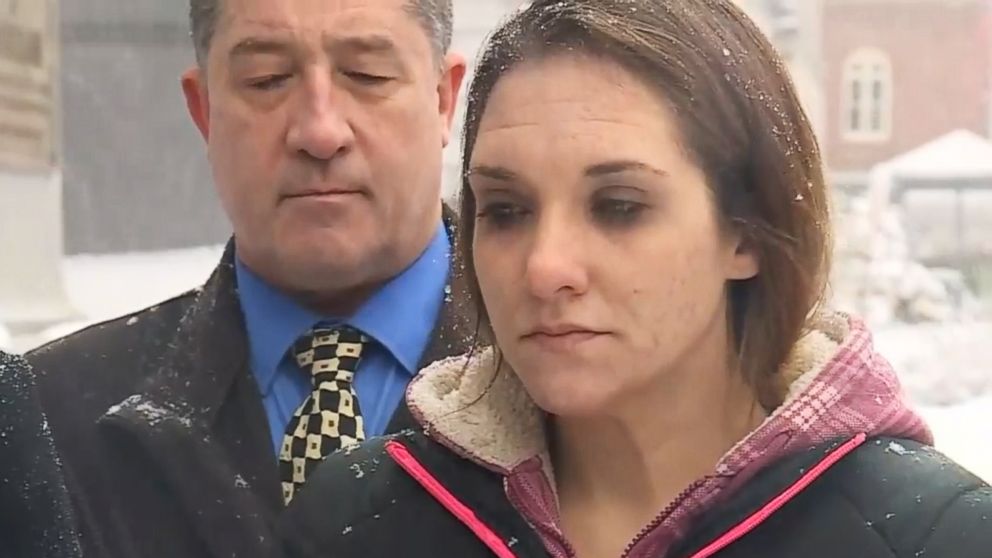
The report went out, and the urgency built from there.
What time the call came in is not specified in the source.
Who first called police is not specified in the source.
The record gives the day, the father's account, and the empty search.
That was all it gave.
A missing toddler, a father's story, an open window.
The window stayed open in the story.
The lock stayed silent in the record.
The morning turned to afternoon, and the search widened.
No sign of her.
The urgency was real.
The answers were not.
THE BASEMENT BLOOD
The search moved to the basement of the home.
Blood was found there.
Testing confirmed the blood matched Ayla’s DNA.
Justin DiPietro claimed the blood came from a nosebleed.
Police did not find that explanation credible.
The source does not specify when the blood was discovered.
It does not specify how much was found.
The exact location of the blood is not in the record.
The quantity of the blood is not in the record.
Whether the nosebleed explanation was ever medically verified is also not in the record.
That would require evidence.
The blood was a fact.
The explanation was a claim.
The gap between them became the center of the investigation.
It was a physical trace of the child in a house where she was last seen.
It was a stain that raised more questions than it answered.
THE CONTRADICTIONS
Police treated the case as a potential abduction.
They quickly focused on inconsistencies in DiPietro's account instead.
DiPietro initially said he checked on Ayla during the night.
He later said he had not.
Two versions of the same night, offered by the same man.
The gap between them became the focus of investigators.
A critical turning point came when DiPietro's girlfriend and her sister gave statements to police.
According to court documents later released, those statements contradicted his timeline.
The specific content of those statements is not detailed in the source.
What is documented is this: the two women told police something that did not line up with what the father had said.
The documents also revealed that DiPietro had given inconsistent accounts of his activities that night.
Not one version. Not two consistent ones.
Accounts that shifted under the weight of repeated questioning.
Police named DiPietro as a person of interest early in the investigation.
He was not arrested. He was not charged.
But the label stuck, and the questions kept coming.
Why would a father check on his daughter, then say he hadn't?
Why would the timeline change at all?
That would require evidence.
The blood in the basement was evidence.
The open window was evidence.
The father's shifting words were something else — a pattern, a problem, a pivot point.
It is a story that turns on a single night.
It is also a story that turns on what a man said about that night, and what he later unsaid.
2013 — THE DECLARATION
The declaration came in 2013, two years after Ayla was last seen.
Maine State Police announced they believed Ayla was dead.
They said her disappearance was not an accident.
They said the case was being treated as a homicide.
No one was charged.
Police searched a landfill for her remains.
Police searched a river for her remains.
They found nothing.
The specific evidence that led police to declare it a homicide is not detailed in the source.
It is a shift from missing person to presumed dead.
It is also a shift with no arrest, no trial, no verdict.
Investigators never recovered Ayla's body.
That hampered the ability to bring charges.
Without a body, the case stalled.
Without a body, the questions multiplied.
Without a body, the father's shifting words remained just that — words.
The case was now officially a homicide investigation.
It remained a case with no defendant.
It remains a case with no charges.
THE TWO STORIES
Police believe Ayla is dead.
They believe her disappearance was not an accident.
The basement blood matched her DNA.
The inconsistent accounts pointed to foul play.
That is the prosecution's story, told without a prosecutor.
There has been no trial.
There has been no verdict.
Justin DiPietro has consistently maintained his innocence.
Police have not named him as a suspect.
They have named him a person of interest.
That is a legal status, not a charge.
It is a status that has held for years.
DiPietro's explanation for the blood was a nosebleed.
Police did not find that credible.
No one has been arrested.
No one has been charged with Ayla's disappearance or death.
The record establishes the blood.
The record establishes the changed story about checking on her.
The record does not establish what happened to Ayla.
The record does not establish who is responsible.
The case has no trial and no verdict.
DiPietro's legal status remains that of a person of interest, not a suspect or defendant.
That is what the law says.
That is also all the law says.
What police believe is not what a jury has decided.
What police announced in 2013 was a homicide investigation.
It was a homicide investigation with no defendant.
It was a homicide investigation with no charges.
It remains a case where belief and proof are two different things.
The belief is public.
The proof is not there.
THE WINDOW REVISITED
The theory circulates online, quietly, in comment threads and forums that outlived the news cycle.
It suggests the open window was an escape route.
It suggests the open window was staging.
The source does not name any online theory, and the record does not establish how the window came to be open.
Police found no signs of forced entry at the home.
The window DiPietro said was open was reportedly difficult to open from the outside.
Was it a route out?
Was it a prop for a story?
Was it simply a window that a two-year-old could not have reached?
That would require evidence.
The blanket was missing too.
The source notes its absence but does not explain its significance.
Not because the blanket proves anything.
But because the absence is part of the scene the father described.
The scene is what police tested, and what they could not reconcile.
They found blood in the basement, and it matched Ayla's DNA.
They found a window that did not open easily from outside.
They found a story that shifted.
The window remains what it was that morning: open, unexplained, and central to a theory no one has proven.
Belief points at it.
The record does not.
The record shows no forced entry.
The record shows a difficult window.
The record does not show who opened it, or why the blanket left with the child.
That gap is where the theory lives.
It is not where the proof lives.
THE 2017 CONVICTION
The case went quiet for a while.
Then, in 2017, Justin DiPietro was convicted on unrelated federal charges.
He was convicted of possessing a firearm as a convicted felon.
He was sentenced to prison for that crime.
That conviction was not connected to Ayla's case.
The record is plain on that point.
No charges related to Ayla have ever been filed against anyone.
Not against DiPietro.
Not against his girlfriend.
Not against her sister.
Not against anyone.
DiPietro served time in federal prison on the firearms conviction.
His release date has been reported variously.
The exact date is not specified in the source.
His current whereabouts are not specified either.
That is not established in the record.
The theory about the window does not become fact because DiPietro went to prison.
It remains a theory.
The blood in the basement remains matched to Ayla.
The explanation for it remains a nosebleed.
The window remains difficult to open from the outside.
The blanket remains gone.
The child remains missing.
A conviction for a gun charge is a fact.
It is a fact about a different crime.
It is not an answer to what happened in that house.
It is not an answer to who opened the window.
It is not an answer to where Ayla is.
The case is still open.
AND THE STORY STILL ISN'T OVER
The tenth anniversary passed in December 2021.
Maine State Police renewed their appeal for information that day, saying they still believed someone knew what happened to Ayla Reynolds.
Ayla remains missing, and law enforcement presumes her dead.
Her case is still open.
Trista Reynolds, Ayla’s mother, has continued to advocate for information about her daughter’s disappearance.
She has publicly criticized the investigation.
The family has held vigils and maintained a public presence, hoping to generate new leads.
No remains have ever been found.
No one has been arrested or charged with Ayla’s disappearance or death.
No charges related to Ayla have ever been filed against anyone.
There is no next concrete step announced — no hearing date, no motion, no decision.
The case remains open with no announced developments.
That is what the record shows.
It is a case without a trial, without a verdict, without a body.
It is a case with a father who has never been charged, though he was a person of interest.
It is a case with blood in the basement that matched Ayla’s DNA.
It is a case with a window that police could not explain.
The vigils continue.
The appeals continue.
The questions remain.
And the story still isn’t over.
Advertisement
You may also like
The $50,000 ransom note left on a nursery windowsill — and the 11-hour jury deliberation that followed
On the evening of March 1, 1932, a ransom note demanding $50,000 was found on a nursery windowsill in the Lindbergh home near Hopewell,…

A mother's shopping trip, a Sears toy aisle, and the six-year-old who never came home
The Sears store at the Hollywood Mall had an air-conditioned hum and a toy aisle that ran long and bright. On July 27, 1981,…
The traffic stop that caught a bombing suspect before the FBI did
The trooper saw the plate first, or rather, he didn't see it. The 1977 Mercury Marquis had no license plate, and that was enough.…

The 14-year-old boy Milwaukee police returned to Dahmer hours before his death
A boy was wandering the street in Milwaukee, drugged and naked. Neighbors reported him in May 1991. Police officers responded to the call. They…

The 1934 torso washing ashore that set off a four-year hunt
The water gave her back on September 5, 1934. A woman's torso, washed up on the shore of Lake Erie near Euclid Beach. She…
Two gas-station murders, one .22 pistol: the timeline the jury followed
The evening of July 19, 1976, in Orem, Utah, was warm and ordinary. A young man walked up to two college students at a…