The fingerprint on the receipt that tied a Gulf War veteran to the Oklahoma City bombing
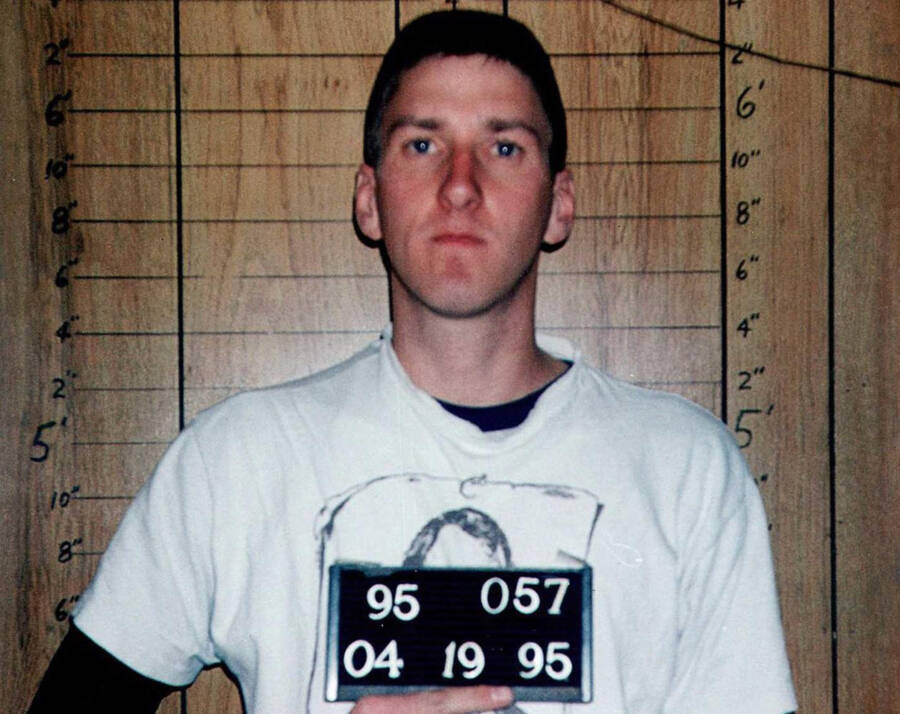
A fingerprint on a receipt.
A receipt for ammonium nitrate, the fertilizer that fueled the bomb.
The bomb that destroyed the Alfred P. Murrah Federal Building on April 19, 1995.
The blast killed 168 people, including 19 children in the building's day care center, and injured more than 500 others.
Forensic evidence linked Timothy McVeigh to the bomb components, and that fingerprint was part of it.
One mark, left on paper, connecting a man to an act of mass violence.
How does a single print carry that weight?
It is a question of contact, of presence, of having held the thing that became the weapon.
The prosecution would argue it was proof of purchase, proof of planning, proof of intent.
The defense argued something else entirely.
At trial, McVeigh's lead attorney, Stephen Jones, presented a theory: that McVeigh was a scapegoat, a patsy, and the real bomber was still at large.
That theory is not established by the record.
It is an argument made in a courtroom, a story told to a jury.
The record shows the fingerprint, the receipt, the axle fragment, the rental records.
The record shows the testimony of Michael Fortier, an Army acquaintance who said McVeigh told him of the plot in advance.
The record shows 137 prosecution witnesses and a jury that deliberated for 23 hours.
The record shows a conviction on all 11 counts of conspiracy and first-degree murder.
None of that erases the question the fingerprint raises.
It only makes the answer heavier.
THE ARREST AND THE TRACE
The trooper clocked the Mercury doing well over the limit and pulled it over.
He arrested the driver, Timothy McVeigh, for driving without a license plate and for carrying a concealed weapon.
The arrest happened within 90 minutes of the blast.
The trooper later looked at the FBI's sketch of the bombing suspect.
He thought the man in his holding cell looked like the drawing.
He notified authorities.
A search of McVeigh's car turned up earplugs.
It turned up a receipt for ammonium nitrate.
It turned up a business card for a gun show.
The ammonium nitrate on that receipt was the same kind used in the bomb.
Investigators worked the other end of the trace at the same time.
Within hours, they found the truck's axle and VIN number at the blast site.
The numbers led to a Ryder rental agency in Junction City, Kansas.
The rental records named a man using the alias "Robert Kling."
The description matched McVeigh.
A traffic stop and a rental record.
They converged within hours.
The trooper who made the arrest is not named in the record for this article.
His role is documented; his name is not.
The investigation moved with improbable speed.
The pieces fit before the dust had fully settled.
THE TRIAL IN DENVER
The change of venue was granted because the local prejudice was intense.
The trial began in April 1997, in Denver, Colorado.
U.S. District Judge Richard Matsch presided.
Prosecutors, led by Joseph Hartzler, presented 137 witnesses.
The forensic evidence was extensive, and the testimony stretched for weeks.
Michael Fortier, an Army acquaintance, took the stand against McVeigh.
He testified that he knew of the plot in advance and had scouted the building with McVeigh.
The specific content of his testimony beyond that is not in the record.
The defense, led by Stephen Jones, argued that McVeigh was not the bomber.
They suggested a broader conspiracy involving foreign terrorists.
They pointed at other suspects, other trails, other men still at large.
The prosecution pointed at the physical evidence: the fingerprint on the receipt, the axle fragment, the rental records.
The jury heard both stories.
They deliberated for 23 hours.
On June 2, 1997, they convicted McVeigh on all 11 counts of conspiracy and first-degree murder.
It was a unanimous verdict.
It was a complete one.
The courtroom in Denver was quiet when the foreman read the counts.
McVeigh stood and listened.
The scale of the battle was in the numbers: 137 witnesses, 23 hours, 11 counts.
The verdict did not end the case.
The penalty phase followed, and the jury recommended death.
Judge Matsch would later formally sentence McVeigh to death.
That sentence was carried out on June 11, 2001.
But the trial itself, the long fight in Denver, was over.
TWO STORIES, ONE FINGERPRINT
Two stories sat on the same exhibit table.
The prosecution pointed to the fingerprint on the receipt for ammonium nitrate, the axle fragment, the rental records.
They added the testimony of Michael Fortier, the Army acquaintance who said McVeigh had told him of the plot and scouted the building.
That chain, they argued, tied McVeigh directly to the bomb components.
The defense pointed at the same fingerprint and called it a frame.
McVeigh, Stephen Jones argued, was a scapegoat; the real bomber was still at large.
They suggested a broader conspiracy, one reaching toward foreign terrorists.
Who else could have rented the truck? Who else knew the building?

Who else left that mark?
The record does not establish any of that.
The jury deliberated for 23 hours and returned guilty on all 11 counts.
The physical evidence and Fortier's testimony, they decided, were overwhelming.
Judge Richard Matsch presided over the Denver courtroom through every witness and every exhibit.
After the jury recommended death, he formally sentenced McVeigh.
The prosecution's story held; the defense's story did not.
It is a claim, not a documented fact.
One fingerprint, two readings.
The jury chose the one with the evidence behind it.
AND THE STORY STILL ISN'T OVER
The jury recommended the death penalty.
Judge Matsch formally sentenced McVeigh to death.
Terry Nichols was tried separately.
Nichols was convicted of conspiracy and involuntary manslaughter.
He was sentenced to life without parole.
Michael Fortier had pleaded guilty to failing to warn authorities.
He was sentenced to 12 years in prison for his cooperation.
McVeigh was executed by lethal injection on June 11, 2001.

The execution took place at the federal penitentiary in Terre Haute, Indiana.
Nichols remains in federal prison.
Fortier was released in 2006.
The Oklahoma City National Memorial & Museum now stands on the site of the Murrah Building.
It honors the 168 victims.
The case remains a landmark in domestic terrorism law.
It is also a landmark in federal investigation procedures.
The record ends there.
No ongoing legal proceedings are in it.
No new developments are in it.
The sentences are final.
The executions are final.
What remains is the memorial, and the weight of what the jury decided.
That weight does not fade with the verdict.
It does not fade with the execution.
It stays in the stone of the memorial, in the names of the 168.
The story, in the record, is over.
The questions the defense raised are not in the record as facts.
They are claims.
The fingerprint is documented.
The conviction is documented.
The sentence is documented.
The memorial stands.
That is what the record establishes.
Advertisement
You may also like
The ransom note demanding $118,000 that matched John Ramsey's bonus
The 911 call came at 5:52 a.m. on December 26, 1996. Patsy Ramsey told the dispatcher her 6-year-old daughter was missing. A ransom note…
The trunk stain that sent Casey Anthony to trial for Caylee's death
The car was a Pontiac, and the trunk smelled before anyone opened it. In July 2008, after Caylee Marie Anthony was reported missing, a…
The two-phase attack that began at a streetlight and ended in a hallway
The light at 82-70 Austin Street in Kew Gardens, Queens, marks the spot. Not a hallway. Not a doorway. The open street, under the…
The 911 call at 12:10 a.m. — and the glove that would not fit the timeline
The dog came back first. It was past midnight on June 13, 1994, in the Brentwood neighborhood of Los Angeles. A neighbor named Sukru…
Cell phone data put Chase Merritt near the grave site — then QuickBooks opened after the family vanished
The motorcyclist stopped because something in the sand caught his eye. It was February 2013, and he was riding near Victorville, California, in the…
The parking ticket that led police to David Berkowitz's door
It was a piece of paper, folded under a windshield wiper. A parking ticket issued near one of the Son of Sam shootings. The…