The pressure-cooker lid fragment that turned a marathon finish line into a crime scene

🚨 THE LID FRAGMENT THAT CHANGED EVERYTHING
The lid fragment did not look like much.
It was a curved piece of metal, scorched and bent, pulled from the rubble on Boylston Street.
Days after the blasts, investigators found it beside a scrap of circuit board.
The FBI led the search, with Boston police and state authorities working the grid.
A pressure cooker lid is a kitchen object.
Most homes have one, or something like it, sitting in a cabinet.
Here, it was evidence that a bomb had been built from ordinary things.
The finish line had become a crime scene.
The fragment was the first concrete link to the construction of the device.
It said nothing about who placed it.
It said nothing about why.
It only said that the explosion was made, not accidental.
The exact spot where the fragment lay is not specified in the record.
Neither is its condition beyond the recovery itself.
What is known is that it was recovered within days.
What is known is that it connected the blast to a design.
A circuit board fragment suggested a trigger.
A lid fragment suggested a sealed vessel under pressure.
Together, they pointed to a pressure cooker bomb.
That was the first step.
The rest of the investigation would unfold from there.
APRIL 15, 2:49 P.M. — THE FIRST BLAST
It was 2:49 in the afternoon on a Monday in April.
The first bomb exploded near the finish line on Boylston Street.
Seconds later, a second blast followed.
The exact time of the second explosion is not given in the record.
Two pressure-cooker bombs had been placed in backpacks and left on the sidewalk among the spectators.
Three people were killed.
A restaurant manager, 29 years old.
A graduate student, 23 years old, from China.
An 8-year-old boy.
More than 260 others were injured, many with severe limb damage.
The attack was discovered immediately by the chaos and carnage at the scene.
Emergency responders converged within minutes.
Medical personnel converged within minutes.
Law enforcement converged within minutes.
The finish line had been a celebration.
Now it was a crime scene.
The bombs were ordinary kitchen pressure cookers, packed into ordinary backpacks.
They sat among the crowd, unnoticed, until they detonated.
The first blast came at 2:49 p.m.
The second came seconds later.
The day was April 15, 2013.
The place was Boston, Massachusetts.
The Marathon was still officially underway.
It was not.
THE VICTIMS AND THE WOUNDED
Krystle Campbell was a 29-year-old restaurant manager.
She had gone to watch the Marathon with a friend.
She was killed.
Lu Lingzi was a 23-year-old graduate student from China.
She was at the finish line, cheering with classmates.
She was killed.
Martin Richard was an 8-year-old boy.
He was standing with his family, waiting for his father to cross the line.
He was killed.
More than 260 others were injured.
Many suffered severe limb damage.
The specific injuries of individual survivors are not detailed in the source.
The three names became the human cost of the afternoon.
Krystle, Lu, Martin.
Two women and a boy, gone in seconds.
The Richard family became widely known in the months that followed.
They issued public statements, measured and quiet.
They established a foundation in Martin's name.
It funds community programs, education, and peace-building work.
The foundation is one way a family turned grief into action.
The other victims and their families have largely remained private.
Some have spoken publicly about their recovery.
Most have not.
The city holds an annual remembrance on the anniversary of the bombing.
Names are read.
Bells are rung.
The three who died are never far from that ceremony.
Krystle, Lu, Martin.
The record keeps their ages, their roles, their futures cut short.
It does not keep more.
THE SURVEILLANCE FOOTAGE AND THE FBI'S RELEASE
The FBI led the investigation, with assistance from Boston police and state authorities.
Surveillance footage from a department store and nearby cameras captured two men carrying heavy backpacks.
The specific department store is not named in the source.
The footage placed the two men near the finish line.
It placed them there before the blasts.
It placed them carrying the weight of what would follow.
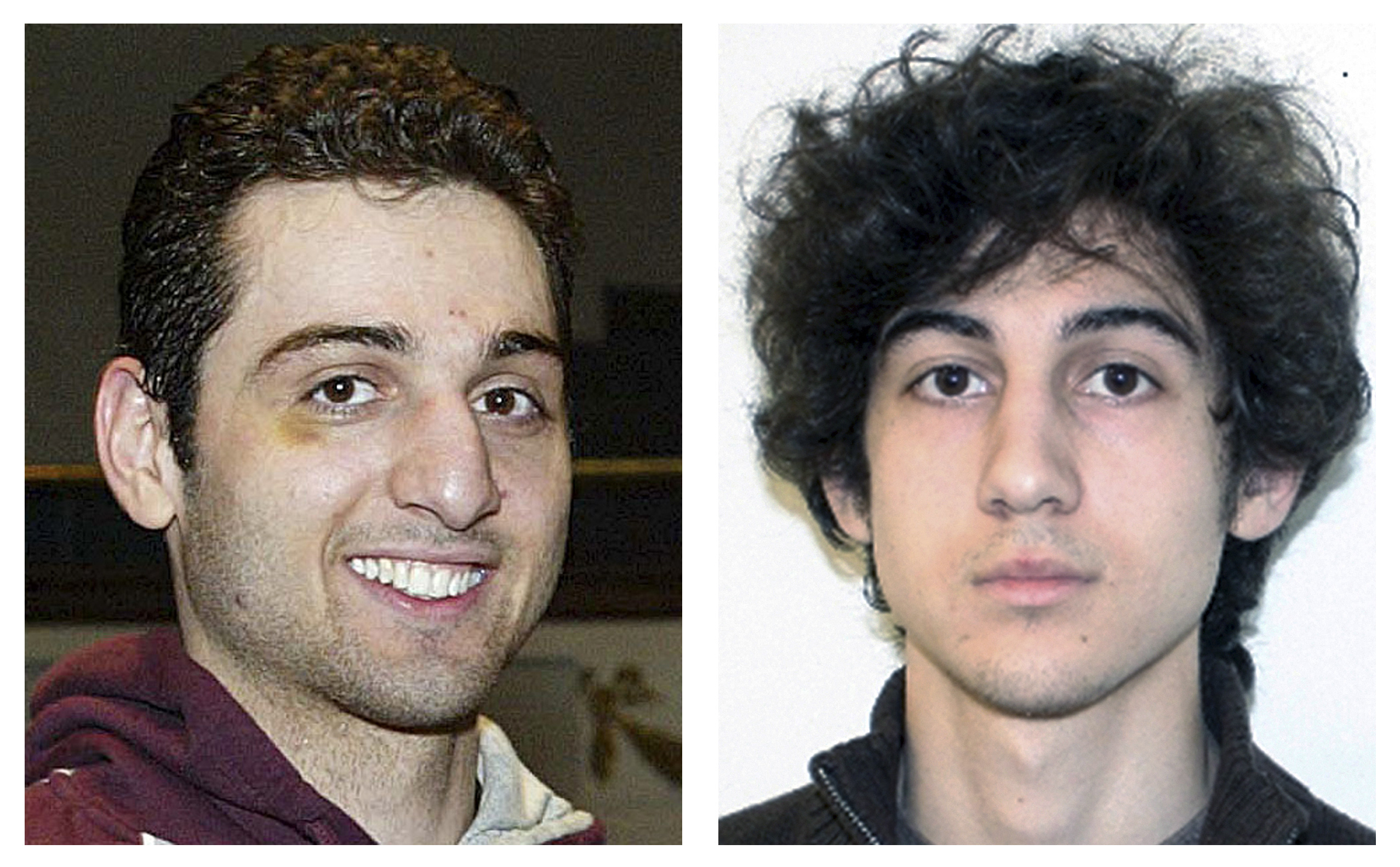
On April 18, 2013, the FBI released images of the two suspects.
The public saw their faces for the first time.
The images were a critical step in identifying the brothers.
Not because the names were known then.
But because someone in the city might know them.
The release turned millions of spectators into witnesses.
It turned the investigation outward, into the open.
Who were these men?
Where had they gone?
What were they carrying?
The record does not answer those questions from the footage alone.
It shows the images released, the date of the release, and the role they played.
That is what the record establishes.
The rest was still unfolding.
THE NIGHT OF APRIL 18 — THE OFFICER AND THE CARJACKING
The FBI released the images on a Thursday.
That same night, the brothers allegedly killed a campus police officer at the Massachusetts Institute of Technology.
The source does not provide the officer's name.
They also carjacked a driver.
That driver later escaped and alerted police.
The carjacked vehicle was used during their escape attempt.
A massive manhunt followed.
What did the brothers do after the images went public?
Did they know they had been identified?
Did the release push them into motion?
The record shows only the sequence: the images, the night, the officer, the carjack.
It does not establish what the brothers saw or thought that night.
The officer was killed on campus.
The driver was taken, then got away.
The vehicle carried them forward.
The manhunt spread across the region.

Not because the images alone revealed them.
But because the carjack gave police a live trail.
The night of April 18 was the escalation.
It is the pivot between suspects in a photograph and suspects on the run.
It is also the point where the attack became a chase.
The officer's death is alleged.
The carjacking is alleged.
The escape attempt is documented.
What remains open is the intent behind each act.
That would require evidence the record does not supply.
APRIL 19 — THE SHOOTOUT AND THE BOAT
The shootout came on April 19 in Watertown, Massachusetts.
Tamerlan Tsarnaev was killed in that confrontation with police.
Later that same day, Dzhokhar was found hiding in a boat in a backyard, wounded.
He was captured there.
The boat’s interior became evidence.
He had written a message inside it.
The content of that message is not specified in the source.
It is not established what the words were.
Cellphone data was part of the evidence.
Internet history was part of the evidence.
Testimony from friends who said Dzhokhar had discussed jihad was part of the evidence.
What the boat held, what the phone held, what the history held — the record lists them.
The record does not list the message.
The manhunt had ended.
The city exhaled.
Then came the grim accounting: one brother dead, one brother captured, and a case that would take years to resolve.
The escape attempt had failed.
What remained was the evidence, the trial, and the question of what the younger brother had intended.
That question would require testimony, records, and a jury.
It would not be answered in the boat.
THE MEDIA'S FALSE REPORT
Before the FBI released the images, some media outlets named a suspect.
They reported that a "dark-skinned male" had been arrested.
No arrest had been made.
The report was wrong, and the error was retracted.
The specific outlets that made the mistake are not named in the source material.
Still, the false report spread while the real manhunt was still underway.
It was a mistake born of pressure.
It was a mistake born of confusion.
It was a mistake born of a city waiting for an answer.
The record does not establish which newsroom made the first call.
What the record does establish is the sequence: a false arrest reported, a false arrest walked back, and a city left with nothing but the images of two men carrying heavy backpacks.
The FBI had released those images on April 18.
The brothers were still out there.
A campus police officer was allegedly killed that same night.
A driver was carjacked.
The manhunt had not ended.
It had only become louder, faster, and less certain.
The media's error did not change the investigation.
It changed what the public believed for a few hours.
That would require a retraction, not a correction of the record.
The record holds only what happened.
What happened was a false report.
What happened was a retraction.
What happened was the search continuing.
THE TRIAL — TWO BROTHERS, TWO STORIES
The trial began in January 2015 in U.S. District Court in Boston.

Dzhokhar Tsarnaev was charged with 30 federal counts.
The counts included conspiracy to use a weapon of mass destruction and bombing a public place.
Prosecutors sought the death penalty.
The defense did not deny that Dzhokhar had participated.
They argued that his older brother, Tamerlan, was the mastermind.
They argued that Dzhokhar had been under his brother's influence.
The specific arguments beyond that claim are not detailed in the source.
So the record holds one story from the defense: the older brother led, the younger followed.
It holds the prosecution's story: 30 counts, each one answered.
In April 2015, the jury found Dzhokhar Tsarnaev guilty on all 30 counts.
Not some of the counts.
Not most of them.
All of them.
Was the verdict about what he did, or about what he failed to stop?
Was the influence argument a defense, or an explanation?
That would require evidence the record does not provide.
The jury heard the case.
The jury weighed the two brothers.
One brother was dead by then, killed in a Watertown shootout.
The other sat in the courtroom, convicted of every charge.
The weight of justice landed on the younger brother alone.
THE SENTENCE AND ITS OVERTURN
The same jury that convicted him on all 30 counts decided his punishment.
In the penalty phase, that jury determined he should be sentenced to death.
In June 2015, the judge formally sentenced Dzhokhar Tsarnaev to death by lethal injection.
The sentence was pronounced in a Boston federal courtroom, four years after the finish line bombing.
Then the legal whiplash began.
In 2020, a federal appeals court overturned the death sentence.
The court ruled that the trial judge had not adequately screened jurors for bias.
The specific details of the appeals court's reasoning are not fully provided in the source.
What is established is the ruling itself, and its consequence: the death sentence was set aside.
The case did not end there.
In 2022, the U.S. Supreme Court reinstated the death sentence.
The case was returned to the lower courts for further proceedings.
Was the matter settled?
Was the punishment final?
Was the long arc of justice complete?
That would require evidence of an ending.
The record shows a case still moving through the courts, a sentence restored and contested.
The younger brother remains on federal death row.
His appeals continue.
No execution date has been set.
AND THE STORY STILL ISN'T OVER
He remains at the federal supermax prison in Colorado.
His appeals continue.
The death sentence stands after the Supreme Court’s 2022 ruling. No execution date has been set.
What comes next in the courts is not mentioned in the source. No specific motion, no next date, no calendar the record can point to.
Boston holds its annual remembrance on the anniversary of the bombing.
The Richard family speaks through the Martin Richard Foundation, their advocacy for community causes now part of the public record.
The surviving victims and their families have largely stayed private. Some have spoken about their recovery.
That is where the documented case rests.
The guilty verdicts are on the record. The sentence has been reinstated. The appeals continue.
Not because the story is resolved. Because the legal process moves in filings and rulings, not in certainties.
His name remains attached to the charges. His brother is dead. The death penalty hovers, unexecuted, unset.
A date would give the story an ending. The record does not provide one.
The lid fragment, the circuit board, the boat, the carjacked vehicle — all evidence, all entered into the trial record.
What remains is a man on death row and a city that marks the day every April.
The foundation carries the child’s name. The survivors carry their own recoveries.
The appeals continue.
No execution date has been set.
Advertisement
You may also like
The $50,000 ransom note left on a nursery windowsill — and the 11-hour jury deliberation that followed
On the evening of March 1, 1932, a ransom note demanding $50,000 was found on a nursery windowsill in the Lindbergh home near Hopewell,…

A mother's shopping trip, a Sears toy aisle, and the six-year-old who never came home
The Sears store at the Hollywood Mall had an air-conditioned hum and a toy aisle that ran long and bright. On July 27, 1981,…
The traffic stop that caught a bombing suspect before the FBI did
The trooper saw the plate first, or rather, he didn't see it. The 1977 Mercury Marquis had no license plate, and that was enough.…
The 14-year-old boy Milwaukee police returned to Dahmer hours before his death
A boy was wandering the street in Milwaukee, drugged and naked. Neighbors reported him in May 1991. Police officers responded to the call. They…

The 1934 torso washing ashore that set off a four-year hunt
The water gave her back on September 5, 1934. A woman's torso, washed up on the shore of Lake Erie near Euclid Beach. She…
Two gas-station murders, one .22 pistol: the timeline the jury followed
The evening of July 19, 1976, in Orem, Utah, was warm and ordinary. A young man walked up to two college students at a…