A tip from a truck driver led police to a parked Chevrolet Caprice — what they found inside
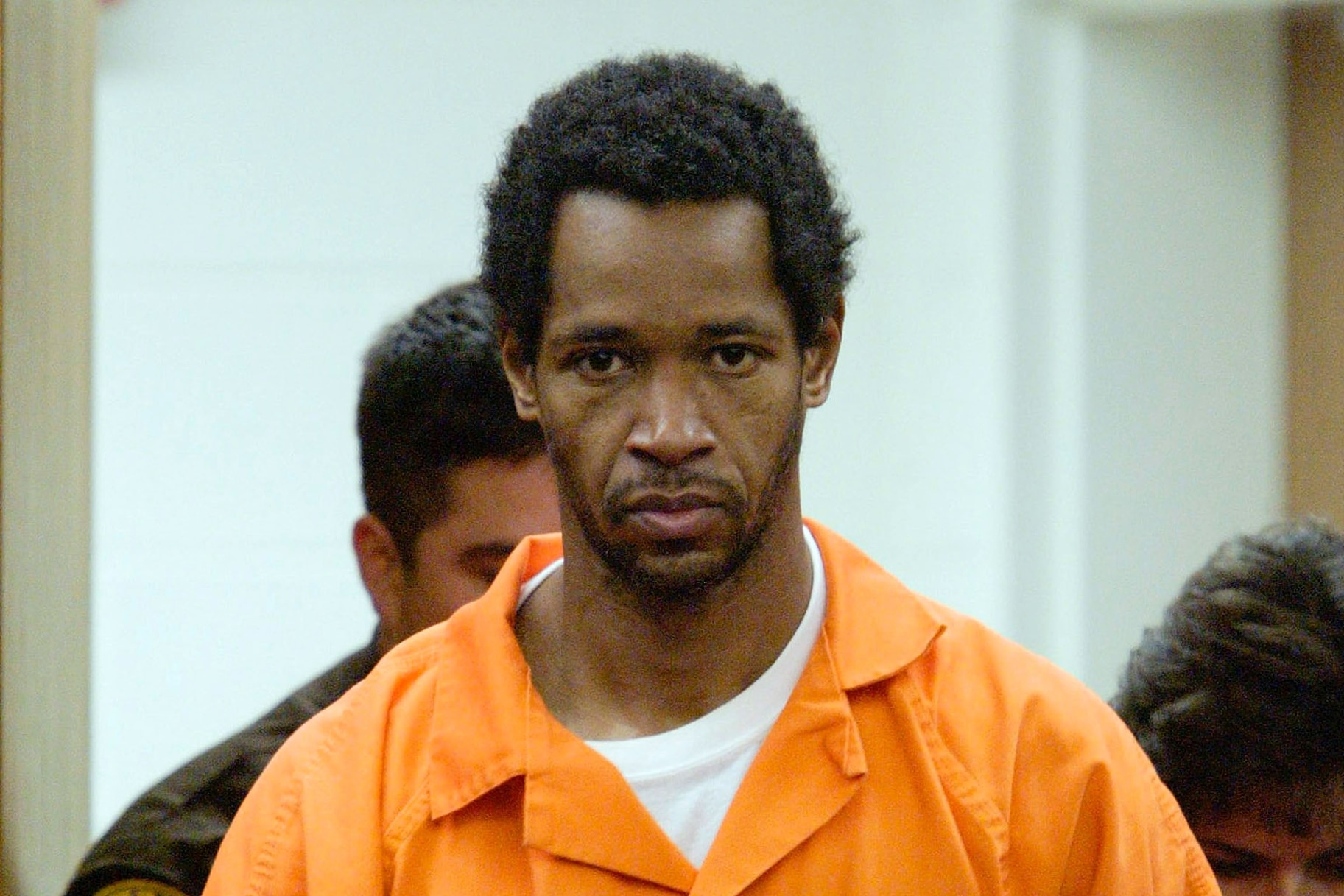
A truck driver made a call on October 24, 2002.
The tip led police to a rest stop on Interstate 70 near Myersville, Maryland.
Parked there was a blue Chevrolet Caprice.
Inside the car, officers found a Bushmaster XM-15 .223-caliber rifle.
The car had been modified.
A hole had been cut in the trunk, allowing a shooter to fire from inside without being seen.
The region had been hunting for a sniper for weeks.
Shootings had struck gas stations, parking lots, and other public places across Maryland, Virginia, and Washington, D.C.
Schools had closed. People crouched behind their cars while pumping gas.
Then a single tip brought the hunt to a parked car.
Who was in that car?
How did one tip end it?
The truck driver's identity is not in the record.
The exact wording of the tip is not in the record either.
What is documented is this: a witness at a shooting in Ashland, Virginia, on October 19 reported seeing a white van.
The actual vehicle was a blue Chevrolet Caprice.
The white van was a witness error.
It was not the vehicle used.
The tip came anyway.
It pointed to the Caprice.
Inside the trunk was the rifle.
The rifle would later be linked by ballistics to several of the shootings.
That would require evidence, and the evidence was in the car.
One tip, one parked car, one rifle.
The rest of the story was still ahead.
THE FIRST SHOT
Between October 2 and October 24, 2002, a series of shootings occurred across Maryland, Virginia, and Washington, D.C.
The first attack was on October 2, when a man was killed in a grocery store parking lot in Wheaton, Maryland.
Over the following weeks, ten more people were killed and three wounded in seemingly random shootings at gas stations, parking lots, and other public places.
The attacks terrorized the region.
Schools closed.
People crouched behind cars while pumping gas.
No one knew where the next shot would come from.
No one knew why.
No one knew who.
The record does not name the individual victims in this article; the names are excluded.
What remains is the pattern: a man in a parking lot, a woman at a gas station, a bus driver on a highway.
Each shooting was public.
Each was sudden.
Each left a body and a crowd of witnesses who saw nothing useful.
Police had little to go on, with shootings occurring in different jurisdictions.
A white van was reported at one scene in Ashland, Virginia.
That sighting was a witness error.
The actual vehicle was a blue Chevrolet Caprice.
That would come later.
For now, the region held its breath, and the shootings continued.
THE HUNT
Police initially had little to go on.
The shootings spanned Maryland, Virginia, and the District of Columbia, each one falling in a different jurisdiction.
A witness at a shooting in Ashland, Virginia, on October 19 reported seeing a white van.
That sighting was an error; the actual vehicle was a blue Chevrolet Caprice.
Chief Charles Moose of the Montgomery County Police Department became the public face of the investigation.
He read statements and appeals for information, standing before cameras as the region waited.
A key piece of evidence was a tarot card left at a shooting scene.
The card contained a handwritten message.
The exact contents of that message are not detailed in the source.
What the card said, and what it was meant to communicate, remains undocumented.
The investigation was a multi-jurisdictional effort.
Local police worked alongside the FBI and the Bureau of Alcohol, Tobacco, Firearms and Explosives.
Agencies shared tips, ballistics reports, and witness accounts across county lines.
Each shooting added another file, another jurisdiction, another layer of coordination.
The suspects were also linked to earlier shootings in other states.
A killing in Alabama.
A shooting in Louisiana.
Those connections came later, pieced together after the arrests.
For now, the manhunt sprawled.
Few solid leads existed.
A white van that was not there.
A tarot card whose message remains unrecorded.
Chief Moose asked the public for help, and the public watched.
Schools closed.
People crouched behind cars while pumping gas.
The region held its breath, and the shootings continued.
THE ARREST
On October 24, a truck driver's tip led police to a parked blue Chevrolet Caprice at a rest stop on Interstate 70 near Myersville, Maryland.
Inside were John Allen Muhammad, a 41-year-old U.S. Army veteran, and Lee Boyd Malvo, a 17-year-old Jamaican national.
Officers found a Bushmaster XM-15 .223-caliber rifle in the car.
Ballistics later linked that rifle to several of the shootings.
The car had been modified with a hole in the trunk, allowing a shooter to fire from inside without being seen.
The arrest was the break the region had waited for.
It was not the end of the case.
It was the beginning of the legal proceedings.
Muhammad was tried first, in Virginia, in Prince William County.
He faced charges of capital murder for the killing of a victim on October 9.
He was convicted on November 17, 2003.
He was sentenced to death.
Malvo was tried separately in the same jurisdiction.
He faced charges for the killing of a victim on October 14.
The specific charges against Malvo beyond that one killing are not detailed in the record.
He was convicted.
He was sentenced to life without parole, as he was a juvenile at the time of the crimes.
The trials were separate.
The verdicts were different.
The legal weight landed on both.
Muhammad's sentence would be carried out in 2009.
Malvo's would keep him in prison.
The closure of the arrest was real.
The weight of what followed was heavier.
AND THE STORY STILL ISN'T OVER
The mother of one victim said the grief never left her.
She spoke about her daughter, a nanny, at vigils and in interviews over the years.
Other families did the same, telling the story of the man at the gas station, the man on the lawn, the man by the school bus.
They spoke so the dead would not become a number.
Muhammad was executed by lethal injection on November 10, 2009, in Virginia.
He was 48.
The sentence was carried out.
Malvo remains in prison, serving life without parole.
He was a juvenile when the shootings happened, and the law on juveniles changed after his trial.
In 2017, the U.S. Supreme Court declined to hear an appeal from Malvo, who argued that his sentence was unconstitutional under rulings that banned mandatory life without parole for juveniles.
The Court did not explain.
The outcome of any further appeals or legal challenges for Malvo after 2017 is not in the record.
What is in the record is the system he forced to change.
The case led to changes in how multi-jurisdictional investigations are coordinated.
Police agencies that had guarded their own territories learned to share.
The tip from the truck driver was one call.
The coordination that followed was a structure built to last.
It is a legacy the families did not ask for.
It is also the one they got.
The shooters are gone or imprisoned.
The victims’ names remain.
The story still isn’t over.
Advertisement
You may also like
The ex-wife's custody fight that prosecutors linked to the D.C. sniper attacks
October 2, 2002. A man was shot outside a grocery store in Wheaton, Maryland. That was the first. Between that evening and October 22,…
The fingerprint on a door, the eyeglasses left behind, and the witness who tied Manson to the murders
The word was on the front door, written in blood. PIG. Five people were dead inside the house at 10050 Cielo Drive in Benedict…
The 911 call that sent searchers to Wyoming — and the notebook that changed everything
The notebook sat in the dirt beside his remains. October 20, 2021, in the Myakkahatchee Creek Environmental Park in Florida. The remains belonged to…
The 10 pm check that sent Kate McCann running from the tapas table
The tapas restaurant was a short walk from the apartment, and the check was the kind of errand that had become a holiday ritual.…
The 1965 confession that never reached a trial — and the one name police could not clear
He confessed in 1965. He was already in custody, held for other crimes, when he gave a detailed account of the Boston Strangler murders.…
The 35,000-word manifesto that unmasked a killer after 17 years
A 35,000-word document arrived at two newspapers in 1995. Its title was "Industrial Society and Its Future." The writer demanded that it be published.…