The 1969 cipher that taunted Bay Area papers and left a killer unnamed
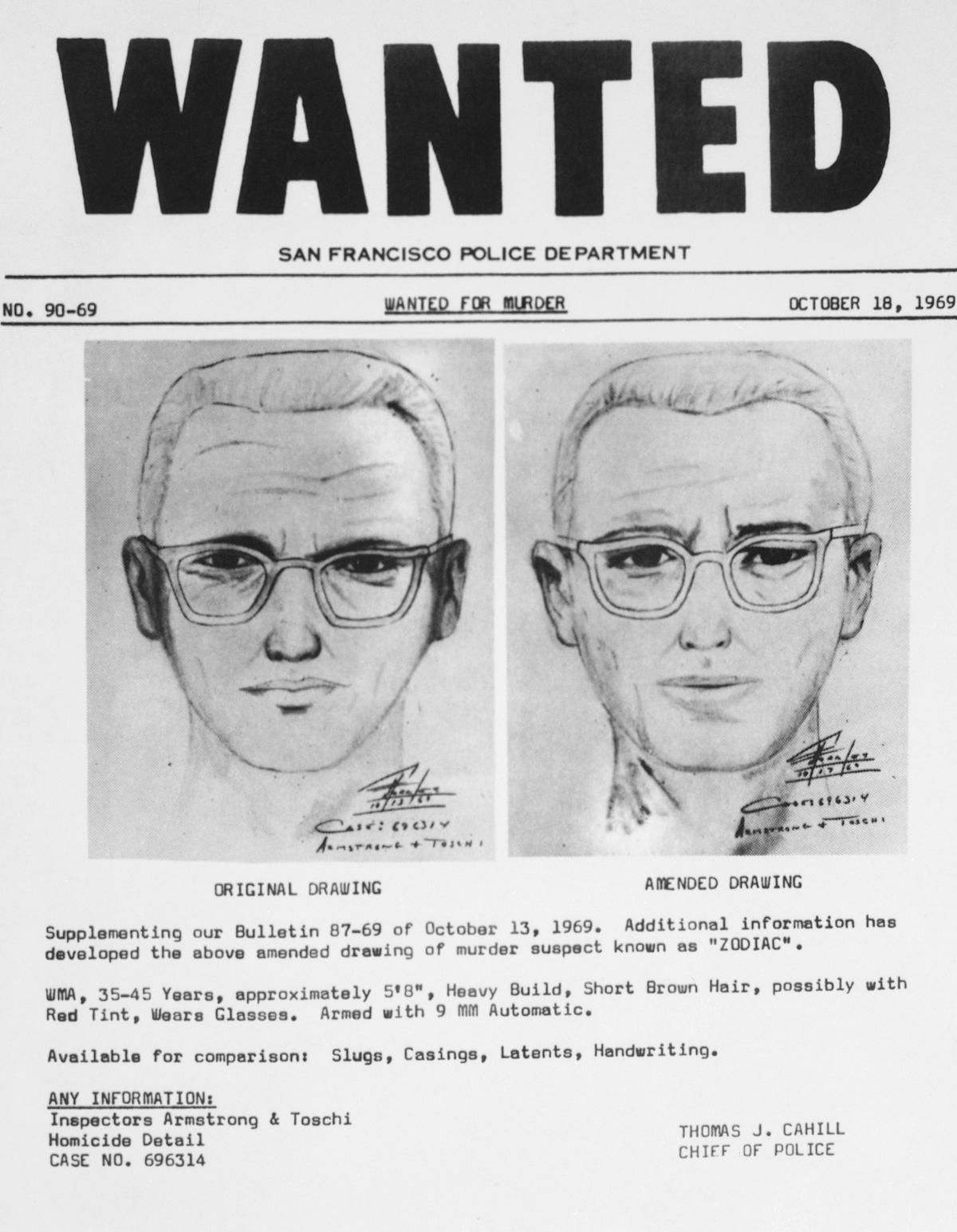
August 1969, and three Bay Area newspapers each received the same taunt.
The San Francisco Chronicle. The San Francisco Examiner. The Vallejo Times-Herald.
The sender called himself the Zodiac and dared them to solve a cryptogram.
A high school teacher and his wife in Salinas, California, solved it within days.
The decrypted message claimed the killer was collecting slaves for the afterlife.
The letters kept coming, each one coining the name that dominated headlines.
A second cipher arrived later.
It was not solved until December 2020, when a team of codebreakers finally cracked it.
A third cipher remains unsolved.
That fact still draws online sleuths and renewed public interest.
The puzzle hangs in the air.
Was it a confession? A game? A boast that outlived its author?
The record does not establish what the third cipher says.
It does not establish who sent any of them.
What the record does show is a killer who understood the press.
He wrote to them directly. He gave himself a name. He took credit for murders.
The newspapers printed his letters, and the public read them in fear.
The cipher that won't die is the one nobody has solved.
It sits there, still unsolved, still inviting the next attempt.
The killer's identity is not established.
Neither is the meaning of that final code.
The taunt remains unanswered.
THE BAY AREA IN FEAR
December 20, 1968.
Two teenagers were shot while parked at a lovers' lane near Vallejo.
Both died.
The next attack came on July 4, 1969.
Two people were shot at Blue Rock Springs Park in Vallejo.
One died.
One survived.
On September 27, 1969, two people were stabbed at Lake Berryessa.
One died.
One survived.
On October 11, 1969, a taxi driver was shot and killed in San Francisco's Presidio Heights.
That made five dead between December 1968 and October 1969.
The killer claimed more.
Those additional victims are not confirmed by the record.
The weapon changed.
A 9mm handgun was used in the Vallejo and San Francisco shootings.
A knife was used at Lake Berryessa.
The attacks spread across the Bay Area.
Vallejo first.
Then a lake.
Then a city street.
Each attack brought new headlines.
Each headline brought new fear.
The papers reported the deaths.
The public read the names.
The killer wrote to the newspapers, coining the name "Zodiac" and taking credit.
The letters arrived with ciphers.
The ciphers demanded attention.
The attention fed the dread.
It is a timeline of five confirmed deaths.
It is also a timeline of claimed ones.
The record holds the five.
The claim holds the rest.
That distinction matters.
It is the line between what happened and what was said to have happened.
THE LETTERS AND THE PRESS
The killer signed his letters with a crossed circle and a name: Zodiac.
He sent them to the *San Francisco Chronicle*, the *San Francisco Examiner*, and the *Vallejo Times-Herald*.
He took credit for murders he may or may not have committed.
That was the arrangement.
The newspapers printed his ciphers, and the public read them.
Headlines carried his taunts.
Fear and fascination competed for the front page.
Paul Avery, a crime reporter for the *San Francisco Chronicle*, received Zodiac letters.
He became part of the case he was covering.
Avery worked the story, and the story worked through him.
The press was not a bystander.
It was the stage.
At Lake Berryessa, a witness described a man in a hooded costume.
That description went into the record.
After the Stine murder, a composite sketch was produced.
A San Francisco police officer reportedly saw a man matching that sketch near the scene.
He did not stop him.
That sighting is reported.
It is not confirmed as the killer.
The officer saw someone.
What that someone was, the record does not say.
The letters kept coming anyway.
Each one promised more.
Each one revealed less.
The ciphers were puzzles, and the public solved them in the papers.
The Zodiac used ink.
The papers used type.
The killer's name stayed his own, even as his symbol became theirs.
THE SUSPECT AND THE DNA
Arthur Leigh Allen was the name the record keeps.
A former acquaintance tipped police to him in 1971, and investigators spent years looking at him.
He was never arrested. He was never charged. Police never formally named him as a suspect.
He was a suspect in the press, though. A 2007 documentary and a 2007 film both portrayed him as the likely killer.
Then the DNA came in.
In 2002, testing on a stamp from a Zodiac letter was compared with Allen's profile. It did not match.
That effectively cleared him. The record states that plainly.
Allen died in 1992, a decade before the test that removed his name from the active column.
His guilt is not established. His innocence is not established, either. The DNA cleared him, but the case remains open.
The FBI reopened it in the 2010s. The San Francisco Police Department kept reviewing evidence. Multiple agencies have held the file over the decades.
What does the record actually support?
That a man was suspected on a tip. That he was investigated extensively. That a stamp's DNA did not match his.
That would require evidence to go further. The evidence stops at the stamp.
So the weight sits where it always sat: on a suspect who was never charged, and on a test that let him go without a verdict.
The killer's name stayed his own. Even after the papers printed Allen's, even after the films argued it, the record never closed the loop.
AND THE STORY STILL ISN'T OVER
The case remains open.
The San Francisco Police Department and the FBI have continued to review evidence.
The 2020 decryption of the second cipher renewed public interest.
It was a fresh headline for an old name.
Arthur Leigh Allen's name was cleared by DNA evidence in 2002.
Not because the record proved his innocence. Because the stamp did not match him.
Some authors and filmmakers continue to argue for his guilt.
The argument is a theory. The record does not establish it.
The killer's identity remains unknown.
The third cipher remains unsolved.
The letters and ciphers still sit among the most famous artifacts in American criminal history.
Books have been written. Documentaries have been made. Films have been shot.
Each one reopens the question the record never closed.
The identities of the victims' families have largely faded from public view.
The names of the dead appear in the files. The faces of the living do not.
The media moved on. The public moved on. The case did not.
The San Francisco Police Department reviewed. The FBI reopened it in the 2010s.
The evidence stops where it always stopped.
At a suspect who was never charged. At a test that let him go without a verdict.
The cipher that was solved in 2020 gave the case a new day.
It did not give the case a name.
The killer stays unnamed. The story stays open.
That is not a mystery to be solved. That is a record to be read.
Advertisement
You may also like
The newspaper clipping found beside Elizabeth Short's body that detectives could never link to a suspect
A newspaper clipping lay beside Elizabeth Short's body in the vacant lot on Norton Avenue. Investigators noted it, bagged it, and ran it down.…
The ransom note left on a windowsill, and the voice Charles Lindbergh swore he recognized
The crib was empty. On the evening of March 1, 1932, Charles Lindbergh Jr., the 20-month-old son of aviator Charles Lindbergh and Anne Morrow…
The smiley-face letters that unmasked a trucker — and exposed a wrongful conviction
The letters arrived with a smiley face drawn at the bottom. They were taunts, sent to police and the media, signed with a grinning…
The traffic stop that caught Timothy McVeigh — before the FBI knew his name
The trooper saw the Mercury Marquis first. A 1977 model, no license plate, rolling down an Oklahoma highway. Within 90 minutes of the blast…
The Christmas Eve disappearance that turned a quiet street into a 24/7 news circus
The Christmas Eve lights were up on Covena Avenue, and the lawn was wet with winter rain. Laci Peterson, 27 and eight months pregnant,…
The severed head found in a Florida canal that changed how America searched for missing children
The video games were the new model, the kind that beeped and flashed and drew a crowd of children. Six-year-old Adam Walsh stood among…