The bloody shirt scrap mailed to a newspaper that proved a killer's boast
A scrap of shirt arrived at a newspaper, stiff with dried blood.
It was mailed as proof. Proof that the writer was the killer.
The letter claimed a taxi driver's murder in San Francisco's Presidio Heights. The shirt scrap belonged to that victim, Paul Stine.
The source states the killer mailed the piece of Stine's bloody shirt as proof of authenticity.
So the object proved something. It proved the writer had been there.
It never proved who the writer was.
The identity of the person who mailed the scrap is not established. The source does not state who sent it beyond the killer.
The letters were taunting. They were full of cryptograms. They coined the name "Zodiac."
The killer claimed responsibility for attacks in those letters. For the shootings. For the stabbings. For the murder of the taxi driver.
No physical evidence has ever conclusively identified him.
The scrap was a specific, unresolved detail. It confirmed a killer's claim. It still failed to lead to an arrest.
How does a piece of a victim's shirt prove a murder — and prove nothing at all?
That would require evidence. That would require a name.
The fabric sat in a file. The killer sat somewhere else.
THE FIRST REPORTS
The first confirmed attack came on December 20, 1968.
Two victims were shot and killed on a secluded road in Benicia, California.
The source names them: David Faraday and Betty Lou Jensen.
On July 4, 1969, two more victims were shot at Blue Rock Springs Park in Vallejo.
One died; one survived.
The source names them: Darlene Ferrin and Michael Mageau.
Vallejo Police Department detective Jack Mulanax handled the Ferrin and Mageau case.
The killer began to write.
He sent letters to the San Francisco Chronicle, the San Francisco Examiner, and the Vallejo Times-Herald.
The letters claimed responsibility for the attacks.
They were taunting.
They were cryptogram-laden.
The first cipher was solved in August 1969.
A Salinas high school teacher and his wife cracked it.
It contained a confession to the Faraday/Jensen and Ferrin/Mageau killings.
A confession in code.
A confession on paper.
The source does not state whether the killer was identified at any point during these early investigations.
The attacks mounted.
The letters mounted.
A local crime story became a public taunt.
The killer had a name now, of his own making.
The dread built slowly.
It was a case without a face.
It was a case with a signature.
THE ATTACKS CONTINUE
The lake at Berryessa was quiet that afternoon.
On September 27, 1969, two victims were stabbed there; one died, one survived.
Napa County Sheriff's Department detective Ken Narlow investigated the Lake Berryessa attack.
It was a knife, not a gun.
It was a different county, a different jurisdiction, a different file.
Two weeks later, on October 11, 1969, a taxi driver was shot and killed in San Francisco's Presidio Heights.
The source names him: Paul Stine.
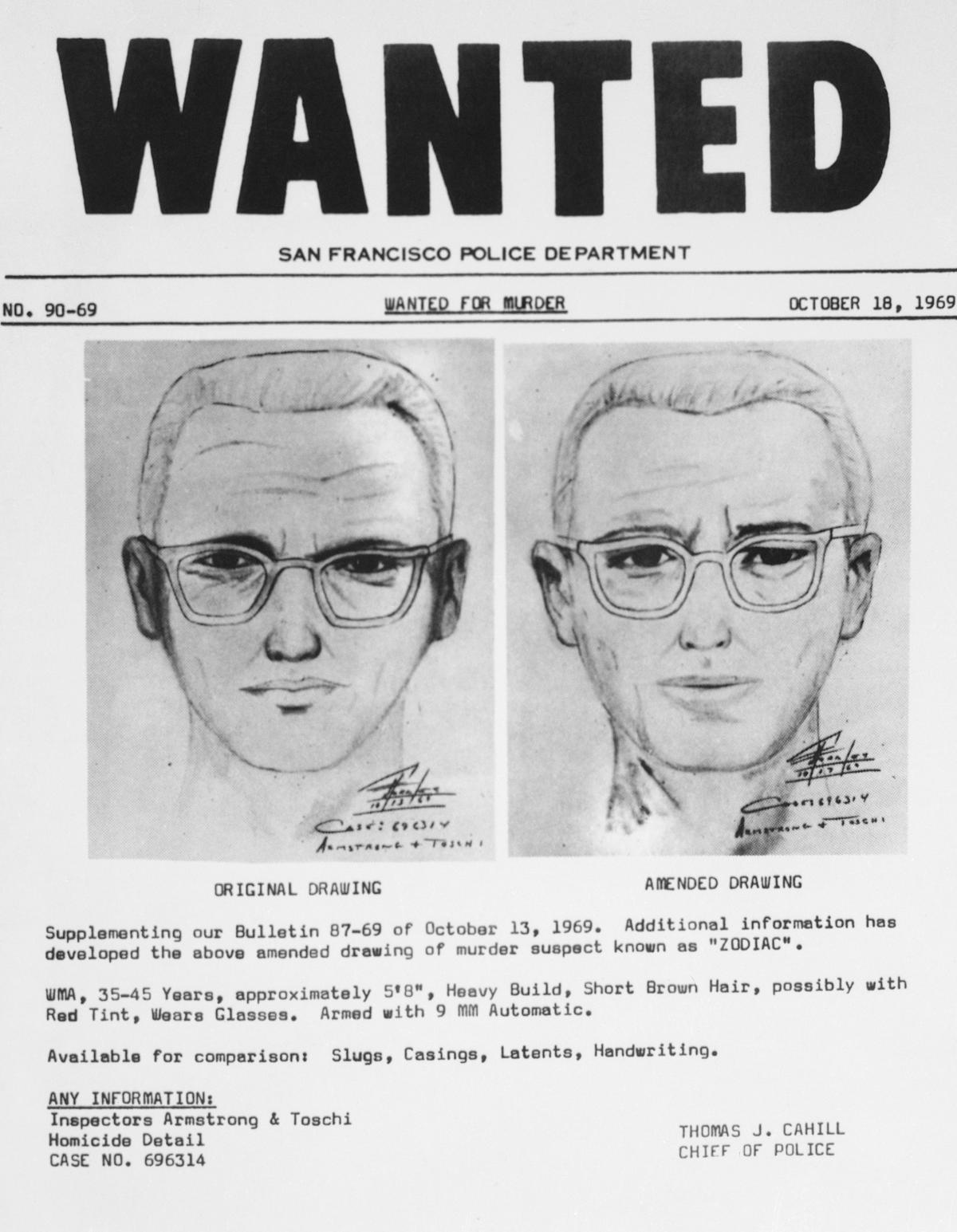
San Francisco Police Department homicide inspectors Dave Toschi and Bill Armstrong led the Stine investigation.
A key witness, a teenager who saw the killer near the Stine crime scene, provided a description.
The suspect was not apprehended.
The source does not state the content of the teenager's description.
The source does not state why the suspect was not apprehended.
That would require evidence.
Then the killer mailed a piece of the Stine victim's bloody shirt as proof of authenticity.
A torn scrap of fabric, sent to a newspaper.
Proof of a boast.
Proof that the man who wrote the letters had been there.
It was a case without a face.
It was a case with a signature.
It was a case splitting across three counties, three police forces, three sets of files.
The Vallejo detective had his shootings.
The Napa detective had his stabbing.
The San Francisco inspectors had their shooting.
The letters were the only thread that tied them together.
A bloody shirt scrap was the only physical proof.
And still, no arrest.
THE CIPHERS AND THE SUSPECT
The second cipher arrived in 1970, and it stayed unsolved for fifty years.
In December 2020, three amateur codebreakers cracked it: David Oranchak, Sam Blake, and Jarl Van Eycke.
They worked from home, not from a police lab.
The solution generated renewed public interest.
It did not identify the killer.
Arthur Leigh Allen was a Vallejo schoolteacher who drew the investigators' attention in 1971.
He was investigated. He was searched. He was never charged.
A former acquaintance publicly named Allen as the Zodiac.
The accusation followed him for years.
In 2002, after Allen's death, DNA testing cleared him.
The crime-scene evidence did not match.
Inspector Toschi received anonymous letters during the investigation.
They were later determined to be hoaxes.
The source does not state who sent those hoax letters.
It does not state whether they were ever linked to the killer.
What they did was complicate the investigation.
No physical evidence has ever conclusively identified the killer.
A solved cipher does not name a face.
A named suspect does not survive a DNA test.
A hoax letter does not point anywhere real.
That would require evidence.
The case produced no trial, no conviction, no formal charges.
Decades of work, and the file still ends the same way.
The killer remains a name in the letters, not in the record.
AND THE STORY STILL ISN'T OVER
There was no trial.
No suspect was ever charged, indicted, or convicted in connection with the Zodiac killings.
The file stays open in multiple jurisdictions, and each reopening raises the same question again.
The San Francisco Police Department re-opened the case in 2007.
They re-opened it again in 2018.
In 2020, a team of amateur codebreakers solved the second cipher, the one mailed in 1970.
The solution generated renewed public interest.
It did not identify the killer.
In 2021, a team of cold-case investigators claimed to have identified the killer as Gary Francis Poste, a deceased Arizona man.
Law enforcement agencies publicly rejected the claim.
No charges were filed.
The source does not state whether the Poste claim was based on any physical evidence or was purely circumstantial.
That would require evidence.
Each new claim brings the same pattern: a name, a headline, a denial.
The case remains officially open.
The letters remain the only unifying thread, and the killer remains a name in those letters, not in the record.
The bloody shirt scrap proved one boast.
The ciphers proved another.
What they never proved was a name.
The case produced no trial, no conviction, no formal charges.
Decades of work, and the file still ends the same way.
The killer remains a name in the letters, not in the record.
Advertisement
You may also like
The blood on his pajama sleeve that contradicted Jeffrey MacDonald's intruder story
The pajama sleeve was examined under a microscope, and the blood on it held a pattern. The pattern was a transfer, a smear of…
The defense’s claim that McVeigh was a scapegoat — and the witness who testified he built the bomb
The blast at the Alfred P. Murrah Federal Building occurred at 9:02 a.m. on April 19, 1995. It killed 168 people and injured more…
One palm print from the Zodiac's Lake Berryessa attack that no lab could ever match
A palm print and a partial fingerprint were left at the Lake Berryessa scene on September 27, 1969. They are part of the official…
Eleven Branch Davidians on trial: the defense claim of self-defense against a government raid
The warrant was for Mount Carmel Center, a ranch near Waco, Texas, and for the arrest of David Koresh. It was February 28, 1993,…
The truck painter who picked up victims on Pacific Highway South — and the DNA that ended 20 years of silence
He painted trucks for a living, the same job for decades. He lived in Auburn, a Seattle suburb, and went to church. He was…
The fishing trip Scott Peterson said he took — and the evidence that says otherwise
He told investigators he spent the morning of December 24, 2002, fishing alone at the Berkeley Marina. That was the claim. It became the…