The bushy-haired intruder Sam Sheppard said knocked him out before his wife was found dead
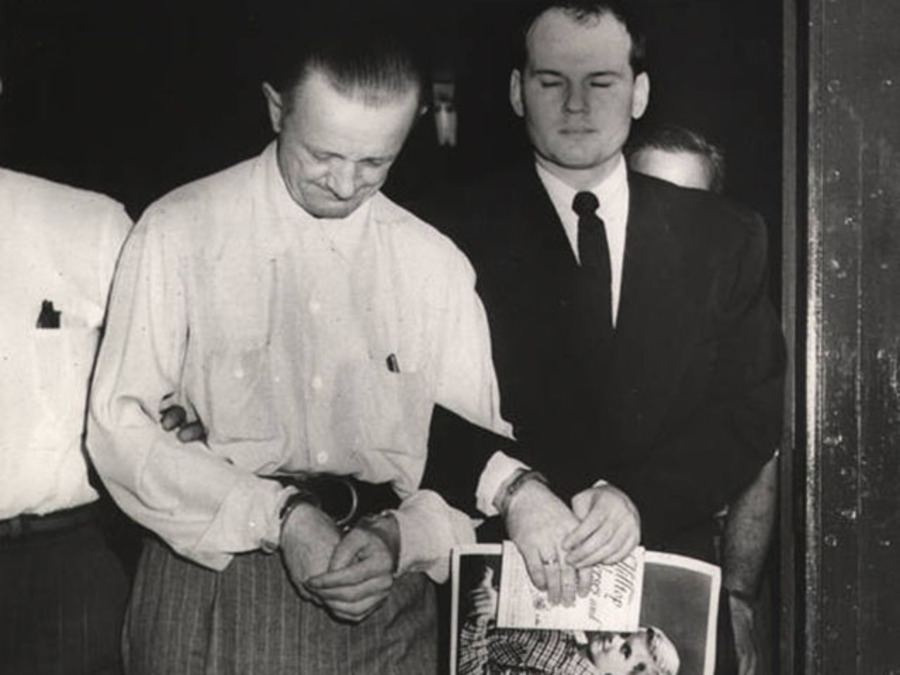
He told police he was asleep on the downstairs couch.
His wife’s screams woke him, he said, and he fought a "bushy-haired" intruder who knocked him unconscious.
That was the claim Sam Sheppard made on July 4, 1954, in Bay Village, Ohio.
Upstairs, in the bedroom, his wife was dead.
Marilyn Reese Sheppard, 31 and pregnant, had been bludgeoned about the head with a heavy object.
The crime scene showed signs of a violent struggle.
The couple’s 7-year-old son was asleep in another room.
He was not harmed.
No weapon was ever recovered.
No intruder was ever identified.
No intruder was ever found.
The record establishes the claim was made.
The record does not establish the intruder existed.
It is only Sam Sheppard’s account of him.
The bushy-haired man lives in that single sentence, repeated in headlines and retold for decades.
He is the phantom at the center of everything.
What did the police find when they arrived?
What did the evidence show?
What happened in that upstairs bedroom before the screams?
That would require evidence.
The record holds the scream, the struggle, the body.
It holds the story of a man who said he was knocked out.
It does not hold the man who did the knocking.
THE ACCUSED
Sam Sheppard was a well-known osteopathic physician in Bay Village, Ohio.
He was prominent, respected, and familiar to the community that would soon turn on him.
His wife, Marilyn Reese Sheppard, was the victim.
His brother, Richard Sheppard, also a physician, arrived at the scene and examined her.
The couple's 7-year-old son was in the house that night.
He was asleep in another room.
He was unharmed.
The case drew intense national media attention from the first morning.
The press covered the investigation and the trial as a spectacle.
The lead investigator was the Cuyahoga County coroner.
He concluded that Marilyn was killed with a blunt instrument, possibly a surgical tool.
He concluded that the killer had not been an intruder.
That conclusion is a theory, not a proven fact.
The murder weapon was never identified.
No weapon was ever recovered.
The coroner's theory pointed to Sam Sheppard as the only plausible suspect.
The respected doctor became the sole suspect in his wife's murder.
How does a man go from healer to accused in a single night?
How does a brother examine the body and then watch suspicion fall on his own family?
How does a physician's own surgical tools become a possibility in the record?
That last question would require evidence.
The record does not provide it.
THE CIRCUMSTANTIAL CASE
The prosecution’s case rested on what was not there.
No clear sign of forced entry, prosecutors said.
Sam’s story of a bushy-haired intruder was inconsistent, they claimed.
And Sam had reportedly been unfaithful to his wife.
These were claims, not established facts.
The record does not show whether the door was locked or the story unsteady.
It shows only what the prosecution argued.
The defense answered with a different absence.
The investigation was sloppy, they said.
The crime scene had been contaminated by family members and police before evidence was properly collected.
Sam was indicted for first-degree murder in August 1954.
The trial opened in October 1954 before a judge.
The prosecution presented its circumstantial case.
The defense argued the investigation was flawed and that an intruder had committed the crime.
No weapon was ever recovered.
No direct evidence placed Sam at the killing.
The jury deliberated.
They found him guilty of second-degree murder.
He was sentenced to life in prison.
A case built on circumstance had held.
Not because the intruder was disproven.
But because the story did not persuade.
What would have persuaded?
A witness. A weapon. A footprint that matched.
That would require evidence.
The record does not provide it.
THE CARNIVAL ATMOSPHERE
The newspapers printed the story before the jury heard it.
They printed editorials that presumed Sam Sheppard was guilty.
They printed the details of his marriage, his affairs, his character.
The trial opened in that atmosphere.
The jury convicted him of second-degree murder.
The conviction was upheld on appeal in Ohio courts.
It was upheld, and Sheppard went to prison.
In 1964, F. Lee Bailey took up the case.
Bailey argued that the pretrial publicity had poisoned the proceedings.
He argued that the trial judge had failed to control the courtroom.
He argued that Sheppard had been denied a fair trial.
In 1966, the U.S. Supreme Court agreed.
The Court overturned the conviction.
The Court ruled that the trial had been conducted in a "carnival atmosphere."
That phrase is the Court's ruling, not a description of what happened in the courtroom.
It is a legal finding about how the trial was conducted.
Sheppard was retried in 1966.
His defense team, led by Bailey, presented a more robust case.
The jury acquitted him.
Not because the bushy-haired intruder was found.
But because the state's case did not hold up the second time.
AND THE STORY STILL ISN'T OVER
The acquittal did not give him back his life.
He struggled with alcoholism and drug addiction, and his medical career never recovered.
He died in 1970 at the age of 46.
The case did not close with his death.
In the 1990s, DNA testing was conducted on evidence from the crime scene.
The results were inconclusive.
They did not implicate Sheppard, as the record states.
But they also did not establish who killed Marilyn Sheppard.
That remains open.
In 2002, the Sheppard family filed a wrongful imprisonment lawsuit against the state of Ohio.
The Ohio Supreme Court ruled that the state was not liable.
The family sought an answer.
The court gave them a ruling.
Not an answer.
The bushy-haired intruder was never found.
No one else was ever charged.
The murder weapon was never recovered.
Books were written.
Documentaries were made.
A television series retold the story.
It remains one of the most famous American criminal cases of the 20th century.
The fame outlived the man.
The question outlived the fame.
What happened in that upstairs bedroom on July 4, 1954?
That would require evidence the record does not provide.
Sam Sheppard was acquitted.
He was also destroyed.
The case is closed in the courts.
It is not closed anywhere else.
Advertisement
You may also like
The pajama top fibers that tied a Green Beret doctor to a murder scene he blamed on hippies
The pajama top was never found. It was never recovered from the house, never turned up in the woods, never produced by anyone who…
The cell phone records that put Adnan Syed near Leakin Park — and the alibi witness never called
A classmate later came forward with a name and a date: Asia McClain said she had seen Adnan Syed in the school library around…

The repeat offender with a palm print on a bedpost after Polly Klaas vanished
She was twelve years old, asleep at a slumber party in her mother's home in Petaluma, California. The night was October 1, 1993. Two…
The confession to a psychologist that broke the Menendez brothers' alibi
The 911 call came in at 11:47 p.m. from the mansion on North Elm Drive, and Lyle Menendez was sobbing into the phone. "My…
The drifter who turned a Miami morning into a fashion icon's last walk
The man who walked up the steps of Casa Casuarina that morning had, for years, been inventing himself. Andrew Cunanan was 27 years old,…
The Army vet and the teen who met in Antigua — what made them a sniper team
He was forty-one, an Army veteran with firearms training from the Gulf War. She was seventeen, a teenager from Jamaica. They met in Antigua.…