The confession that didn't match: 27 murders, but the trial centered on one victim
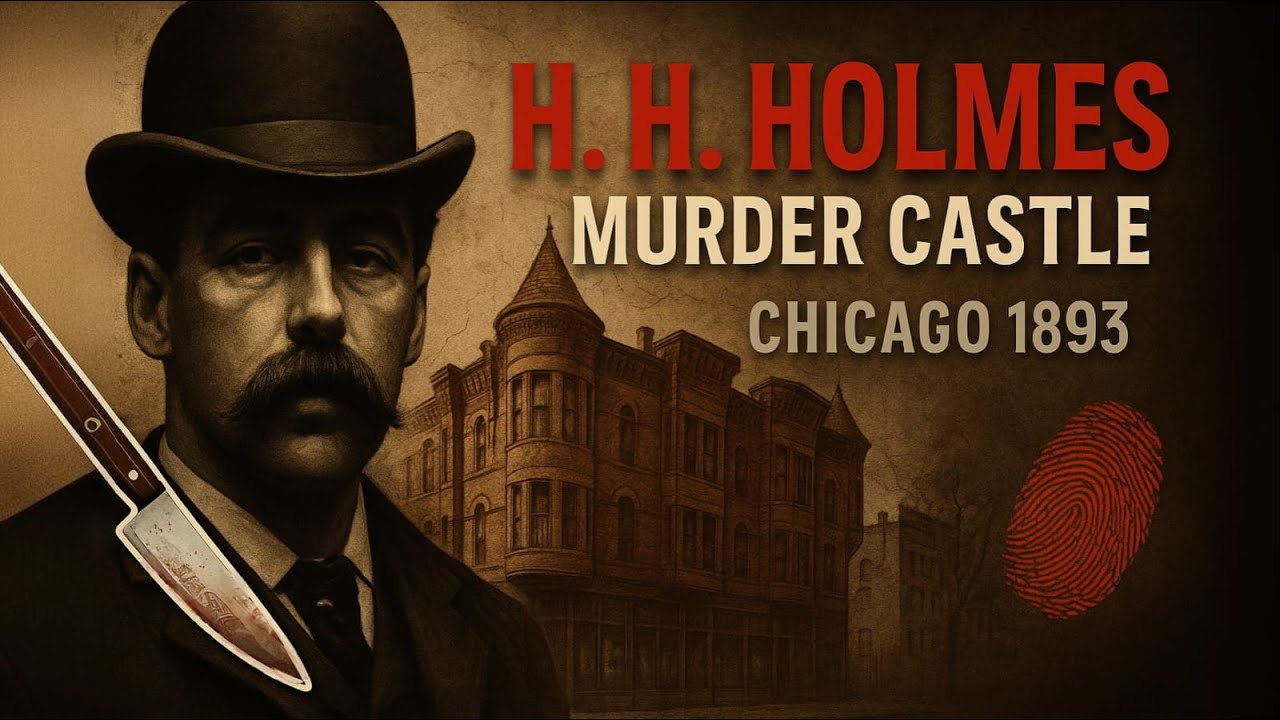
He was arrested in Boston in 1894, on an outstanding warrant for fraud tied to a St. Louis real estate scheme.
In custody, he confessed to killing his business associate.
He said the death had been accidental.
The confession was inconsistent.
It was self-serving.
He changed his story frequently.
Then he confessed to more.
Twenty-seven murders, he said.
Some contemporary accounts suggested as many as two hundred victims.
The exact number was never established.
His confession to twenty-seven was never independently verified.
Why would a man confess to twenty-seven murders?
Why would a trial that followed center on just one?
Why would the state bother with a single death when he had already admitted to so many more?
That would require evidence.
That would require a death that could be proven in court.
The trial that followed centered not on the twenty-seven.
It centered on the one.
The business associate.
The death he had already confessed to, calling it an accident.
The record would rest on that single victim, not on the confessed numbers.
He confessed to the many.
He would be tried for the one.
THE BUILDING
He built it under his own name: Herman Webster Mudgett, though he called himself H.H. Holmes.
Three stories rose in Chicago's Englewood neighborhood in the late 1880s, a structure he named the "World's Fair Hotel."
The address was 63rd and Wallace Streets.
It was finished around 1892, just in time for the World's Columbian Exposition of 1893.
Inside was a labyrinth.
Rooms connected to rooms that connected to nowhere.
Secret passages ran behind the walls.
Trapdoors opened in the floors.
The basement held vats of acid and quicklime.
During the Fair, and after it, people entered the building.
Some of them were never seen again.
That is the record: the building existed, the building was strange, and people disappeared.
When investigators searched the building in July 1895, they found human bones.
They found teeth.
They found remnants of clothing.
The press gave the building its name: the "Murder Castle."
It is a name that suggests a scale the record does not support.
The full scope of crimes committed inside was never definitively established.
The building was not fully excavated.
How many people died there?
That would require evidence the investigation did not produce.
What was found was enough for dread, but not enough for a number.
The building stood in a city street, among neighbors.
It was there for years.
It was a hotel during a world's fair, and people went in.
The dread is in the ordinary address.
The scale is in the silence after the names stopped being counted.
THE TRAIL
The lead detective was assigned to trace Holmes's movements after Pitezel's death.
He traveled to Indianapolis.
He traveled to Cincinnati.
He traveled to Toronto.
In Toronto, the detective discovered the bodies of two of the Pitezel children buried in a rented house.
A third child's body was later found in Indianapolis.
The case was no longer a single murder.
It was now a multiple-murder investigation.
Holmes had taken custody of three of Pitezel's children.
Two of them he subsequently murdered.
The detective's journey mapped a trail of bodies, each stop adding a name to a list that had started with one man.
The exact circumstances of the children's deaths are not detailed in the record.
The timeline is not established.
The manner is not established.
The record holds the discovery, not the sequence.
The detective found the children.
The detective found them because he followed Holmes's movements after Pitezel's death.
He followed the trail through Indianapolis, through Cincinnati, through Toronto.
He followed it to a rented house.
He followed it to a grave.
He followed it to another grave.
The horror was in the ordinariness of the addresses.
The dread was in the silence after the third body was found.
The case had grown beyond one victim, but the trial would not.
THE TRIAL
The trial was held in Philadelphia.
It was for the murder of one man, not the Chicago killings.
Holmes was charged with the death of his business associate, the man at the center of the insurance fraud scheme.
The trial began in October 1895.
The prosecution presented evidence of the insurance fraud scheme.
They presented evidence of the circumstances of the man's death.
The defense argued the death was an accident.
The defense said the man had died during a botched scheme.
The specific evidence presented at trial is not detailed in the source.
The defense was led by a prominent Philadelphia attorney.
The jury deliberated briefly.
It returned a verdict of guilty of first-degree murder.
The judge sentenced Holmes to death.
Holmes appealed.
The conviction was upheld.
The trial centered on one victim.
The confession had named 27.
The evidence in court did not reach that far.
What was examined was one death.
What was argued was one scheme.
What was decided was one life.
The verdict was for the death of Benjamin Pitezel.
Not for the bones in the Chicago basement.
Not for the children found in Toronto.
Not for the rooms and the trapdoors and the vats.
The case had grown beyond one victim, but the trial would not.
AND THE STORY STILL ISN'T OVER
He was hanged on May 7, 1896, at Moyamensing Prison in Philadelphia.
Reports vary on his final words.
Some accounts claim he asked for his coffin to be filled with cement to prevent grave robbers.
That detail, like so many others, cannot be verified.
The full number of his victims has never been established.
He confessed to 27 murders.
Popular accounts suggest more, some as many as 200.
The record does not support a precise number.
The exact count remains unestablished, and many popular accounts contain embellishments and inaccuracies.
The building known as the Murder Castle was damaged by a fire in 1895.
It was demolished in 1938.
The site is now a post office parking lot.
The victim's widow, who had lost her husband and three children to him, lived until 1911.
She testified at the trial.
She outlived him by fifteen years.
His own family—his wife and daughter—largely withdrew from public life.
They did not speak.
They did not explain.
They did not need to.
The case has been the subject of books, documentaries, and dramatizations.
It is often cited as one of America's first documented serial murder cases.
It is that.
It is also a case whose documented record rests on a single conviction.
Not on the 27 confessions.
Not on the estimates.
The trial centered on one victim.
The verdict named one victim.
The execution answered for one victim.
Everything else remains theory, rumor, and unresolved possibility.
That would require evidence.
The building is gone.
The bodies found in Toronto and Indianapolis were buried.
The widow lived quietly.
The family withdrew.
What remains is a parking lot, a hanging date, and a file that never closed.
Advertisement
You may also like
A pair of eyeglasses found by a body that would force two teens to confess
The glasses were horn-rimmed, found near the body of 14-year-old Robert "Bobby" Franks in a culvert close to the Indiana border. They were traced…
The 31-day gap between Caylee Anthony's last sighting and the 911 call that started it all
June 16, 2008, was the last day anyone saw Caylee Anthony alive. She was two years old. Her grandmother, Cindy Anthony, called 911 on…
The 90-second cell phone video that shattered Alex Murdaugh's alibi
Paul Murdaugh’s phone recorded for ninety seconds at the dog kennels on June 7, 2021. The video was played at trial in Colleton County.…
The tie left on the plane that never yielded a fingerprint
The tie sat on the seat of a Northwest Orient Airlines Boeing 727 on November 24, 1971. A man calling himself Dan Cooper had…
The confession that shifted — and the voices a jury refused to hear
He walked into a local bar on November 13, 1974, and told the patrons his family had been shot. Police found six bodies in…
Inside the 1980 courtroom where 33 murder counts met a confession
On December 11, 1978, a 15-year-old boy told his mother he was going to meet a contractor about a job. He never came home.…