Inside the 1980 courtroom where 33 murder counts met a confession
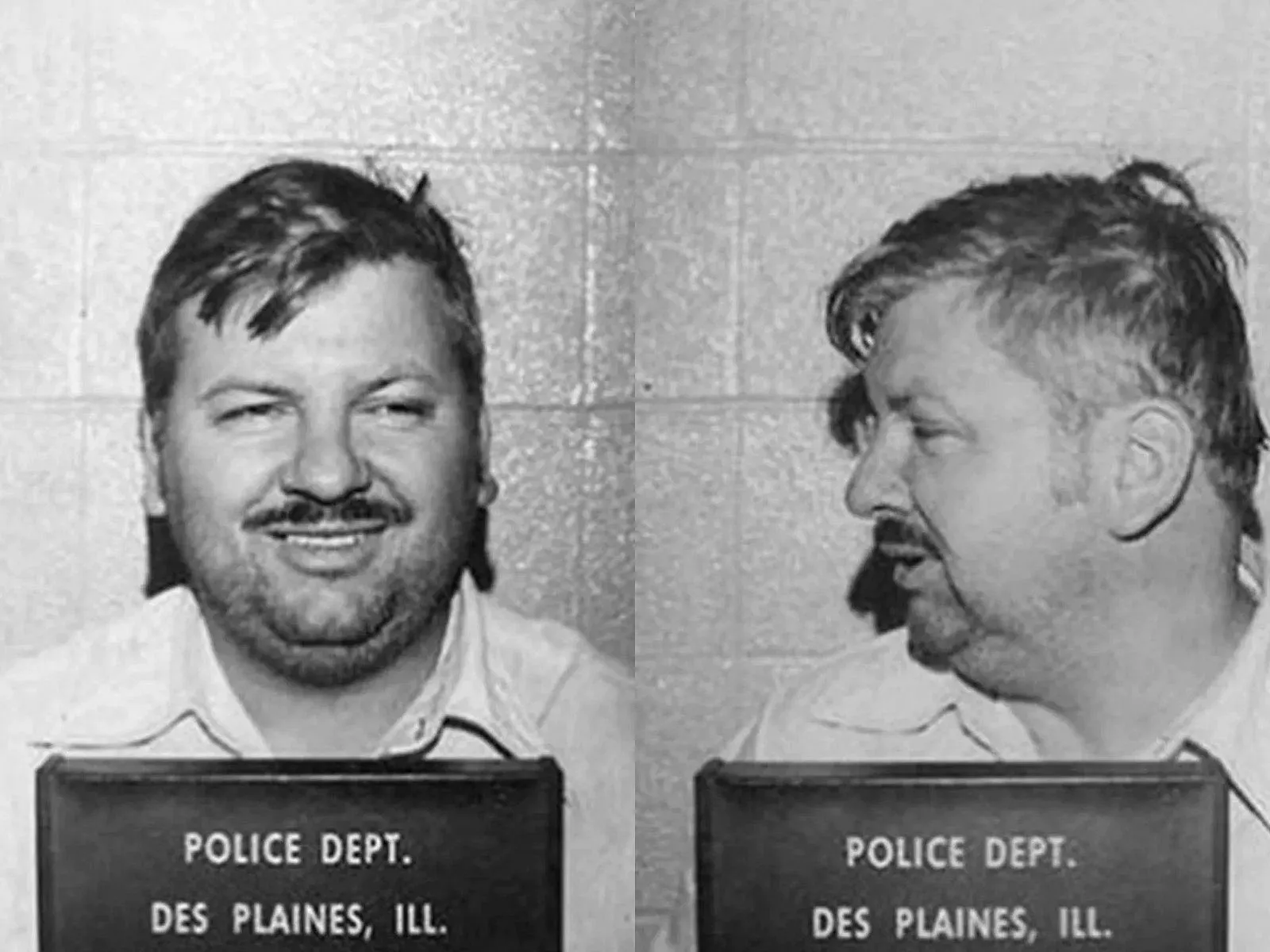
On December 11, 1978, a 15-year-old boy told his mother he was going to meet a contractor about a job.
He never came home.
A coworker later identified the contractor as John Wayne Gacy, a building contractor and part-time clown performer in suburban Chicago.
The boy's disappearance triggered the investigation that would lead to a crawl space beneath Gacy's home at 8213 West Summerdale Avenue.
The record shows police obtained a search warrant after tracing the boy's last contact to Gacy.
The crawl space would yield human remains.
What did police find next?
What did the warrant authorize?
What was buried in the dark beneath the house?
The record answers the first two questions plainly: bones, remains, and the beginning of a case that would reach 33 murder counts.
The third question would take months of excavation and a trial to answer.
A theory circulating online — that Gacy was blackmailed — is not a fact established by the record.
It is a claim he made later, an assertion from the defendant.
Not because the courts hid it.
But because the confession and the counts are court record, and the blackmail claim is not.
The errand was ordinary.
The contractor was a neighbor.
The boy told his mother he would be back.
THE SEARCH WARRANT
The warrant was for a house.
Police arrived at 8213 West Summerdale Avenue on December 13, 1978.
The crawl space gave off a strong odor.
A cadaver dog alerted.
Excavation revealed human bones and remains.
Gacy was arrested on December 21, 1978.
After the arrest, he confessed to 33 murders.
He gave details of each killing and each disposal.
The medical examiner oversaw the recovery of the remains.
He later testified about identifying victims through dental records.
The vehicle was a black Oldsmobile.
It was used to transport victims.
Most victims were strangled with a rope or a tourniquet-like device.
The record states at least 33 victims.
It does not establish an exact count beyond that.
The confession was detailed.
It was methodical.
The dog had found what the odor promised.
The bones were under the house.
The house was in a suburb.
The man who lived there was a contractor.
He was also a clown.
The confession came fast.
It came with specifics.
It came with names.
The medical examiner matched the remains to the records.

The black Oldsmobile sat in the driveway.
The rope was not recovered.
The crawl space held the weight of the evidence.
The dog had done its work.
The bones had done theirs.
The confession did the rest.
THE COURTROOM
The trial opened in February 1980 before a Cook County Circuit Court judge.
Gacy sat charged with 33 counts of first-degree murder.
The prosecution called victims' families, forensic experts, and Gacy's own confession.
The confession was detailed. It matched the bones. It named the crawl space.
The defense did not deny the killings. The defense argued insanity.
Psychiatric testimony described a personality disorder.
That is where the record stops. The specific diagnoses are not detailed beyond that term.
The prosecution answered with a simpler frame: Gacy knew right from wrong.
He had planned. He had buried. He had confessed.
Several mothers took the stand.
One was Elizabeth Piest, whose 15-year-old son had gone to meet a contractor and never come home.
She testified about the errand. She testified about the wait.
The courtroom held the weight of what the crawl space had yielded.
The judge presided over each witness, each exhibit, each objection.
The jury had to weigh a confession against a personality disorder.
They had to decide whether a man who strangled 33 times could not tell right from wrong.
That would require believing the disorder erased the knowledge.
The prosecution said the planning proved the knowledge.
The burial patterns proved it. The confession proved it.
The mothers proved it.
The trial ran through the winter and into March.
On March 12, 1980, the jury returned.
THE VERDICT AND THE RECANTATION
The jury was out, and then the jury was back.
On March 12, 1980, the jury found Gacy guilty of all 33 counts of first-degree murder.
The courtroom had heard the prosecution lay out the methodical burial patterns in the crawl space.
The courtroom had heard the confession, played and read into the record.
The courtroom had heard the defense argue insanity, with psychiatric testimony about a personality disorder.
The jury rejected the insanity argument.
The verdict carried the weight of premeditation, not illness.
Gacy was sentenced to death.
The sentence was pronounced, and then the appeals began.
They were unsuccessful.
The appeals failed, one after another, over the years that followed.
But before the appeals, there was the recantation.
Gacy later attempted to recant his confession.
He claimed he had been blackmailed.
The blackmail claim is not supported by any evidence in the record.
It is an unproven assertion from the defendant.
The confession stands in the court record.
The 33 counts stand with it.
Was the recantation credible?
Did it change anything?
Could it have?
That would require evidence.
The record does not provide it.
The jury had heard the confession as evidence of planning.
The jury had heard the burial patterns as evidence of intent.
They found him guilty on every count.
The sentence was death.
The recantation came later, and it came alone.
It remains an assertion, nothing more.
AND THE STORY STILL ISN'T OVER
The execution was carried out on May 10, 1994, at Stateville Correctional Center in Illinois.
Lethal injection, the sentence carried out fourteen years after the verdict.
The crawl space beneath the home was demolished in 1979, before the trial even ended.
That part of the ground is gone.
What remains is the record, and the record has gaps.
Several victims were never identified at the time of the trial.
In 2011, Cook County authorities exhumed remains to attempt DNA identification.
Some of those victims were later identified through genetic genealogy.
The exact number of unidentified victims is not specified in the record.
The status of ongoing identifications is not detailed.
That is what the record does not establish.
The case remains a landmark in serial murder investigation and victim identification.
It is cited for how a crawl space was searched, how dental records were matched, how a confession was weighed.
Elizabeth Piest and other victims' families have advocated for missing persons legislation.
She testified at the trial about her son.
The home's site is now a vacant lot.
Not a memorial, not a marker — a vacant lot.
The case is closed.
The identification of victims continues.
It is a closed case with open questions.
It is a landmark with unnamed names.
The confession stands in the record.
The blackmail claim stands nowhere.
Gacy is gone.
The ground where 26 bodies were buried is gone.
The mothers who testified are not all gone, but some are.
What remains is the work of identification.
What remains is the law named for a missing boy.
The lot is empty.
The story is not.
Advertisement
You may also like

The truck painter who led detectives to 49 Green River victims — and the DNA that closed in on him
He painted trucks for a living. Gary Leon Ridgway lived in Auburn, Washington, a suburb south of Seattle. He was married multiple times. He…
The 1939 tip that put a suspect behind bars — but the murder charge never came
1939. A tip. A tip put a former bartender and carnival worker behind bars in Cleveland, Ohio. He was the most prominent suspect in…
The Zodiac cipher that cracked open a killer's boast — but not his name
In August 1969, a cipher arrived at the offices of the *San Francisco Chronicle*. It was not the first taunting letter, and it would…

The smiley-face letter that made a sister call police on her own brother
The letter arrived at the Oregonian with a claim of responsibility for a murder and a mocking of police. It was signed with a…
The 2005 massage-table complaint that opened Epstein's case, and the detective who kept digging
A mother called Palm Beach police in 2005. She said her 14-year-old stepdaughter had been recruited by an older girl to give a man…
The 13-day trial that hinged on a dress burned in a stove — and a timeline no one could explain
The dress was burned in a stove on the third day after the bodies were found at 92 Second Street. The prosecution called it…