The truck painter who led detectives to 49 Green River victims — and the DNA that closed in on him
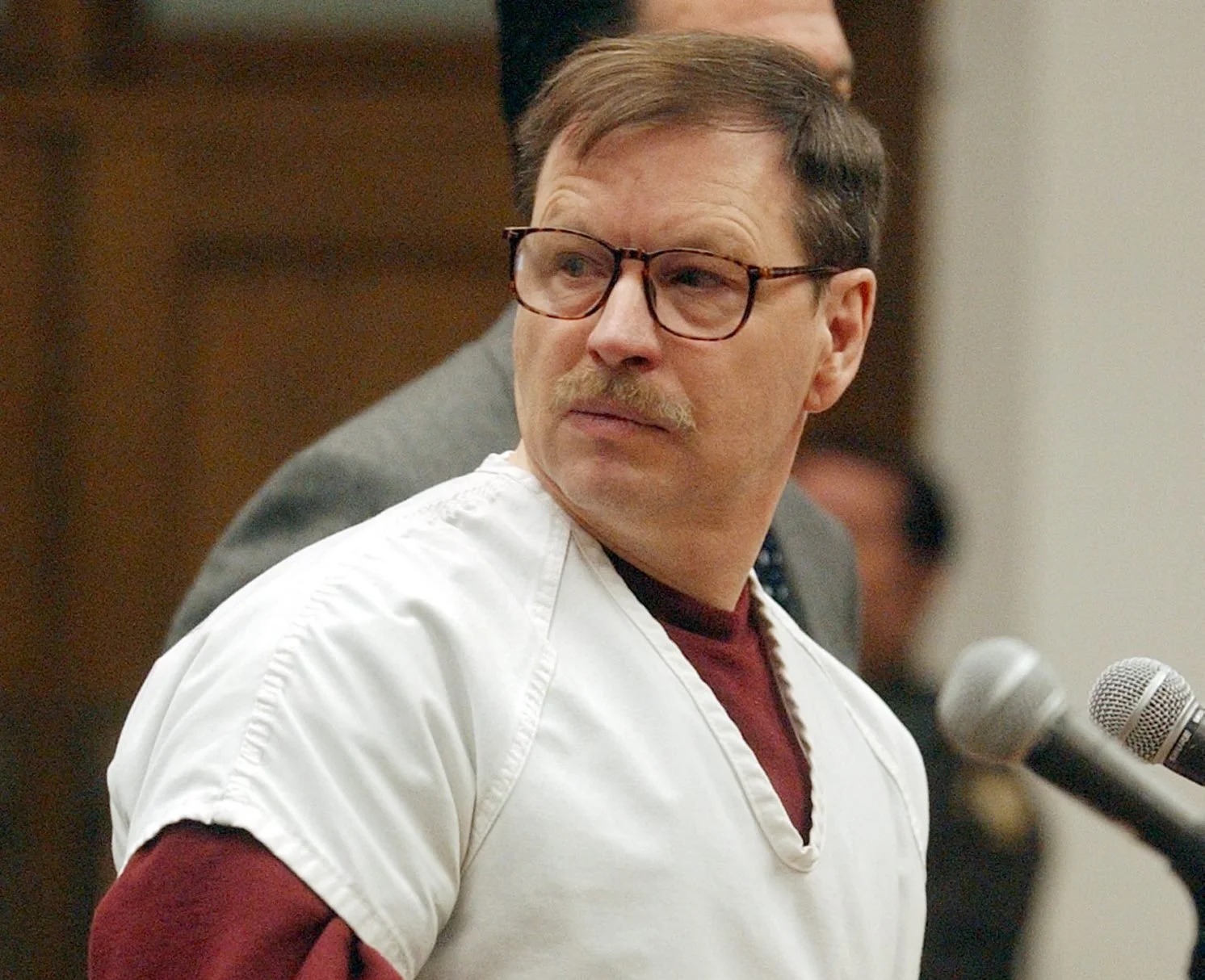
He painted trucks for a living.
Gary Leon Ridgway lived in Auburn, Washington, a suburb south of Seattle.
He was married multiple times. He had a son.
For nearly two decades, the Green River murders went unsolved.
Then, in 2001, a DNA match linked Ridgway to the murders of four victims.
The evidence against him included paint chips and fibers from his truck and his home.
The same truck he used for work. The same home where he raised a family.
What kind of man paints trucks by day and, according to investigators, kills women by night?
The record does not establish a motive.
It does not establish a psychological profile.
It establishes only the DNA match, the paint chips, the fibers.
He was arrested in November 2001.
A working man, a father, a husband.
The neighbors must have wondered.
The co-workers must have wondered.
His own family must have wondered.
He was a truck painter from Auburn.
That is what the case summary says.
That is what the record shows.
The rest is theory.
The rest is what the evidence does not say.
THE FIRST BODIES
The first bodies were discovered in 1982 along the banks of the Green River.
Between 1982 and 1998, a series of women were murdered in and around the Seattle–Tacoma area of Washington State.
Many of them were sex workers, runaways, and drug users.
The victims were typically strangled.
Their bodies were dumped in remote wooded areas, riverbanks, and ditches.
Dozens were found over the following years.
The case became known as the Green River murders.
The exact number of victims was not known at the time.
The official count was later set at 49.
That number came after a suspect was identified through DNA evidence in 2001.
In 1982, the record shows only the river and the bodies.
Investigators did not yet know how many women were missing.
They did not yet know how many were dead.
They did not yet know if one person was responsible.
That would require evidence.
The scale of the killings was still taking shape.
The horror was real.
The count was not.
THE TASK FORCE YEARS
The year was 1982.
The first bodies were pulled from the Green River.
The investigation began, led by detective Robert Keppel of the King County Sheriff’s Office.
Keppel had worked the Ted Bundy case before this one.
He knew what the scale of a serial killer’s work looked like.
A task force was formed.
At its peak, it involved dozens of investigators.
The exact number is not specified in the record.
Neither is the exact duration of the task force.
What is documented is the weight.
Early difficulties piled up.
Forensic technology was lacking.
DNA testing as it exists today did not exist then.
The victims lived transient lives.
Many were sex workers, runaways, drug users.
They moved. They disappeared. They were not always missed quickly.
The riverbank gave up bodies slowly.
Each one had to be identified.
Each identification took time the task force did not have.
In the 1980s, a suspect named Melvin Foster was cleared.
He was ruled out.
The leads went cold.
Not because no one was looking.
But because the looking was blind.
Frustration built.
Dozens of investigators worked.
They had files, they had maps, they had theories.
They did not have a name.
The river kept its count.
The task force kept its watch.
Years passed.
The case seemed to go nowhere.
That would require evidence.
The evidence was still waiting in the technology of the next decade.
THE DNA MATCH
DNA technology changed in the 1990s.
The old tests needed more material than the evidence could give.
New methods could read what was left in a single fiber, a single flake of paint.
In 2001, a DNA match linked Gary Ridgway to the murders of four victims.
That is the documented fact.
The specific DNA evidence is not detailed in the record.
The exact method of the match is not detailed either.
What is known is the arrest.
Ridgway was arrested in November 2001.
The evidence gathered around him was physical and personal.
Paint chips from his truck.
Fibers from his truck and his home.
Witness statements from his ex-wife.
She had spoken about his behavior.
The case that had gone nowhere for nearly two decades suddenly had a direction.
Not because of a confession.
Because of a laboratory result.
The relief came with horror.
The man who painted trucks for a living had been there all along.
The technology just had to catch up to him.
He was charged with 49 counts of aggravated first-degree murder.
That charge came later.
In November 2001, there was only the arrest.
And the match.
Four victims' murders, linked to one man by the science of the next decade.
The record shows the match.
The record does not show the precise swab, the exact strand, the particular sample.
That would require evidence.
The evidence was already in the truck.
AND THE STORY STILL ISN'T OVER
The DNA match closed the investigation.
It did not close the case.
In 2003, Ridgway was charged with 49 counts of aggravated first-degree murder.
He pleaded guilty to all 49 counts.
The plea agreement spared him the death penalty.
In exchange, he cooperated.
He led detectives to remains.
He provided details of his crimes.
The trial judge accepted the plea.
Ridgway was sentenced to 49 consecutive life sentences without parole.
The prosecution argued the deal brought closure to victims' families.
The defense negotiated it.
The sentence was final.
The story was not.
In 2011, Ridgway was charged with an additional murder.
The victim was Sandra Kay Gabbert.
The charge was later dropped.
The reason is not specified in the record.
That would require evidence.
The record does not provide it.
Ridgway remains incarcerated at the Washington State Penitentiary in Walla Walla.
He is serving 49 life sentences.
The investigation is considered closed.
All known victims have been identified.
But new charges can still surface.
A case can reopen.
A family can wait years.
A name can be added to the count.
Then removed.
The record holds the charge and the drop.
It does not hold the why.
That is the line.
The conviction is documented.
The closure is documented.
The rest remains open.
Not because the case is unresolved.
But because the impact lingers.
It is a landmark in forensic DNA investigation.
It is also a reminder.
The truck painter is in a cell.
The victims are in the ground.
The families are still here.
That is the part the record cannot close.
Advertisement
You may also like
The bite mark on Lisa Levy that tied Ted Bundy to the Chi Omega murders
She was on the ground below. On the body of the second victim, investigators found something the blunt instrument had not made: a bite…
The ransom money that led detectives to a carpenter's door — but what did the jury hear?
The gold certificate was a twenty-dollar bill. In September 1934, it surfaced at a gas station in New York City. The attendant, Walter Lyle,…
Manson jury deliberated nine days — one witness told all from the driver's seat
She drove to Cielo Drive. She drove away from it. Linda Kasabian drove the car to both crime scenes on the nights of August…
The alibi that hung on a 14-foot boat and one cold morning
The 14-foot aluminum boat sat low in the water at the Berkeley Marina. It was December 24, 2002, and the morning was cold. Scott…
The $10 million note and the call that cracked the D.C. sniper case
The phone rang, and the priest answered. Father Michael Smargiassi was a priest in Montgomery County. Police had asked him to relay a message.…
The math professor in a Montana cabin who mailed bombs for 17 years — what made him do it?
The cabin sat on a half-acre of scrub and pine outside Lincoln, Montana, population roughly one thousand. Inside, a former mathematics professor lived alone,…