The crabapple tree letters that still shadow a 1922 double murder,
The letters were not hidden.
They lay in the open, scattered near the bodies beneath the crabapple tree.
On the night of September 14, 1922, the bodies of Reverend Edward Wheeler Hall and Mrs. Eleanor Reinhardt Mills were found at a spot called "Lovers' Lane" in New Brunswick, New Jersey.
Mills's throat had been slashed.
Both had been shot.
And there, on the ground, were letters from Hall to Mills.
These are the physical objects that still draw attention.
Not the bullet wounds.
Not the slashed throat.
The letters.
They were the one tangible thing left at the scene, the proof of a secret written in the dead man's own hand.
The couple, both married to other people, had been having an affair.
Hall was an Episcopal minister.
Mills was a choir singer.
That was the story the letters told before anyone spoke a word.
The case became one of the most sensational murder mysteries of the 1920s.
But on that night, the letters were simply there.
Who killed them is not established at this point.
That would require evidence.
The letters remain.
THE AFFAIR AND THE COLD CASE
The Reverend Hall was an Episcopal minister.
Mrs. Mills sang in the choir.
Police looked at them first, not at whoever had fired the shots.
The affair became the story, and the story swallowed the crime scene.
The initial investigation was marred by confusion and alleged interference.
Some evidence may have been contaminated or overlooked.
The bodies lay under the crabapple tree, and the letters lay near them, and the case stalled.
It went cold.
It stayed cold for four years.
Then, in 1926, new evidence appeared.
Letters and a witness.
What the new evidence specifically was, beyond those letters and that witness, is not detailed in the record.
That is not established.
The arrests followed anyway.

Hall's widow was charged with murder.
Her two brothers were charged with murder.
The families of the dead were drawn into the public spectacle.
Mrs. Mills's husband, James Mills, watched the trial from the edges of the story.
The accused watched from the dock.
A promising investigation had stalled, and the affair had overshadowed the crime.
Frustration was the only honest response.
The letters remained the surest objects in the case, and they proved nothing about who held the gun.
THE 1926 ARRESTS AND THE TRIAL
Four years after the bodies were found, the widow and her two brothers were arrested.
They were charged with the murders of Hall and Mills.
The case against them rested largely on one witness.
She was a woman who claimed she had seen the killings from a distance.
The trial opened in November 1926.
The prosecution argued the three had conspired to kill the couple.
The defense answered that the investigation was flawed and the witness was unreliable.
The witness gave her testimony from a hospital bed.
She was reportedly ill, and her credibility was attacked from the first question.
The specific inconsistencies in her account are not detailed in the record.
Her name is not in the record either.
The jury heard the case for weeks.
They deliberated for several hours.
They returned verdicts of not guilty for all three.
The verdict felt decisive.
It also felt unsatisfying.
A single witness had carried the prosecution's case, and she had not held it.
No physical evidence tied the defendants to the crime scene.
The letters under the tree proved nothing about who held the gun.
The three walked free, and the case was closed.
No one else was ever charged.
The acquittals settled the legal question.
They did not settle the other one.
THE TWO STORIES OF THE SAME FACTS
The prosecution told one story.
They said the three defendants conspired to kill Hall and Mills, and they built that story on a single witness who claimed she saw them at the scene.
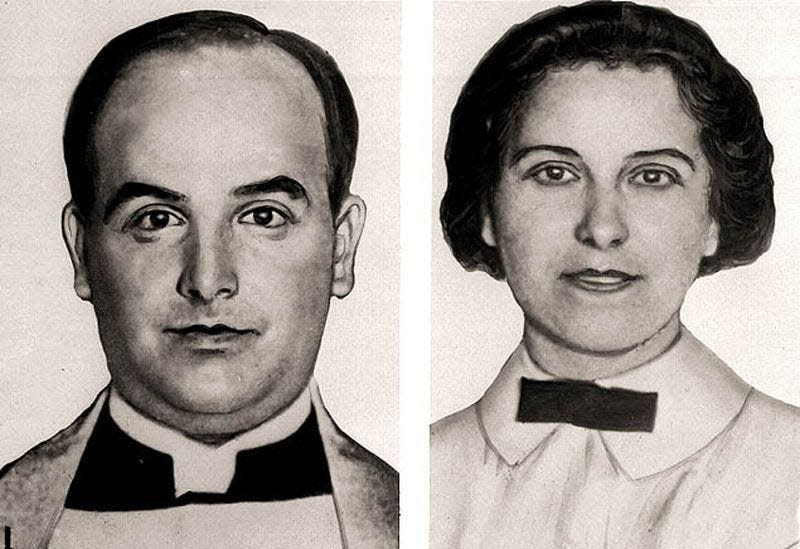
The defense told another.
They said the investigation was flawed, the witness was unreliable, and there was no physical evidence linking the defendants to the crime.
Both stories used the same facts.
The letters under the crabapple tree were real, documented objects.
The bodies were real.
The witness gave her testimony from a hospital bed, reportedly ill, and the defense tore at her credibility.
The prosecution's case was further weakened by a lack of physical evidence.
A .32-caliber revolver was reported as the likely murder weapon.
It was never recovered.
That weapon's existence is only "reported," not confirmed.
It is a detail in the record, not a fact in evidence.
Which interpretation is true is not established.
Not by the letters.
Not by the witness.
Not by the missing revolver.
The jury heard both stories and returned verdicts of not guilty for all three defendants.
The acquittals settled the legal question.
They did not settle the other one.
The acquittals were met with mixed reactions.
Some saw a family wrongly accused.
Some saw a case that never found its killer.
The record holds both possibilities open.
That would require evidence.
AND THE STORY STILL ISN'T OVER
The acquitted returned to New Brunswick, and the town let them be.
Frances Hall lived quietly until her death in 1942.
Her brothers died earlier, in 1935 and 1933.
The families of the victims and the accused have largely faded from public view.
No one else was ever charged.
The case has never been solved.
Not because the record closes it.
But because the record never opened it further.
Over the decades, theories have been proposed.
Theories about other individuals, other motives, other hands on the revolver.
None have been proven.
That would require evidence.
The .32-caliber revolver was never recovered.
The case remains one of the most famous unsolved murders in American history.
It is frequently cited in true-crime literature.
It appears in documentaries.
It is a historical mystery now, remembered primarily as a story.
The next concrete step is not a court date.
No new investigation is in the record.
No future legal action is in the record.
That would require evidence.
The letters scattered near the bodies still shadow the story.
They are documented evidence.
The identity of the killer is not.
Some see a case that found its suspects.
Some see a case that never found its killer.
The record holds both possibilities open.
The ache is quiet.
The case is closed.
It is not solved.
Advertisement
You may also like
The severed head found by two fishermen that changed an abduction case forever
The head surfaced in a drainage canal along the Florida Turnpike near Vero Beach, about 120 miles north of Hollywood. Two fishermen found it…
The 1987 witness sighting that didn't stop the Green River Killer
A witness reported seeing Gary Ridgway with a victim. The year was 1987. The report was made to police working the Green River Killer…
The taunting smiley-face letters that led to a serial killer's downfall
The letters arrived unsigned, except for one thing. A circle. Two dots. A curved line. A smiley face, drawn in pen at the bottom…
The empty frames left on display after thieves took Vermeer and Rembrandt
The empty frames still hang in the Isabella Stewart Gardner Museum in Boston. Where Vermeer's *The Concert* once hung, there is an empty rectangle…
The missing ladder rail that led detectives to a Bronx lumberyard — and then to Hauptmann's attic
The ladder was left behind on the night of March 1, 1932, a homemade thing of wood and nails, abandoned at the scene. It…
The phone call that could have caught the Zodiac — and the officer who let him walk
It was a phone call that could have ended it. After the July 4, 1969 attack at Blue Rock Springs Park, the killer called…