The informant's claim that broke the Boston Strangler case — and the confession it produced
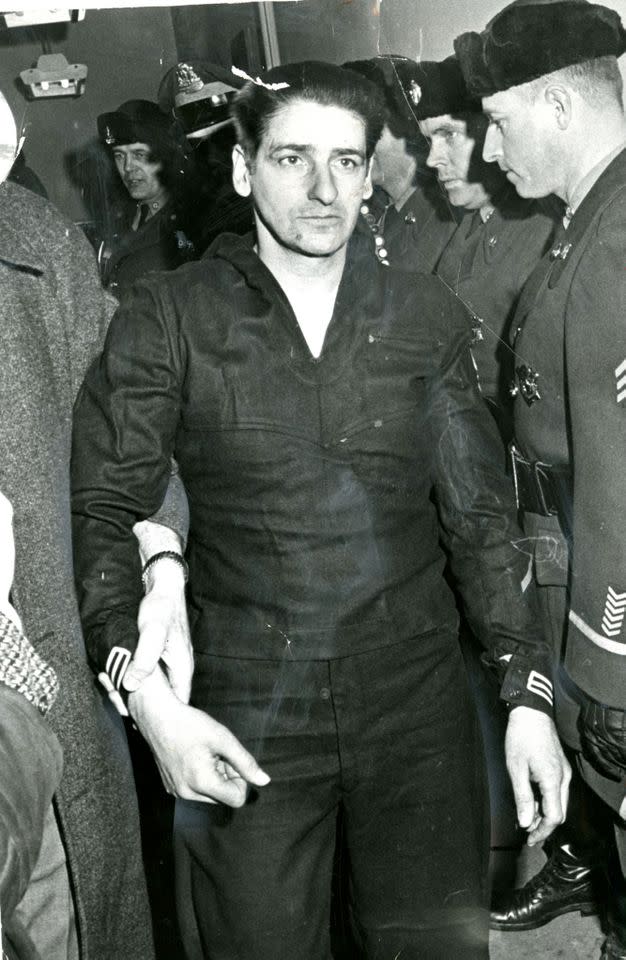
Thirteen single women, aged 19 to 85, were strangled between June 1962 and January 1964.
They were found in their own apartments, ligatures made from their own clothing or stockings around their necks.
The investigation began fragmented.
City police and state police ran separate tracks, and information did not move between them.
In 1964, Attorney General Edward W. Brooke consolidated the case under a single lead prosecutor.
That prosecutor leaned on one source.
A man named George Nassar, a suspect who was questioned but never charged, claimed that Albert DeSalvo had confessed to him.
That claim, not physical evidence, redirected the entire investigation.
It produced DeSalvo's detailed confession in 1965.
No forensic test tied DeSalvo to the crime scenes.
DNA testing was decades away, and the confession was never checked against the physical record.
Nassar's credibility was never established.
His motive was never established.
The claim itself remains unverified, a single man's word carrying the weight of thirteen deaths.
How did one informant's assertion outweigh the absence of evidence?
How did a confession, untested in any court, come to define the case?
How did an investigation built on jurisdiction failures come to rest on a story?
That would require evidence the record does not provide.
THE FRAGMENTED INVESTIGATION
The first widely attributed murder came in June 1962.
The final attributed murder came in January 1964.
Between those dates, thirteen single women were strangled in their own apartments.
The ligatures were made from their own clothing or stockings.
The exact number of victims is stated as thirteen, but individual case details beyond the first and last are not in the record.
City police and state police did not share information.
The investigation fragmented along jurisdictional lines.
A detective in one city did not know what a trooper in another had found.
The crimes terrorized the region.
Press coverage was intense, and public fear ran through every neighborhood.
The manhunt stalled.
It stalled not because the killer was careful.
It stalled because the system was broken.
The turning point came in 1964.
Attorney General Edward W. Brooke consolidated the investigation under a single lead prosecutor.
One office, one chain of command, one set of files.
That prosecutor relied heavily on a single informant.
The informant was a man named George Nassar, questioned but never charged.
Nassar claimed DeSalvo had confessed to him.
That claim produced a confession.
The confession was detailed.
It was never corroborated by physical evidence linking DeSalvo to the crime scenes.
DNA testing was decades away.
The confession was never tested against crime scene evidence.
The investigation was criticized for focusing on a narrow suspect pool.
Some later argued the confession was coerced or fabricated.
The record does not establish that.
It establishes only the claim, the confession, and the absence of independent proof.
THE CONFESSION
A man named George Nassar, a suspect who had been questioned and cleared, made a claim.
He said Albert DeSalvo had confessed to him.
That claim led the lead prosecutor to DeSalvo's door, and in 1965 DeSalvo gave a detailed confession.
The confession was detailed.
It was not corroborated by physical evidence linking DeSalvo to the crime scenes.
DNA testing was decades away.
The confession was never tested against crime scene evidence.
The investigation had been criticized for focusing on a narrow suspect pool.
The lead prosecutor relied heavily on this single informant's word.
The pressure on DeSalvo to confess was noted by some later observers.
Some later argued the confession was coerced or fabricated.
The record does not establish that.
It establishes only the claim, the confession, and the absence of independent proof.
The content of the confession itself is not detailed in the source material.
Whether it was truth or pressure remains disputed, not established.
The case was built on words alone.
It would never be tested in court.
THE TRIAL THAT NEVER CAME
The confession was never tested.
Albert DeSalvo was never tried for the Strangler murders.
No verdict was ever reached on those thirteen cases.
Instead, he stood trial in 1967 for a different set of crimes.
These were the robberies and sexual assaults committed in 1964, known as the "Green Man" crimes.
He was convicted and sentenced to life in prison.
His defense attorney was F. Lee Bailey.
The prosecution's case rested on the confession.
The defense argued it was unreliable.
What the defense specifically argued at trial is not in the record.
What the prosecution presented beyond the confession is not detailed either.
That would require evidence.
It is a conviction for lesser crimes.
It is also an open wound for thirteen families.
The case was built on words alone.
It would never be tested in court.
The Strangler cases sat untried.
The central figure was convicted of robberies.
He was convicted of assaults.
He was never convicted of murder.
The record holds the confession.
The record holds the conviction.
The record does not hold a trial for the stranglings.
That gap is not a mystery to be solved.
It is a fact of the file.
The man who confessed went to prison for other crimes.
The murders went nowhere.
Frustration is the correct response.
The law moved on.
The record did not.
AND THE STORY STILL ISN'T OVER
He was stabbed to death in prison in 1973.
That is where the confession ends.
In 2013, DNA evidence from the final victim’s crime scene was tested.
It matched DeSalvo.
That match provided posthumous confirmation of his involvement in that case.
Some disputed the match.
The other Strangler murders remain officially unsolved.
The case is not closed.
Not because a court said so.
Because no court ever did.
The confession was never tested against the crime scenes.
The conviction that sent him to prison was for robberies and sexual assaults, not murder.
The DNA match is disputed.
The record does not establish that the match resolves the other twelve deaths.
What the record establishes is narrower.
It establishes one match, one victim, one contested result.
The families of the victims have continued to seek closure.
They have not found it in the files.
They have not found it in the confession.
They have not found it in the DNA.
That would require evidence.
The informant’s claim was never corroborated by physical evidence.
The confession it produced was never tested in court.
The man who confessed was never tried for the murders.
He died by violence in prison.
The investigation was criticized for a narrow suspect pool.
It was criticized for the pressure on DeSalvo to confess.
Some later argued the confession was coerced or fabricated.
The debate continues.
The re-examination continues.
The case remains one of the most infamous unsolved serial murder investigations in American history.
The weight of it does not lift.
A confession, a conviction, a death.
Still no final answer.
Advertisement
You may also like
The FBI named the wrong man the night before the Tsarnaev brothers were caught
On April 18, 2013, the FBI released images of two suspects taken from Lord & Taylor surveillance footage. That same night, the FBI initially…
The love letters that vanished from police custody after the 1922 double killing
The crabapple tree stood in a lane called Lovers' Lane, in Phillipsburg, New Jersey, near New Brunswick. On the evening of September 14, 1922,…
The clip-on tie that held no answers after the skyjacker vanished — FBI's 45-year puzzle
The clip-on tie sits in an FBI evidence file, a strip of fabric no wider than a man's hand. It was recovered from the…
The 8:44 p.m. video on Paul Murdaugh's phone that cracked Alex's alibi
He called at 10:07 p.m. On June 7, 2021, Alex Murdaugh told emergency dispatchers in Colleton County, South Carolina, that he had found the…
The parole agent who spotted a face in a sketch — and what it took to bring Polly home
A parole agent looked at a composite sketch and saw a face he knew. The date was December 4, 1993. The face belonged to…
The unpaid $33.5 million judgment the Goldman family still pursues after Simpson's death
A jury in a 1997 civil trial found O.J. Simpson liable for the wrongful deaths of Nicole Brown Simpson and Ronald Goldman. The award…