The missing surgical bag and a bloody footprint that Sam Sheppard's defense said pointed to an intruder
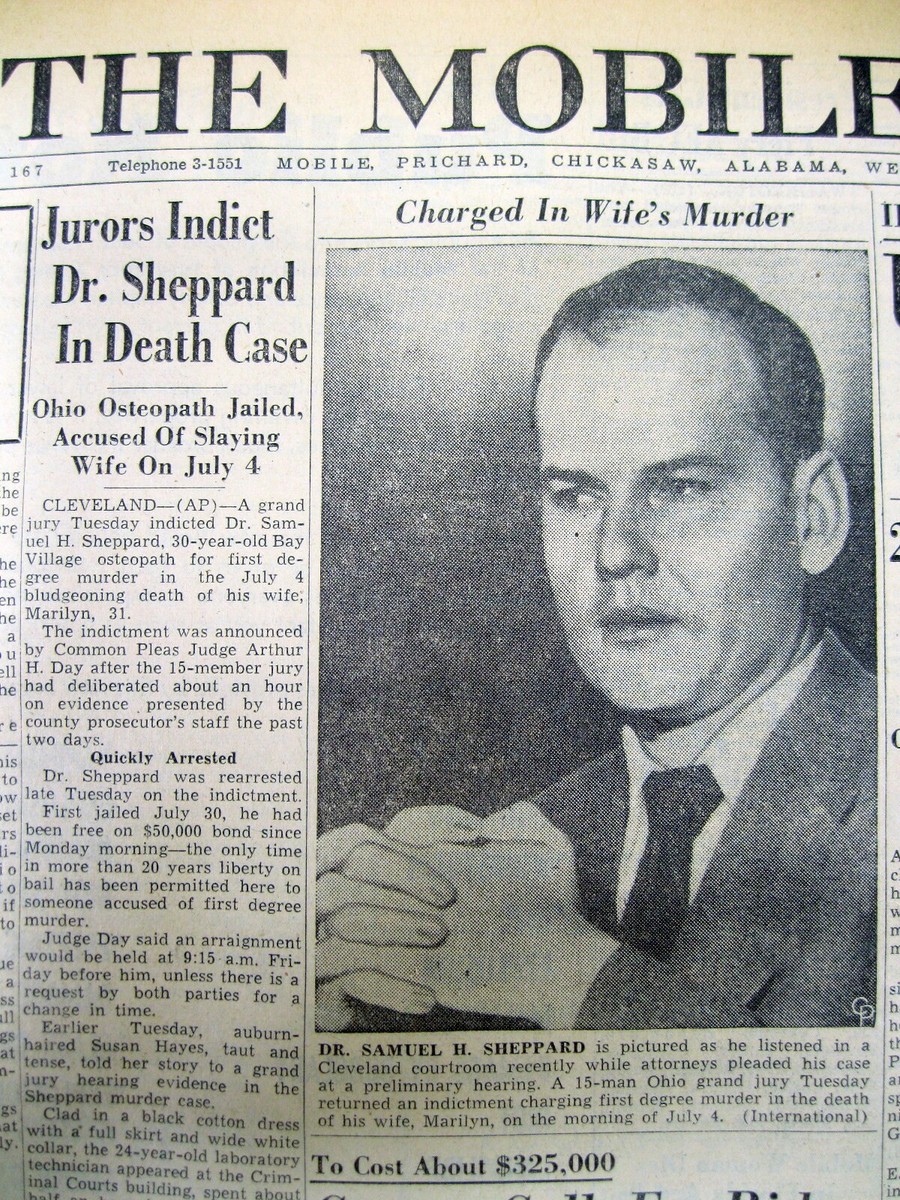
The footprint was one of them.
The defense pointed to it as evidence of an intruder.
A bloody footprint at the scene, they argued, could not belong to the man who said he fought a "bushy-haired" stranger who knocked him unconscious.
Dr. Sam Sheppard told police that story on July 4, 1954, after his wife, Marilyn, was found bludgeoned to death in the upstairs bedroom of their Bay Village, Ohio, home.
The coroner, Dr. Samuel R. Gerber, concluded Marilyn died from 27 blows from a heavy instrument, likely a flashlight.
No weapon was ever found.
The footprint was there.
What the record does not establish is whose footprint it was.
The source does not identify the footprint's owner.
It is not established as belonging to an intruder.
A theory circulating online holds that the footprint proves an outsider committed the murder.
That theory is not a fact established by the record.
It is a detail that has become a focal point for those questioning the official narrative.
It is also a detail that the investigation never tied to anyone.
The house was left unguarded that night.
Family and friends moved through the scene before police secured it.
The footprint could have been left by any of them.
It could have been left by the killer.
No one knows.
The record does not say.
THE UNGUARDED HOUSE
They did not secure the crime scene.
The house was left unguarded, and family and friends moved through it.
What exactly they touched or moved is not detailed in the source.
The record does not say.
Sam Sheppard told police he had been asleep on a downstairs couch.
He said he was awakened by his wife’s screams.
He said he fought with a "bushy-haired" intruder who knocked him unconscious.
The couple’s 7-year-old son, asleep in another room, was not harmed.
Marilyn’s sister and brother-in-law, who lived nearby, were called to the scene.
They were identified in coverage.
They were inside the house.
So were Sam’s brothers, both physicians, and his father, a prominent osteopath.
They publicly supported him.
They were named in coverage.
The murder went unsolved for weeks.
Intense media coverage followed.
The *Cleveland Press* ran editorials demanding Sheppard’s arrest.
Sam Sheppard was arrested and charged with first-degree murder on July 30, 1954.
That was twenty-six days after his wife was killed.
The evidence had been walked through.
The evidence had been touched.
The evidence had been left where it lay, unguarded, in a house full of people.
Not because the police were careless.
Because the police let them in.
The investigation was compromised from the start.

The defense would say so at trial.
The record does not say what was moved.
It only says the house was open.
It only says the people came through.
It only says the stain on the floor stayed where it was, and no one knows who stepped near it.
THE MISSING SURGICAL BAG
Sam Sheppard was a prominent osteopathic physician.
He owned a surgical bag.
On the night of July 4, 1954, after his wife was found bludgeoned to death upstairs, the bag was missing.
The defense pointed to that missing bag.
They pointed to it and to a bloody footprint at the scene.
Their argument: an intruder had killed Marilyn Sheppard.
An intruder who took the bag.
An intruder who left the footprint.
An intruder who fled.
It was a story that fit the open house and the unguarded doors.
It was a story that fit the "bushy-haired" man Sam said knocked him unconscious.
The bag was later found.
The source does not state where.
The source does not state under what circumstances.
So what did the recovery prove?
Nothing about an intruder.
That would require evidence.
The record shows only that the bag was missing, and that it was found.
No connection between the bag and an outsider is established.
Blood evidence was central to the case.
Bloodstains were found on Sam Sheppard's clothing.
Bloodstains were found in the bedroom.
Prosecutors said the blood placed him at the scene of the beating.
Defense experts argued the pattern was inconsistent with a beating of that severity.
A beating that left Marilyn dead from 27 blows.
The prosecution's theory was simpler.
Sam Sheppard killed his wife in a rage over an extramarital affair.
No motive was proven in court.
The bag was not enough to prove an intruder.
The footprint was not enough to prove an intruder.
The defense had a story.
The record has a gap.
THE TWO STORIES
The prosecution told one story.
Sam Sheppard killed his wife in a rage over an extramarital affair.
The bloodstains on his clothing and in the bedroom were the central evidence.
The defense told another story.
An intruder committed the murder.
The crime scene was contaminated, and the bloody footprint and the missing surgical bag pointed to an outsider.
The first trial began in October 1954.

The defense argued the scene had been contaminated and an intruder was responsible.
The prosecution presented circumstantial evidence.
No motive was proven in court.
On December 21, 1954, the jury found Sheppard guilty of second-degree murder.
He was sentenced to life in prison.
The conviction was upheld on appeal in 1956.
Two stories, built on the same flawed evidence.
Which one was true?
Which one could be proven?
That would require evidence the record does not establish.
The source does not establish which interpretation is correct.
The motive for the prosecution's theory was not proven in court.
The footprint was not enough.
The bag was not enough.
The blood was not enough.
The jury chose one story.
The record keeps both open.
AND THE STORY STILL ISN'T OVER
In 1964, Sheppard's new attorney, F. Lee Bailey, filed a habeas corpus petition.
He argued the first trial had been unfair.
He argued the media had poisoned it before the jury ever sat.
In 1966, the U.S. Supreme Court agreed.
The Court ruled in *Sheppard v. Maxwell* that the trial had been prejudiced by a circus-like atmosphere.
It ordered a new trial.
At the retrial in 1966, the jury deliberated for less than a day.
Sheppard was acquitted.
The blood was still not enough.
The footprint was still not enough.
The missing surgical bag, later found, was still not enough.
After acquittal, Sheppard returned to medicine briefly.
He struggled with alcoholism.
He struggled with legal troubles.
He died on April 6, 1970, at age 46, of liver failure.
The story did not end there.
In 2000, DNA testing excluded Sam Sheppard as the source of blood found under Marilyn's fingernails.
Other samples were inconclusive.
In 2002, a Cuyahoga County judge declared Sam Sheppard innocent.
The judge cited the DNA evidence.
The judge cited the failure of the original investigation.
A window washer who had worked in the Sheppard home was later suspected.
He was never charged.
He died in prison in 1998.
The identity of the actual killer is not established.
The case remains officially unsolved.
That is not a theory.
That is the record.
Justice was partial.
The truth is still elusive.
Advertisement
You may also like

The cell tower data that put Adnan Syed near Leakin Park — and the questions it left behind
On January 13, 1999, Hae Min Lee, an 18-year-old senior at Woodlawn High School, disappeared after leaving school. Her car was found on February…
One anonymous note sent police to a witness — is that note the key to Hae Min Lee's 1999 murder case?
The note was anonymous. It arrived after Hae Min Lee's body was found on February 9, 1999, in Leakin Park, partially buried. She had…
The last video Paul Murdaugh filmed minutes before the shots that killed him and his mother
He was 22, and he was filming his dogs. Paul Murdaugh held up his cell phone at the family's hunting estate in Colleton County,…

The pillowcase that tied a kidnapper to Polly Klaas — and the parole officer who spotted him
Two girls lay on the floor of the bedroom, their hands and feet bound. They had been tied up, but they had not been…
The pajama top that told the FBI a different story than Jeffrey MacDonald's
The pajama top was folded on an evidence table, and it told two stories at once. On the night of February 17, 1970, at…
The 10 p.m. check that found an open door and an empty bed
The key turned in the lock at approximately 10:00 p.m. on May 3, 2007. Kate McCann stepped into the holiday apartment in Praia da…