A name nobody claimed: the only identified victims of the Torso Killer
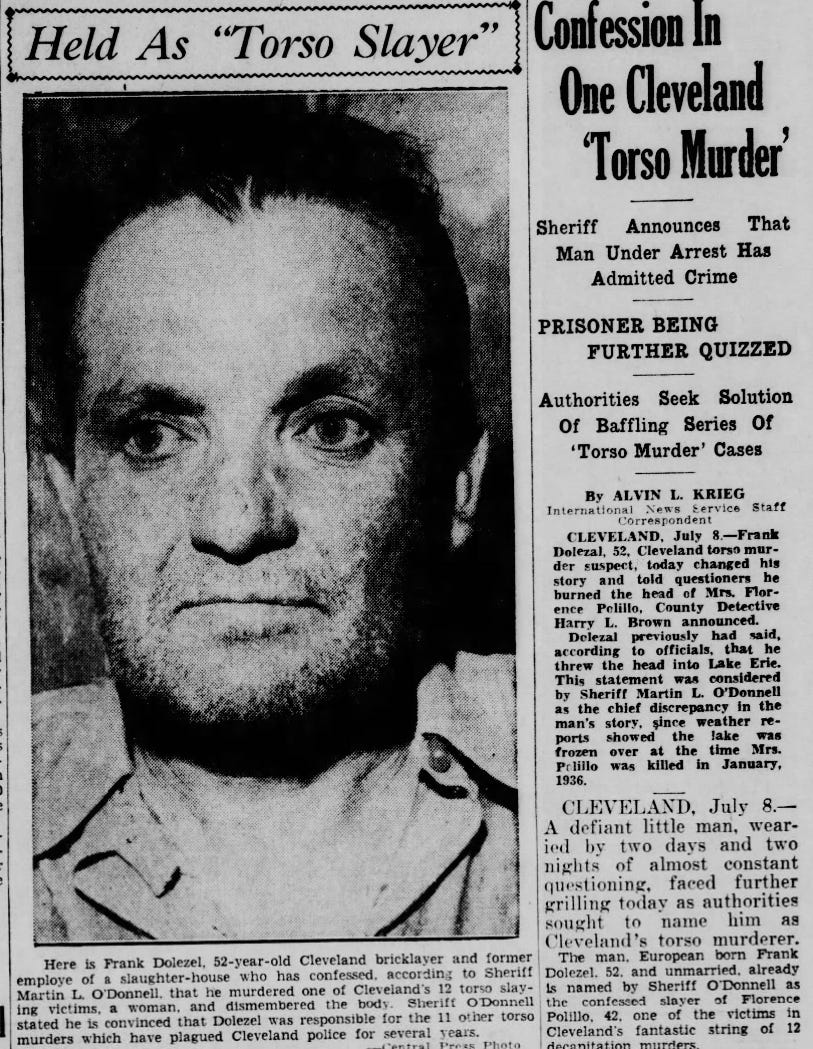
Between 1934 and 1938, at least twelve people were murdered in Cleveland's Kingsbury Run area.
Most of them were never identified at all.
Among the few who were named: a young laborer found in September 1935, and a woman known in the neighborhood, found in January 1936.
The laborer's body was discovered in a shallow grave.
He was headless and limbless — the most infamous find of the entire series.
The woman had a name that people in the neighborhood knew.
Her family never came forward publicly.
Not because they didn't exist. Because they were estranged, or unknown, or simply absent from the record.
The full identities and life stories of these two named victims are not in the record beyond their names and the circumstances of their discovery.
That is what the record holds: two names, two dates, two places.
No one was ever convicted.
The case remains officially unsolved.
Two people had names.
Almost no one claimed them.
SEPTEMBER 1935 — THE SHALLOW GRAVE
The headless, limbless torso of an unidentified man was found in a shallow grave in Kingsbury Run in September 1935.
The exact date of that discovery is not in the record.
Over the following weeks, more body parts surfaced in the same area.
Each part was a question.
The victim was later identified as Edward Andrassy, a young laborer.
He was one of the few named.
Coroner Arthur J. Pearce performed the autopsies.
His examinations established that the victims were killed and dismembered with surgical skill.
That is what the record says: surgical skill.
Not a butcher's haste.
Not a random act of violence.
Police under Eliot Ness and Detective Peter Merylo focused on the transient population of Kingsbury Run.
They conducted mass roundups and interrogations.
They burned the shantytowns.
They scattered the people who lived there.
Andrassy's name was claimed.
His body was not whole, but his name was his.
It is a small relief.
It is also a reminder.
Most of the dead in this series never got that.
They were buried in potter's fields.
They were called by numbers or by descriptions.
The horror of a body reduced to parts is one thing.
The horror of a name nobody claims is another.
Andrassy's name was claimed.
That is all the record holds.
JANUARY 1936 — THE WOMAN THEY KNEW
In January 1936, the body of Florence Polillo was found.
She was a woman known in the neighborhood.
In a series where most victims were never identified, she was one of the few with a name.
But a name is not the same as a claim.
Her family rarely came forward publicly.
Most victims' families were estranged or unknown.
That is the loneliness the record holds: a person known to her neighbors, not to her kin.
The exact circumstances of her death and discovery are not detailed in the record.
That is not established.
What is established is the difficulty of the investigation.
The victims' anonymity hampered every step.
The lack of forensic technology hampered every step.
Police conducted mass roundups of the transient population.
They interrogated the transient population.
They swept through Kingsbury Run, the skid-row district where the victims had lived.
Not because they had a name to follow.
But because they had no name at all.
Roundups produce suspects.
They do not produce families.
No one came to claim her.
No one came to ask what had been done to her.
Her neighbors knew her name.
That would require evidence of who mourned her.
The record holds the name.
The record does not hold the mourners.
THE SUSPECT WHO NEVER STOOD TRIAL
The suspect was a former bartender, arrested in 1939 after a tip.
He confessed to the murder of one of the named victims.
Police said his confession matched the crime scene.
He later recanted, claiming detectives beat him.
A physician examined him in jail and documented injuries consistent with his claim.
The physician documented the injuries.
The physician wrote them down.
That is the record.
The suspect died in his cell on August 24, 1939, before any indictment.
The coroner ruled it suicide.
His family disputed that.
The physician disputed that.
Whether he was guilty or innocent is not established.
Whether his death was suicide is not established.
What is established: a confession, a recantation, a death, and no trial.
No other suspect was ever charged.
The lead investigator's reputation suffered.
He left Cleveland in 1942.
Not because the case was solved.
Because the case was not.
The record holds the confession.
The record holds the recantation.
The record does not hold the trial.
AND THE STORY STILL ISN'T OVER
The record holds the confession.
The record holds the recantation.
The record does not hold a verdict.
The Cleveland Torso Murders remain officially unsolved.
No one was ever charged, and no trial occurred.
The primary suspect died in his cell before any indictment was returned; his death was ruled a suicide by the coroner.
He is buried in an unmarked grave.
Most victims were buried in potter’s fields.
Their names were never claimed.
Detective Peter Merylo continued investigating until his retirement, convinced the suspect was the killer.
He carried that conviction for years, past the point when the case had gone cold.
Eliot Ness died in 1957, having never solved the case.
The lead investigator left Cleveland in 1942, his reputation bruised by the unsolved murders.
The Kingsbury Run area was demolished and redeveloped, erasing the physical landscape of the crimes.
The shantytowns were burned, the transients scattered, and the evidence went with them.
The identity of the perpetrator is not established.
No new evidence has emerged to definitively identify who killed these people.
Books and documentaries have revisited the case for decades.
They offer theories.
They offer suspects.
They do not offer proof.
The record holds only what was written down at the time: the confessions, the recantations, the injuries documented in jail, the autopsies noting surgical skill.
It does not hold the answer.
The victims’ families, where they existed, received no closure.
Most were estranged or unknown, so no one came forward to claim the dead.
Two names were claimed.
Two names are all the record holds.
The rest are a series of numbered remains in potter’s fields, unmarked and unnamed.
That is where the story stops.
Not because the killer was caught.
But because the case was never closed.
Advertisement
You may also like
The 31 days Casey Anthony said nothing, and the trunk evidence that turned a missing-child case into a homicide charge
The 911 call came on July 15, 2008, from a grandmother named Cindy Anthony. She told the dispatcher her daughter, Casey Anthony, had not…
The clip-on tie left behind that made FBI agents look twice
The clip-on tie sat on the seat, a plain thing, dark and cheap. It was found after the plane landed, after the man was…
The pharmacy clerk's last stop before vanishing — what police found next
She was at the counter at the pharmacy, and he was going to meet a contractor about a job. Robert Piest was 15 years…
The courtroom theatrics that turned a murder trial into a national spectacle
In June 1970, as the trial opened, the three female defendants walked into the courtroom with shaved heads. Swastikas were carved on their foreheads.…
The cellphone video that placed Alex Murdaugh at the kennels — and the timeline he swore was wrong
Paul Murdaugh’s phone was recording on June 7, 2021, at the dog kennels on the family estate, Moselle. The video was casual, unplanned, the…
The surgical glove blood evidence that reopened the MacDonald case
The surgical glove turned up late. It was not in the initial police report, that first chaotic inventory of the house on Fort Bragg.…