The clip-on tie left behind that made FBI agents look twice
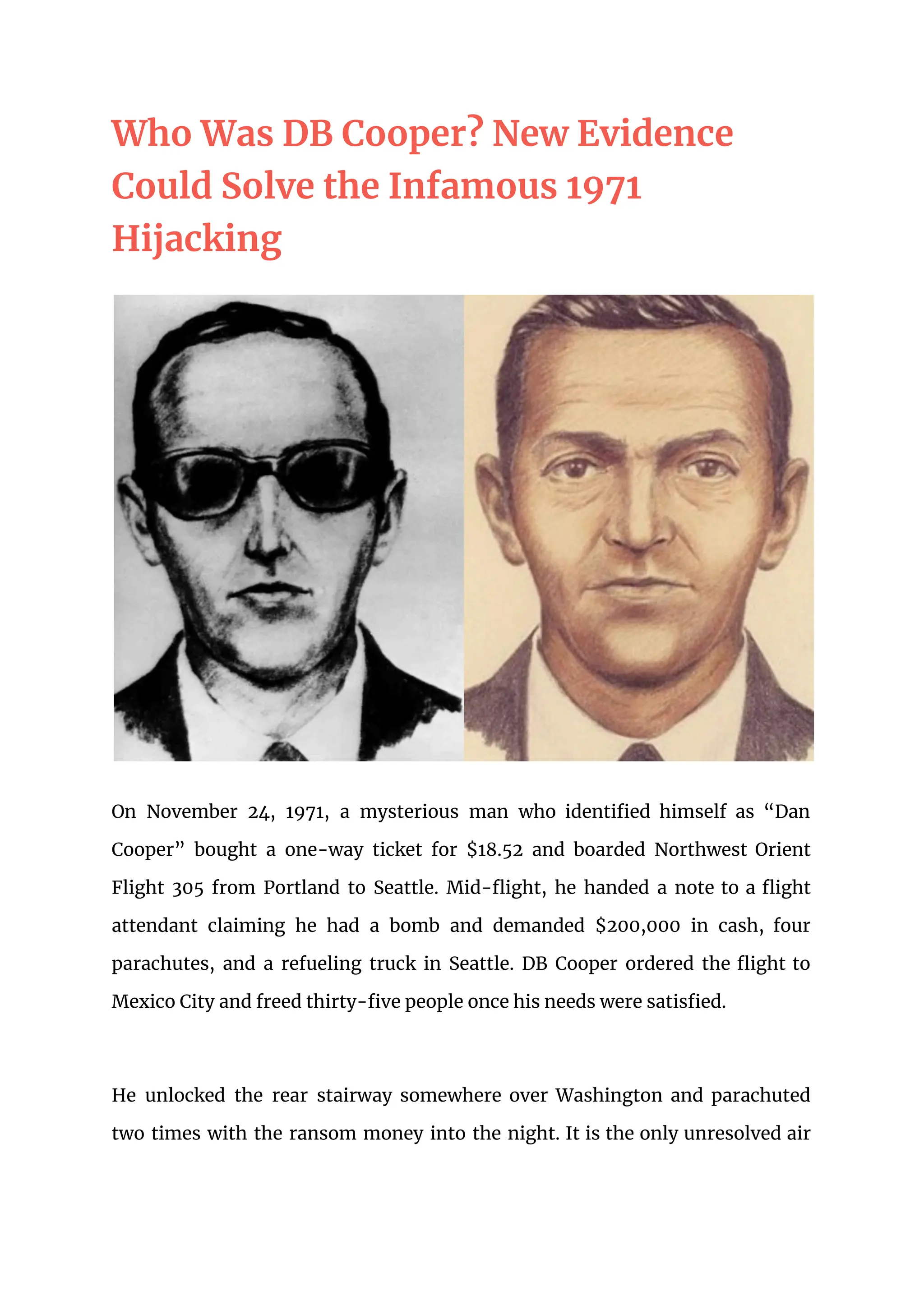
The clip-on tie sat on the seat, a plain thing, dark and cheap.
It was found after the plane landed, after the man was gone.
FBI agents picked it up and looked at it, and what they saw made them look again.
The tie carried microscopic particles of beryllium and titanium.
Those are materials for spacecraft, for precision metals, for a lab or a factory floor.
They suggested a man who worked in aerospace or metallurgy.
The FBI never confirmed where the particles came from.
They never identified the man who wore the tie.
His name remains unknown.
The tie became a forensic puzzle, a mundane object holding a secret.
It is the kind of detail that makes a case feel solvable.
It is also the kind of detail that never resolves.
A man using the alias “Dan Cooper” bought a one-way ticket that evening, November 24, 1971, from Portland, Oregon, to Seattle, Washington.
He boarded Northwest Orient Airlines Flight 305.
He left the tie behind.
The case remains the only unsolved hijacking in U.S. history.
The particles suggested a career.
They did not suggest a name.
That would require evidence.
The tie did not give it up.
It just sat there, on the seat, holding its microscopic secret.
THE NOTE AND THE DEMANDS
The note was passed a few minutes after takeoff.
The flight attendant unfolded it and read a calm, typed demand: there was a bomb in the briefcase.
She took it to the cockpit, and the routine flight became a negotiation.
The man who called himself Dan Cooper wanted $200,000 in cash.
He wanted four parachutes.
He wanted a fuel truck waiting on the tarmac in Seattle.
The pilot radioed ahead, and the plane kept flying toward Seattle-Tacoma Airport.
On the ground, the FBI moved quickly.
They gathered the cash — $200,000 in $20 bills.
Every serial number was recorded before the money was handed over.
That was the key evidence, the one thing Cooper could not scrub clean.
The parachutes were standard military-issue, delivered without ceremony.
The passengers were released after landing; the crew stayed.
One flight attendant had received the note first.
Another sat with Cooper in the cabin for the rest of the flight, close enough to describe his face, his voice, his manner.
She later gave a detailed account: his age, his clothes, his calm.
No explosive device was ever found or recovered.
That was never established, not then, not later.
The briefcase stayed closed, and the threat stayed a threat.
What the record shows is the note and the demand and the money.
What it does not show is a bomb.
THE JUMP AND THE SEARCH
He ordered the crew to fly toward Mexico City at a low altitude.
The rear stairway of the Boeing 727 was deployed in flight.
Somewhere between Seattle and Reno, Nevada, likely over southwestern Washington or northwestern Oregon, Cooper jumped from that stairway with the money.
He was never found.
The exact jump point was uncertain.
The FBI estimated it was somewhere near the Lewis River in Washington.
The vastness of the Pacific Northwest swallowed a man in a business suit.
FBI Special Agent Ralph Himmelsbach led the investigation for years.
He chased a moment that could not be pinned down.
The plane had been in the air, the stairway had been open, and then it was just dark below.
Over the decades, the FBI pursued hundreds of suspects.
Himmelsbach interviewed them, compared them, ruled them out.
The exact jump point is not established.
Whether Cooper survived the jump is not established.
What the record shows is the stairway, the dark, and the money gone with him.
What it does not show is a landing, a body, or a man walking away.
The search was a question without coordinates.
Himmelsbach kept asking it anyway.
He knew the plane's path, the wind, the terrain.
He did not know the second Cooper left the stairway.
That second made all the difference.
THE MONEY ON THE SANDBAR
Eight years after the jump, a boy found something on a sandbar of the Columbia River near Vancouver, Washington.
It was a portion of the ransom money, a few dozen $20 bills, their serial numbers matching the recorded list.
The FBI disputed the exact amount the boy recovered.
The FBI concluded the bills had been washed there, not buried by Cooper.
Not because a current had scattered them. Because the bureau's theory held that the money had been in the river, tumbled and deposited, not hidden by a man who planned to return.
How the money ended up on the sandbar is not established.
The FBI's conclusion is a theory, not a proven fact.
In 1983, a federal judge ruled that the money belonged to the boy's family.
The FBI retained a portion for evidentiary purposes.
The family sold some of their bills at auction. Buyers paid thousands for a single $20 note.
The rest of the recovered money sits partly with the FBI, partly with the family.
In 2016, the FBI officially suspended active investigation of the case.
It cited a lack of new leads.
It continued to review tips.
The case remains officially unsolved.
The money on the sandbar is the only physical trace of the ransom ever found.
It is evidence. It is also a souvenir.
The boy who found it grew up with a story no one else could tell.
And the question the sandbar left open — how the money got there — remains open still.
AND THE STORY STILL ISN'T OVER
The case remains officially unsolved.
The FBI closed its active investigation in 2016, though it continues to accept tips.
Dan Cooper's identity remains unknown, and his fate — whether he survived the jump — is still a matter of speculation.
The case has become a cultural touchstone, inspiring books, films, and annual parodies, but no conclusive evidence has ever emerged.
Several men were publicly suspected over the years.
One was convicted of a similar hijacking in 1972.
Another confessed on his deathbed in 1995.
All were ultimately cleared or not charged.
Whether any suspect was Cooper is not established.
No one was ever charged.
Not because the FBI stopped looking.
But because the evidence never pointed to one man.
The tie held particles.
The money washed ashore.
The parachute never surfaced.
What remains is a folder of tips, some decades old, still reviewed.
The next one could come tomorrow.
It could come from anywhere.
It could change nothing.
The record does not establish that any suspect was Cooper.
The record does not establish that Cooper survived the jump.
The record does not establish that he died in the woods.
That would require evidence.
The door is open.
The question is still on the sandbar, still in the air, still on the seat where he left the tie.
It is a cold case.
It is also an open one.
Advertisement
You may also like
The smiley-face confession that made a sister call the police
The note was found in March 1995, near a woman's body in Oregon. It was handwritten, a confession. It was signed with a smiley…

The body drained of blood and posed — and the only clue was a name
The morning of January 15, 1947, in a vacant lot at 39th Street and Norton Avenue in Leimert Park, Los Angeles. A woman's body…
The 1995 bomb that killed 168 — and the trailer axle that cracked the case
The rear axle of the Ryder truck was a twisted piece of metal, recovered from the rubble within hours. It carried a vehicle identification…

The Green River Killer confession that led detectives to 48 counts — but how many bodies are still missing?
The first bodies were found in 1982, in and around the Green River south of Seattle. Dozens of women disappeared or were found dead…
Manson's follower turned jailhouse informant: the words that cracked the Tate case
She was in jail for something else. Susan Atkins, twenty-one years old, sat in a Los Angeles County cell and told her cellmate, Virginia…
The 340 cipher that took 51 years to crack — and still named no killer
The 340 cipher sat unsolved for fifty-one years. On December 5, 2020, a team of codebreakers—David Oranchak, Sam Blake, and Jarl Van Eycke—announced they…