The neighbor's camera that caught Shanann Watts' truck — and the timeline that broke the case
The neighbor's camera was pointed at the driveway, not the street.
It caught a blue Ford truck pulling into the Watts home in the early morning hours of August 13, 2018.
That truck belonged to Shanann Watts.
Christopher Watts told police his wife had left with the children.
He said she was acting strangely.
The footage shows the truck returning.
It does not show who was inside.
It does not show the children.
It does not show what happened after the engine cut.
The timestamp on the recording is a specific detail.
People online scrutinize it.
They zoom in.
They count seconds.
They compare it to phone records and text messages.
What exactly the camera shows beyond the truck's return is not established in the record.
The footage is documented evidence.
It is also a fragment.
One image.
One moment in a driveway.
It contradicts a story.
That is all the record supports.
The rest is theory.
The rest is what people want it to be.
A truck comes home.
A family does not.
THE MISSING REPORT
The call came on August 13, 2018, in Frederick, Colorado.
Shanann Watts, 34, and her daughters, Bella, 4, and Celeste, 3, were reported missing.
A friend made the report, concerned when Shanann missed a doctor's appointment and failed to answer her calls.
Christopher Watts, 33, told police he had returned from a business trip early that morning.
He claimed Shanann had been acting strangely and had left with the children.
The exact nature of that "strange" behavior is not detailed in the record.
That is not established.
What is established is what the officers noted: inconsistencies in Watts' story.
His calm demeanor.
His failure to ask basic questions about his family's whereabouts.
A husband who does not ask where his wife and children are.
A father who does not ask who took them.
The missing persons report initiated the investigation.
The Frederick Police Department and the Weld County Sheriff's Office took the case.
They took the husband's story.
They took his calm.
They took his silence where questions should have been.
The friend's alarm was the alarm of someone who knew Shanann.

The officers' unease was the unease of professionals who had heard this before.
The truck had come home.
The family had not.
THE CONTRADICTION
The neighbor's security camera showed Shanann's truck returning to the home in the early morning hours of August 13.
That contradicted what Christopher Watts had told police.
He had said Shanann left with the children.
The truck had come home.
The family had not.
Police also discovered that Watts had been having an affair with Nichol Kessinger, a coworker at Anadarko Petroleum.
The affair gave them a reason.
It gave them a motive.
It gave them a place to dig.
On August 15, Watts failed a polygraph test and was arrested.
The exact content of the polygraph questions and results are not in the record.
That part remains unproven.
What followed was a confession.
Watts then confessed to killing Shanann and the two girls, leading police to the oilfield site where the bodies were found.
The medical examiner determined Shanann had been strangled.
The girls had been smothered.
The confession matched the evidence.
The evidence matched the camera.
The camera had shown the truck returning.
That was the contradiction that broke the case open.
It was not a theory.
It was a timestamp.
THE CONFESSION AND THE PLEA
He confessed on August 15, the day of his arrest.
He led police to the oilfield site where the bodies were found.
He first said he had killed Shanann in a rage after she killed the children.
He later admitted to killing all three.
The medical examiner determined Shanann had been strangled.
The girls had been smothered.
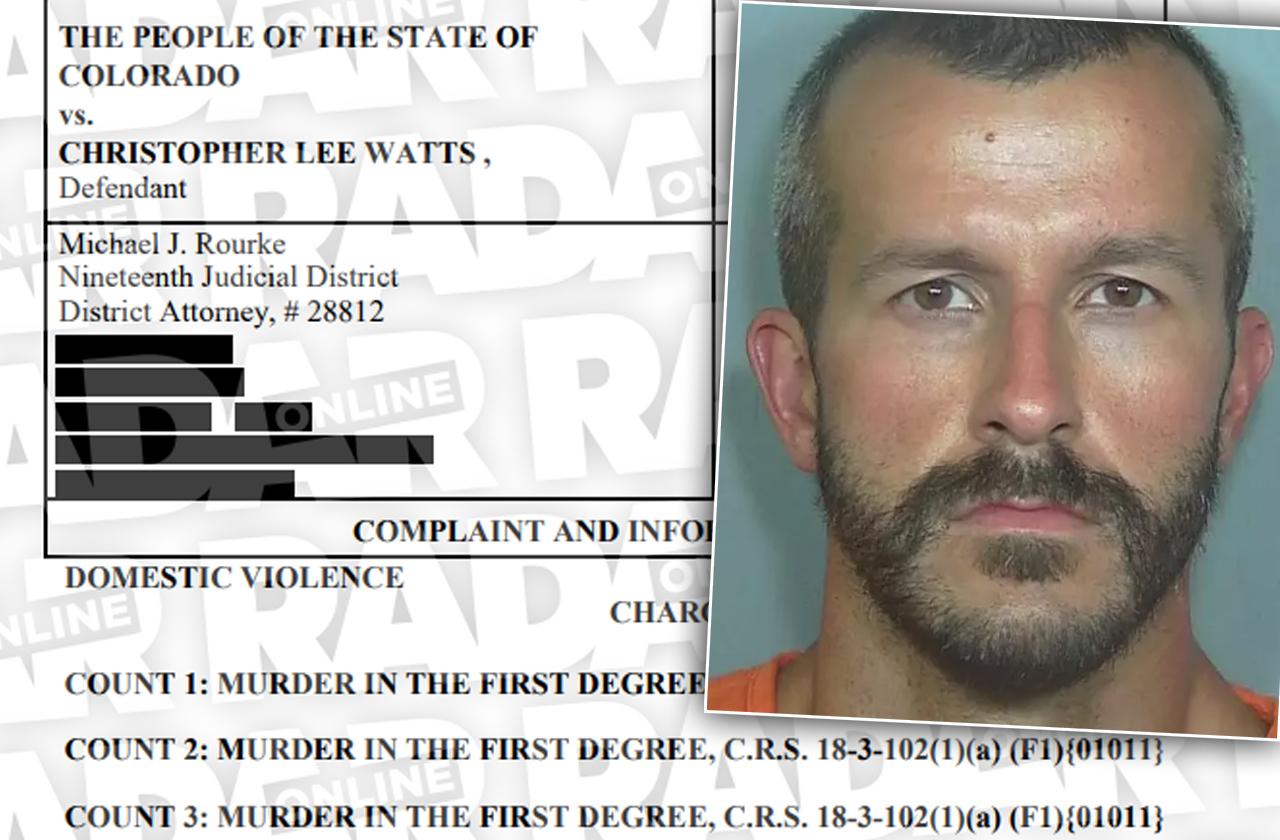
The charges came next: three counts of first-degree murder.
Two counts of murder of a child under 12, and other charges followed.
On November 6, 2018, he pleaded guilty to all charges.
The plea agreement spared him the death penalty.
The specific details of the plea agreement negotiations are not in the record.
Prosecutors argued that Watts had planned the murders to start a new life with Kessinger.
His defense attorneys did not contest the plea.
The judge sentenced him to life in prison without the possibility of parole.
That was for the murders of Shanann and the two girls.
Additional consecutive sentences were added for the other charges.
He was ordered to pay restitution.
:max_bytes(150000):strip_icc():focal(995x318:997x320)/chris-watts-family-main-081325-0e08a43c43f54d3ca80a4ff7eb743064.jpg)
Was the confession a moment of truth? Was it a calculation to avoid the needle? Was it the only move left?
That would require reading his mind.
The record holds only the plea, the sentence, and the finality of the courtroom.
He is serving that sentence now, in a Wisconsin prison.
No successful appeals have followed.
Shanann's parents have spoken publicly about the case since.
The home in Frederick was sold.
The confession closed the trial.
It did not close the story.
AND THE STORY STILL ISN'T OVER
Christopher Watts is serving his life sentence at the Dodge Correctional Institution in Waupun, Wisconsin.
He has made no successful appeals.
That is where the legal record stops.
The plea closed the case on November 6, 2018.
The sentence was life without parole, plus consecutive terms.
The confession was complete.
The verdict was final.
Any potential future legal actions or appeals are not in the record.
That would require new filings, new rulings, new facts.
None are documented.
The story, though, continues outside the courtroom.
Shanann's parents have spoken publicly about the case.
They have been involved in advocacy related to domestic violence.
They have given interviews.
They have attended events.
The family home in Frederick was sold.
It is a house again.
It is also a place people drive past.
The case has been the subject of extensive media coverage.
Documentaries have examined the timeline.
News specials have replayed the neighbor's camera footage.
The truck returns in the early morning, again and again.
The timestamp remains a detail people scrutinize.
It is documented.
It is also unresolved in the public imagination.
What the camera shows is established.
What it means beyond the record is not.
That is a theory.
Theories do not change the sentence.
Watts remains in Wisconsin.
The appeals have failed.
The coverage has not stopped.
The public story continues.
The legal one does not.
Advertisement
You may also like
The tarot card left at a D.C. sniper crime scene that read 'Call me God'
The card was found at one of the crime scenes. It was a tarot card, and it read "Call me God." That much is…
The Sacramento mail bomb that ended the Unabomber's 17-year campaign
The package arrived in Sacramento in April of 1995. It was sent through the U.S. Postal Service, constructed from wood, metal, and other materials.…
The screams a husband said he heard — and the bushy-haired intruder police never found
The screams, he said, were what woke him. On July 4, 1954, in Bay Village, Ohio, Marilyn Sheppard, 31, was found bludgeoned to death…
The 911 call that started the Casey Anthony case — and the 31 days no one can explain
Cindy Anthony dialed 911 on July 15, 2008. She reported her 2-year-old granddaughter, Caylee, missing. It was the first official report that the child…
A Sledgehammer Borrowed and Never Returned: The McStay Case Timeline
He told the jury about the sledgehammer. A witness testified at trial that Charles "Chase" Merritt borrowed a sledgehammer from him. The witness said…
The parking ticket that cracked the Son of Sam case — and the mother who still waits
The ticket sat on a car near the scene of the final shooting. The final shooting, on July 31, 1977, killed a young woman…