The screams a husband said he heard — and the bushy-haired intruder police never found
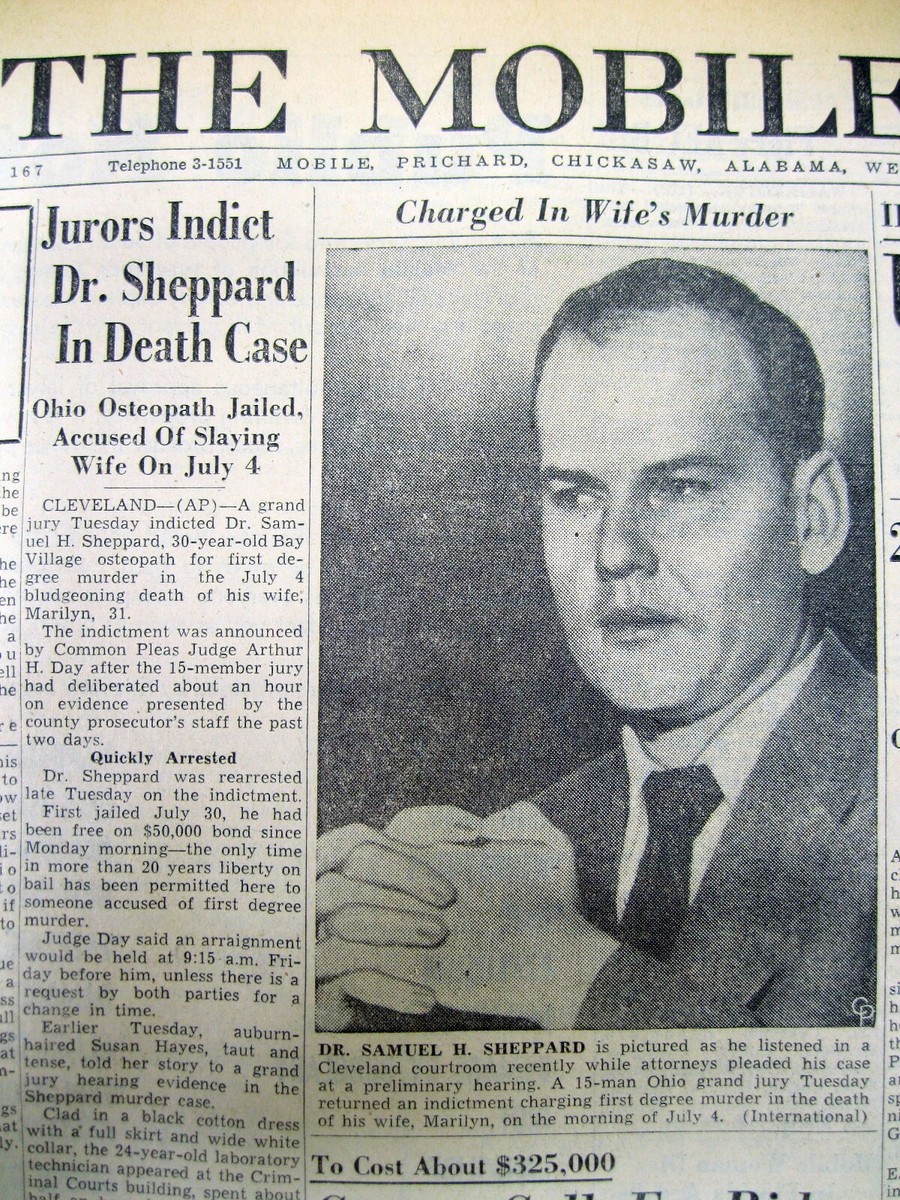
The screams, he said, were what woke him.
On July 4, 1954, in Bay Village, Ohio, Marilyn Sheppard, 31, was found bludgeoned to death in the upstairs bedroom of the lakeside home she shared with her husband, Dr. Sam Sheppard.
He told police he had been asleep on a downstairs couch.
He told them he awoke to her screams.
He told them he struggled with a "bushy-haired" intruder who knocked him unconscious.
Police found no sign of forced entry.
No broken lock. No jimmied window. No sign anyone else had been inside the house at all.
That silence would haunt the case.
The murder went unsolved for weeks.
Sam Sheppard was a prominent osteopathic physician; Marilyn was a homemaker and mother of one.
He was her husband. He was the one who called for help.
He was also the one who told the story of a man no one else saw.
Whether an intruder ever existed is not established by any physical evidence.
None was ever found.
No weapon was recovered. No stranger was identified. No trace of a second person was ever documented.
The house stayed quiet, and so did the record.
The screams were his account. The struggle was his account. The bushy-haired man was his account.
Police could not verify any of it.
For weeks, the case sat open, a home with a locked door and a dead woman inside.
Then Sam Sheppard was arrested.
He was charged with her murder.
The story he told would follow him into the courtroom, and the locked house would follow him too.
THE WIFE AND MOTHER
Marilyn Reese Sheppard was a homemaker and mother of one.
Her parents believed her husband killed her.
They were vocal about that belief, and they testified at trial.
The victim’s mother took the stand for the prosecution.
The victim’s father took the stand for the prosecution.
They were not alone in painting a dark picture of the marriage.
A neighbor testified about the Sheppards’ troubled marriage, describing strain behind the lakeside home’s doors.
The exact nature of those marital troubles is not detailed in the record beyond that neighbor’s testimony.
That is not established.
What the prosecution argued is established: Sam Sheppard killed Marilyn in a rage over an affair.
What the defense argued is established too: no blood on Sam’s clothing, and injuries on Sam himself.
Two stories, one courtroom, one dead woman.
Marilyn’s parents chose their story in public, before the verdict, in front of the cameras.
The family she married into organized his defense.
The family she came from testified against him.
A marriage, torn apart twice — once by the crime, once by the trial.
The neighbor’s testimony carried weight.
It gave the prosecution a motive where the evidence offered none.
It gave the jury a reason to doubt the man who said he fought a bushy-haired intruder.
No forced entry was found.
No intruder was found.
But the locked house would follow him, and so would the testimony about what went on inside it.
THE TRIAL
The trial opened in 1954 in Cuyahoga County.
The judge allowed cameras in the courtroom.
He allowed the press to fill the aisles.
The prosecution, led by the county coroner, argued that Sam Sheppard killed his wife in a rage.
The coroner testified that the weapon was a blunt instrument, likely a flashlight.
The defense presented the intruder theory.
They pointed to the lack of blood on Sam’s clothing.
They pointed to his injuries.
The prosecution pointed to the couple’s strained marriage, as a neighbor testified.
It was a circus.
It was a spectacle.
Was the verdict decided in the courtroom or in the headlines?
That question is not answered by the trial record itself.
What the record shows is speed.
The jury deliberated.
Sam Sheppard was convicted of second-degree murder.
He was sentenced to life in prison.
She was on the ground below.

The house stayed locked.
The intruder stayed unfound.
The media coverage was extensive.
The media coverage was permitted.
Whether it influenced the verdict is not established.
But the judgment came fast, and it came loud.
THE RETRIAL
Ten years passed.
Then the U.S. Supreme Court overturned the conviction in 1966.
The Court ruled that Sam Sheppard had been denied a fair trial.
The reason was prejudicial publicity, the media circus the trial judge had permitted.
A retrial followed that same year.
F. Lee Bailey defended him now.
The jury acquitted him.
That acquittal was based on reasonable doubt.
It was not a declaration of innocence.
The record does not establish that Sam Sheppard was innocent.
It establishes only that the prosecution failed to prove guilt.
For Marilyn Sheppard's family, the verdict changed nothing.
They had testified against him.
They had believed him guilty.
The acquittal did not bring her back.
It did not answer how she died, or who killed her.
Sam Sheppard walked free.
His life was broken.
He died in 1970 of liver failure.
He was 46 years old.
The screams he said he heard, the bushy-haired intruder he described — none of it was ever verified.
No evidence ever supported the intruder.
No evidence ever supported the prosecution's case beyond reasonable doubt.
That is the line this case draws.
What is viral is the husband's story.
What is documented is a conviction, an overturned conviction, and an acquittal.
What remains is the victim.
She was a wife.
She was a mother of one.
She was found bludgeoned to death in her upstairs bedroom.
The murder weapon was never recovered.
The case would not stay closed.
AND THE STORY STILL ISN'T OVER
The window washer had been in the Sheppard home before the murder.
He later confessed to other murders.
He was never charged in Marilyn’s death.
Whether he was involved in her death is not established; the record does not prove it.
He died in prison in 1998.
In 2002, a civil court in Ohio ruled that Sam Sheppard was innocent of the murder.
It was a civil finding, not a criminal exoneration.
Sam Sheppard’s son had requested it.
The murder weapon — a blunt instrument, believed by prosecutors to be a flashlight — was never recovered.
The bushy-haired intruder was never found.
That is the line between what is viral and what is documented: a husband’s claim, a theory, a story police could not verify and no evidence ever supported.
The case remains one of the most famous in American legal history.
It is cited in discussions of media influence on trials.
It is also a family’s grief.
It is also a man’s ruined name.
It is also a question still unanswered.
A wife and mother was found bludgeoned to death in her upstairs bedroom.
Her parents testified at the trial, vocal in their belief that Sam was guilty.
A neighbor testified about the troubled marriage.
They were part of the story too.
The weapon was never found.
The intruder was never found.
The case would not stay closed.
It never fully closed.
Advertisement
You may also like

The mother who watched her daughter's killer walk free — and still says he did it
She was 18 years old. Hae Min Lee was a senior at Woodlawn High School, a popular student and an athlete. She was the…

The slumber party that turned into a nightmare: What one mother found when she came home
The pillowcases were on the floor when Eve Nichol walked in. One was on the bed. One was on the carpet. The girls were…
How a sister and brother-in-law torn apart by Menendez killings still disagree
The den was a room in a Beverly Hills home, and on August 20, 1989, it held two bodies. José and Kitty Menendez were…
The pizza crust that cracked a decade-long Gilgo Beach murder case
A pizza crust, discarded in a Manhattan trash can, ended a decade of silence. In July 2023, DNA from that crust was matched to…
He said four intruders chanted 'acid is groovy' — then the blood evidence shifted
The military police arrived at 544 Castle Drive after a call on February 17, 1970. Fort Bragg, North Carolina. The off-base apartment of Captain…
The morning Gianni Versace walked to a newsstand and never came back
The morning began as an errand. On July 15, 1997, at approximately 8:45 a.m., Gianni Versace walked from his Miami Beach mansion, Casa Casuarina,…