The red-light drive-by that ended Notorious B.I.G., and the car that vanished
12:45 a.m., March 9, 1997.
A dark sedan pulls alongside a black SUV at a red light on Wilshire Boulevard in Los Angeles.
The driver fires multiple shots.
Christopher Wallace is struck four times.
He is pronounced dead at Cedars-Sinai Medical Center.
The sedan is described as dark-colored.
It is never identified.
The weapon is a handgun.
It is never recovered.
The identity of the driver is not established.
The make and model of the sedan are not established.
The origin of the weapon is not established.
That is the documented record.
No one has ever been charged with the murder of Christopher Wallace, the rapper known as The Notorious B.I.G.
The murder has never been solved.
A red light. A sedan. A void.
Who was inside the car?
What was the gun?
Where did it come from?
That would require evidence.
The light turns green.
The sedan is gone.
THE PARTY AND THE DRIVE
He left the party at the Petersen Automotive Museum.
A museum of cars, and then a drive-by.
Wallace was in a car with associates, heading away from the event hosted by Vibe magazine and Qwest Records.
The shooting happened on Wilshire Boulevard, a main artery running through Los Angeles.
Not because the boulevard was empty. Because the light turned red.
The exact route from the party to that red light is not in the record.
Wallace was struck four times.
He was pronounced dead at Cedars-Sinai Medical Center.
The drive was less than two miles from the museum to the hospital, a short stretch of city street.
It is a timeline of minutes.
It is also a timeline of a feud.
His death came amid the East Coast–West Coast hip-hop rivalry, a public war of words and music.
That rivalry had already claimed Tupac Shakur, killed in a drive-by shooting in Las Vegas six months earlier.
Two rappers. Two drive-bys. One of them here, on Wilshire.
The feud was documented in songs, in interviews, in magazine covers.
What it did to the car at the red light is not documented.
Wallace was in Los Angeles to promote his upcoming album.
He left the party.
He got in the car.
The car stopped.
That is what the record holds: a party, a drive, a stop, a hospital.
THE INVESTIGATION AND THE TWO THEORIES
The LAPD investigated, and Detective Russell Poole was among the lead investigators.
Poole developed a theory: rogue LAPD officers were involved in the killing, possibly in connection with Death Row Records and its head Suge Knight.
The theory was never proven.
It remains unproven today.
Poole left the department in 1999, citing frustration with the investigation.
The case was also complicated by the LAPD's Rampart Division scandal, which involved an officer linked to figures in the case.
That officer was not named in the record as responsible.
The scandal exposed corruption among anti-gang officers, and it cast a shadow over the work.
In 2006, the LAPD released a statement.
The statement said the investigation had identified "individuals" but lacked sufficient evidence for prosecution.
Those individuals were not named.
The FBI also conducted a review.
The review did not file charges.
No weapon was ever recovered.
The ballistic evidence existed, but it pointed nowhere conclusive.
Poole's conviction was real. The proof was not.
That is the pull of this case: a detective who believed, and a record that never closed the gap.
Rogue officers, Death Row, a conspiracy — these were theories, not findings.
The LAPD's own statement stopped at "individuals."
It is a word that names no one.
It is a word that proves nothing.
The investigation remains open, officially.
The theories remain open, unofficially.
Poole died in 2015 of a heart attack.
His theory died with him, unproven.
THE CIVIL CASE AND THE SETTLEMENT
There was no criminal trial.
No one was ever arrested or charged with the murder of Christopher Wallace.
In 2002, the Wallace family filed a wrongful-death lawsuit against the city of Los Angeles and the LAPD.
The suit alleged that rogue officers were responsible and that the department covered up evidence.
The case was settled in 2006 for a reported $1.1 million.
The city explicitly denied liability in the settlement.
The settlement did not name any individual as responsible.
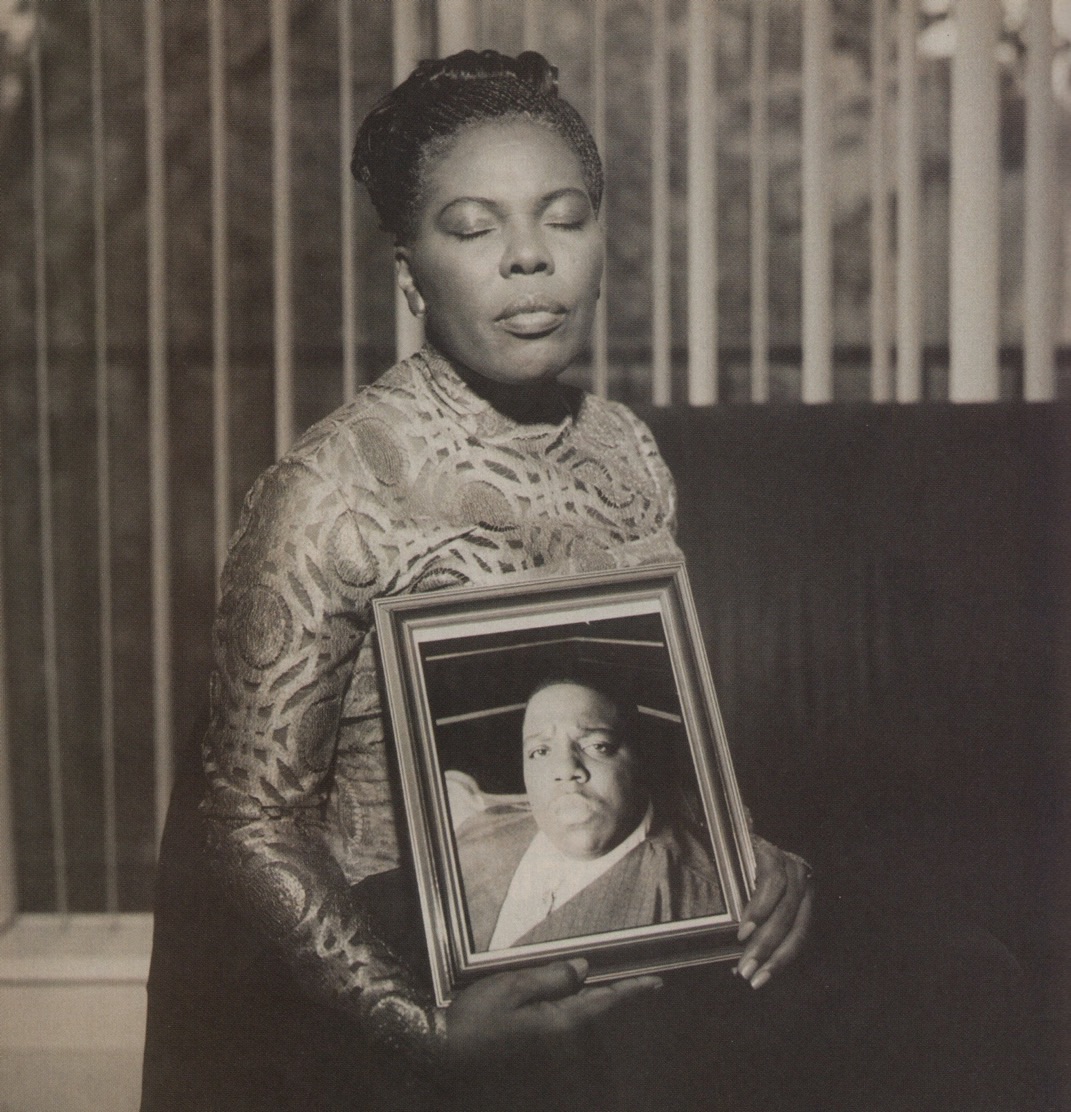
Wallace's mother, Voletta Wallace, and his widow, Faith Evans, publicly demanded answers.
They asked who fired the shots. They asked who ordered the cover-up. They asked who protected the shooter.
That would require evidence.
The settlement resolved the civil claim. It did not resolve the murder.
The record does not establish who was responsible.
The city denied it. The family accepted the money. The questions remained open.
Voletta Wallace kept speaking about her son's death. Faith Evans kept addressing it in interviews.
Neither received the answer they sought from the courtroom.
The criminal case stayed where it had always been: unsolved, with no charges, no trial, no verdict.
The civil case ended with a check and a denial.
The red-light sedan stayed vanished.
AND THE STORY STILL ISN'T OVER
The murder of Christopher Wallace remains officially unsolved.
The LAPD has periodically stated that the case is open but inactive.
Open, and inactive.
No hearing date, no motion, no decision pending — that is not in the record.
Voletta Wallace has continued to speak publicly about her son's death.
She has criticized the LAPD's efforts.
Faith Evans has also addressed the case, in interviews and in her memoir.
She was on the ground below when the news broke; she has carried it since.
Detective Russell Poole died in 2015 of a heart attack.
His theories have been revisited in documentaries and podcasts.
They are revisited, not proven.
The case has been the subject of multiple documentaries.
The 2002 film "Biggie & Tupac" by Nick Broomfield alleged police involvement.
The 2018 series "Unsolved" dramatized the investigation.
A dramatization is not a document.
A theory is not a verdict.
What the record establishes is narrower: a dark sedan at a red light, four shots, a death.
Everything after that — who was inside the sedan, why the shots came, what the department knew — remains unproven.
The next chapter is unwritten.
It has been unwritten since 1997.
The wound has not closed.
It stays open, inactive, and unresolved.
Advertisement
You may also like
The morning Gianni Versace walked to a newsstand and never came back
The morning began as an errand. On July 15, 1997, at approximately 8:45 a.m., Gianni Versace walked from his Miami Beach mansion, Casa Casuarina,…
The ex-convict's tip about a safe that sent detectives to a Kansas farmhouse
He told prison authorities that Richard Hickock had spoken of robbing the Clutter farm. Floyd Wells was a former cellmate. He had worked for…
The ring that identified Emmett Till after his body was found in the Tallahatchie River
The cotton gin fan was still tied to his neck with barbed wire. The body came up from the Tallahatchie River on August 31,…
The tarot card left at a D.C. sniper crime scene that read 'Call me God'
The card was found at one of the crime scenes. It was a tarot card, and it read "Call me God." That much is…
The Sacramento mail bomb that ended the Unabomber's 17-year campaign
The package arrived in Sacramento in April of 1995. It was sent through the U.S. Postal Service, constructed from wood, metal, and other materials.…
The screams a husband said he heard — and the bushy-haired intruder police never found
The screams, he said, were what woke him. On July 4, 1954, in Bay Village, Ohio, Marilyn Sheppard, 31, was found bludgeoned to death…