The tip that ended a three-week sniper terror — a rest stop on I-70
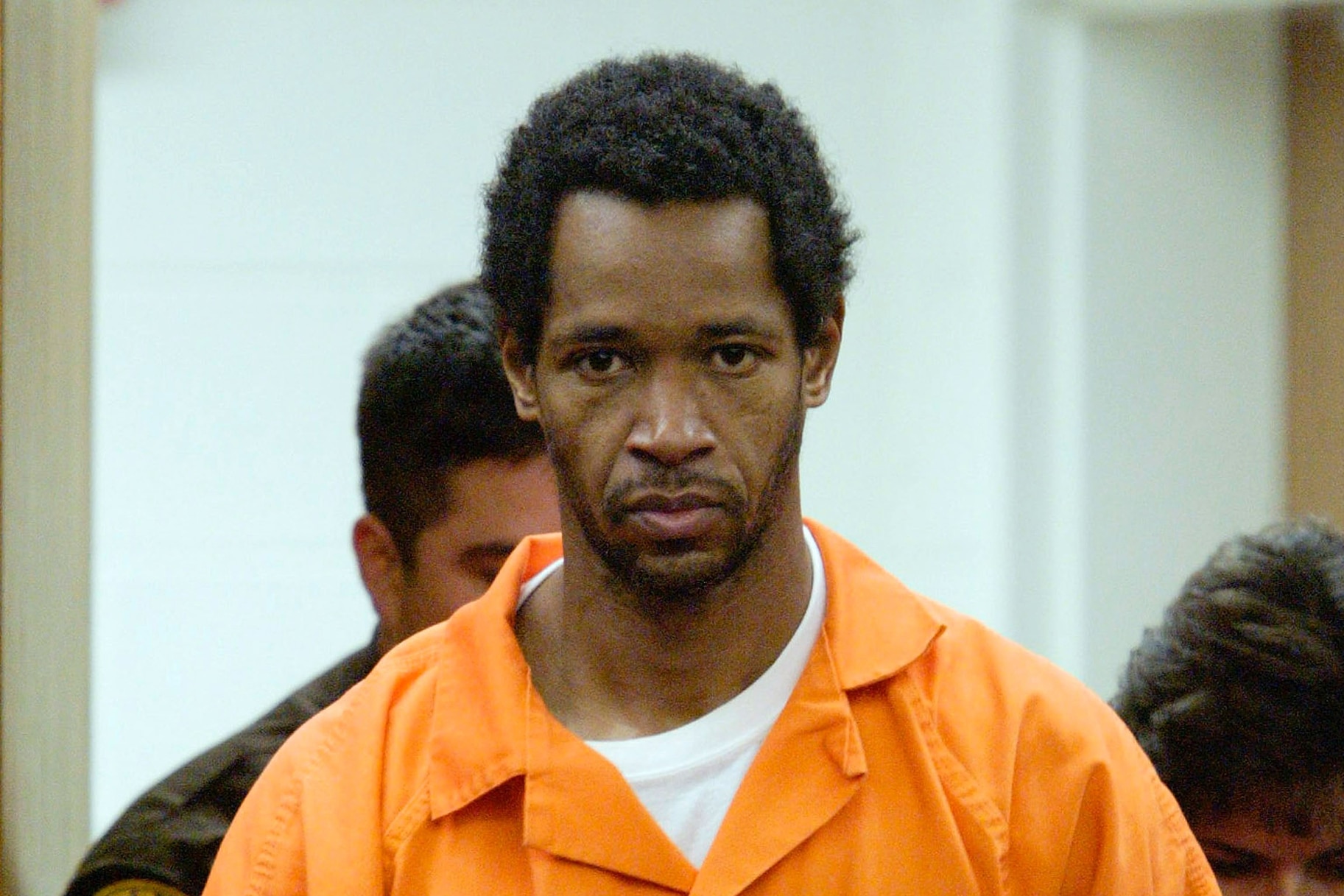
October 24, 2002: a tipster picked up the phone.
The call alerted police to a white Chevrolet Caprice parked at a rest stop on Interstate 70 near Myersville, Maryland.
Officers found two suspects sleeping in the car.
Inside: a Bushmaster .223-caliber rifle, a scope, a tripod.
The trunk had been modified with a hole in the rear bumper, a way to fire from inside without being seen.
That single phone call ended twenty-two days of terror.
Ten people were dead. Three were wounded.
Gas stations, parking lots, bus stops — the attacks seemed random, and the region held its breath.
Schools kept children indoors. Residents avoided the open.
Then a tipster saw a car at a rest stop.
The documented breakthrough is not a theory. It is not a guess.
It is a phone call, a parked car, two sleeping men, a rifle.
What the record does not establish: the identity of the tipster.
That name is not in the case file.
What remains is the mundane weight of the moment.
A stranger noticed a vehicle.
A stranger made the call.
The nightmare stopped because someone looked out a window and described what they saw.
TWENTY-TWO DAYS OF FEAR
Twenty-two days.
That is how long the Washington, D.C., metropolitan area lived with the shootings — from October 2 to October 24, 2002.
Ten people were killed.
Three others were wounded.
The attacks appeared random.
A man pumping gas. A woman loading groceries. A student waiting for a bus.
No pattern held. No place was safe.
The first shooting came on October 2 in Montgomery County, Maryland.
The final fatal shooting came on October 22 in Aspen Hill, Maryland.
The specific locations of the shootings in between are not in the record.
What is in the record is the fear.
Schools kept children indoors.
Parents kept children home from bus stops.
Residents avoided gas stations, parking lots, open sidewalks.
People watched their neighbours cross streets at a jog.
It was not a lockdown. It was a collective crouch.
The public face of the investigation was Montgomery County Police Chief Charles Moose.
He stood at podiums and read statements, his voice calm and tired.
He asked the public for help. He asked the public for patience.
Several victims' relatives spoke publicly.
The wife of Dean Meyers spoke.
The mother of Sarah Ramos spoke.
They did not describe anger. They described waiting.
Waiting for a name. Waiting for a reason. Waiting for it to stop.
The news cycle repeated the same images: police tape, yellow evidence markers, a street with one car left untouched.
Every day, a new location. Every day, the same question.
Where next?
That question had no answer for twenty-two days.
Then a stranger looked out a window and described a white Chevrolet Caprice.
THE BREAKTHROUGH IN ASHLAND
The witness in Ashland looked out and saw a white Chevrolet Caprice.
One sighting, one car, one thread to pull.
The investigation was led by Montgomery County Police Chief Charles Moose, who coordinated a multi-jurisdictional task force.
It was Moose who stood before cameras each day, listing victims and asking for tips.
Nothing he said named a vehicle.
Then came October 19, a shooting in Ashland, Virginia.
A witness reported seeing a white Chevrolet Caprice fleeing the scene.
This witness report was the first documented link to a specific vehicle.
Not a silhouette. Not a theory. A car.
The identity of the Ashland witness is not in the record.
That is not established.
What is documented is the shift: from random terror to a concrete lead.
The suspects were also linked to a shooting spree in the South, including a murder in Montgomery, Alabama, and a killing in Baton Rouge, Louisiana.
Ballistics evidence later linked the Bushmaster rifle found in the car to several of the shootings.
The rifle matched.
The car matched.
The thread pulled.
Moose had a name for the car before he had names for the men inside it.
The public, meanwhile, heard a different story — one of invisible, random terror.
Gas stations. Parking lots. Bus stops.
Schools kept children indoors. Residents avoided open spaces.
That was the fear.
The Caprice was the fact.
It was a white Chevrolet. It was fleeing.
That would require evidence.
The witness gave it.
THE ARREST AND THE EVIDENCE
They were asleep when the police arrived.
October 24, 2002, at a rest stop on Interstate 70 near Myersville, Maryland.
Two suspects sleeping in the white Chevrolet Caprice.
Inside the car, police found a Bushmaster .223-caliber rifle, a scope, and a tripod.
The trunk had been modified.
A hole was cut in the rear bumper.
A shooter could fire from inside without being seen.
The older figure was 41, an Army veteran.
The younger accomplice was 17 at the time.
Both were charged in multiple jurisdictions, including Maryland and Louisiana.
The Virginia convictions were the primary outcomes.
The exact sequence of events between the tipster's call and the arrest is not in the record.
What is documented is the car, the rifle, the sleep.
The relief of capture came with a chilling realization.
The attacks had been carried out from inside that trunk.
Not from a rooftop, not from a distant field.
From a modified car parked at a gas station, a parking lot, a bus stop.
The Chevrolet Caprice was destroyed by authorities after the trials.
It is gone.
The fear it carried, the evidence it held, the sleep it contained.
All of it, gone.
AND THE STORY STILL ISN'T OVER
The wife of one victim stood in a courtroom and described the phone call she never wanted to receive.
Another family spoke of a daughter who stopped at a gas station and never came home.
They spoke because the cameras were there, and because the story had been theirs as much as anyone's.
John Allen Muhammad was tried first in Virginia Beach, Virginia, in 2003, for the murder of Dean Harold Meyers.
He was convicted of first-degree murder and sentenced to death.
The death sentence was carried out by lethal injection on November 10, 2009, in Virginia.
The younger suspect was tried separately in 2003 in Chesapeake, Virginia, for the murder of Linda Franklin.
He was convicted of first-degree murder and sentenced to life without parole.
The conviction was upheld on appeal, and he remains in prison.
Was there more to the story?
Was there a motive the trials never fully explained?
Was there a reason the shootings stopped when they did?
That would require evidence the record does not provide.
The case led to changes in how law enforcement coordinates across jurisdictions in active shooter situations.
The rest stop is gone.
The modified Caprice is gone, destroyed by authorities after the trials.
The fear is not gone, not entirely.
It lives in the way a crowded parking lot can suddenly feel empty.
It lives in the memory of a region that learned to look at a white car differently.
The victims' families have continued to speak publicly about the case.
They speak because the names matter.
They speak because the record holds what the record holds, and no more.
Any ongoing legal proceedings or appeals beyond the upheld conviction are not in the record.
The story is documented.
The terror was real, and it was random, and it was over.
What remains is the testimony, the verdicts, the dates.
What remains is what they said, and what they did, and what the law did with it.
Advertisement
You may also like
The uncle who found six shot in their beds — and the confession that followed
The door at 112 Ocean Avenue was an ordinary Dutch Colonial, the kind of house a family might call home for a decade. On…
The 15-year-old who vanished after one phone call about a job — his mother's final words
December 11, 1978. A 15-year-old boy told his mother he was going to meet a contractor about a job. Her final words to him…
The 95 million who watched O.J. Simpson's Bronco chase and what they saw
The white Ford Bronco moved at 35 miles an hour, and the whole country watched. On June 17, 1994, an estimated 95 million viewers…
The pilot with 711 hours who flew Buddy Holly's plane into a snowstorm
The pilot’s name was Roger Peterson, and he was twenty-one years old. He had logged about 711 hours of total flight time, according to…
The 8:44 p.m. video that placed Alex Murdaugh near the kennels before Maggie and Paul were found
Paul Murdaugh’s phone held a video recorded at 8:44 p.m. on June 7, 2021. The timestamp sits in the middle of the evening his…
The 19-year-old final victim's family pushed for DNA tests — then got a match they couldn't all accept
The apartment was on Beacon Hill, and inside it, on January 4, 1964, they found Mary Sullivan. She was 19 years old. She was…