The 3:15 a.m. attack that 38 neighbors reportedly heard — but the timeline has a hole
She was almost home.
Catherine "Kitty" Genovese, 28, had walked from her job at Ev's 11th Hour Bar to her apartment building at 82-70 Austin Street in Kew Gardens, Queens.
The time was approximately 3:15 a.m. on March 13, 1964.
A man approached her near the building.
He stabbed her multiple times.
She cried out for help.
Her voice went into the dark street, into the rows of apartment windows above.
The attacker fled.
Then he returned.
He continued the assault, and he killed her.
What happened in those minutes between the first cry and the final attack is the hole in the timeline.
The legend says 38 neighbors heard or saw parts of the attack and did not call police.
That legend came from a widely reported account in The New York Times.
Later reporting disputed that account.
It is not established how many neighbors actually heard the cry.
It is not established what they did at that exact moment.
Some later reporting suggested that fewer people witnessed the attack.
Some later reporting suggested that some did call police during the assault.
The documented record is narrower than the legend.
The cry itself is documented.
The response to it is not.
THE BODY IN THE HALLWAY
The attacker fled.
The attacker returned.
The exact sequence of that flight and return is not detailed in the source.
What is documented is the body.
A neighbor, Sophie Farrar, found Genovese in the building's hallway.
She was on the ground below.
Police began investigating after the body was found.
That was in the early morning hours of March 13, 1964.
The investigation started with the body, not with the cry.
The cry is documented.
The response to it is not.
For two weeks, the case was a local murder.
Then, on March 27, 1964, The New York Times published an article.
The article, written by journalist Martin Gansberg, reported that 38 witnesses had observed the attack.
Thirty-eight witnesses, the article said, and none intervened.
That account made the case national news.
It made the case a legend.
Later reporting challenged it.
A 2004 New York Times article revisited the record.
A 2016 documentary examined the same ground.
Their findings were narrower than the legend.
Some neighbors did call police during the assault, the later reporting suggested.
Fewer people witnessed the attack than the original count.
What did the neighbors actually see and hear?
When did anyone call for help?
Was it one call?
Was it several?
Was it after the first attack, or after the second?
The documented record does not answer these questions.
It establishes only the body, the hallway, and the investigation that followed.
SIX DAYS LATER — THE ARREST
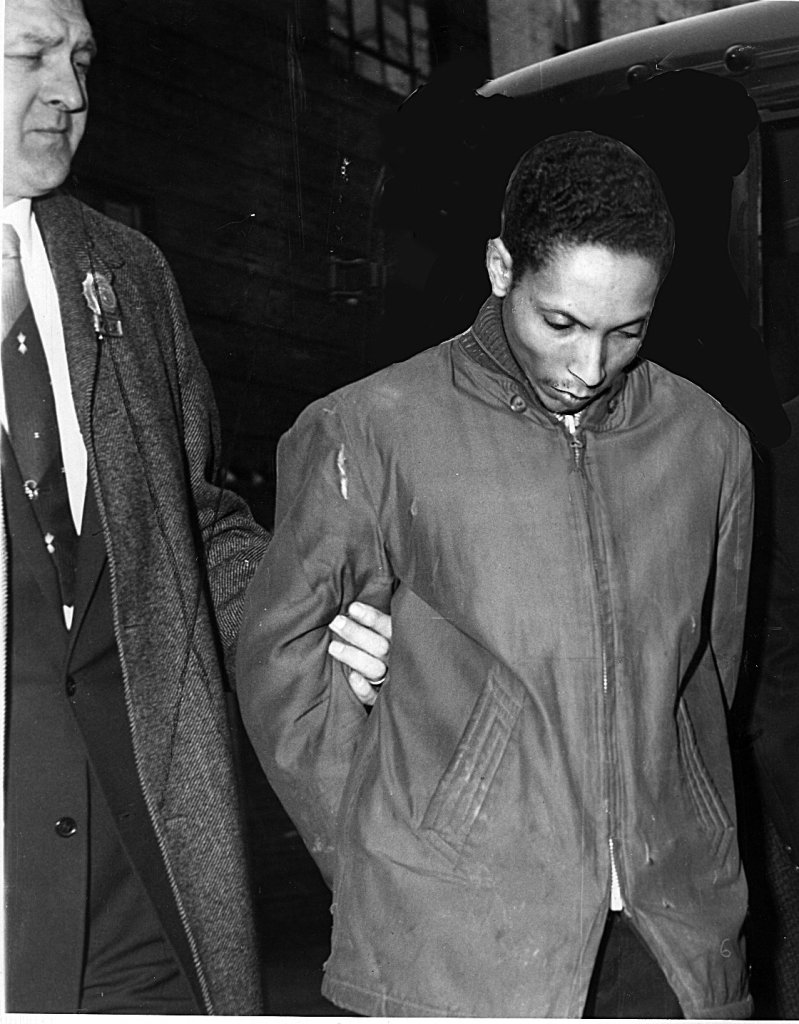
Six days after the body was found in the hallway, police picked up Winston Moseley.
He was 29 years old, a business machine operator, arrested on March 19, 1964, in connection with a burglary.
Moseley confessed.
He confessed to the murder of Catherine Genovese.
He confessed to other crimes, too, including the killing of another woman, Annie Mae Johnson.
The lead detective was involved in the interrogation and the investigation that led to the confession, according to the record.
That is where the documented account narrows.
The specific details of the confession and the interrogation are not in the source.
The record does not say what Moseley told the detective, or how long the questioning lasted.
It does not say whether he volunteered the confession or was coaxed into it.
Those details are not established.
What is established is the relief of an arrest.
What is established is the weight of what else he admitted.
The medical examiner testified about the nature of Genovese's wounds.
The weapon was a knife.
The confession tied the man in custody to the attack at 3:15 a.m.
It tied him to a hallway in Kew Gardens.
It tied him to more than one death.
The timeline had closed on one murder, and opened onto others.
The man who confessed was not just a burglar.
He was a man who said he had killed before.
The record holds the confession.
The record does not hold the room where it happened.
THE TRIAL AND THE VERDICT
The indictment carried a single charge: first-degree murder in the death of Catherine Genovese.
The trial opened in June 1964 in Queens County Court.
The prosecution presented Moseley's confession.
The prosecution also called a neighbor who testified about what he had seen and heard that night.
The specific testimony of that neighbor is not detailed in the source.
The defense argued that Moseley was legally insane at the time of the crime.
The jury heard the argument.
The jury rejected it.
They found Moseley guilty of first-degree murder.
The sentence was death.
It was a verdict with the weight of finality.
It did not hold.
In 1967, Moseley's death sentence was commuted to life imprisonment.
The commutation followed the U.S. Supreme Court's rulings on capital punishment.
The legal twists did not end with the verdict.
They only changed its shape.
Moseley would remain in prison.
He would die there, decades later.
But in June 1964, the courtroom was the whole world of this case.
The confession was on the record.
The witness had spoken.
The jury had answered.
The sentence was death.
That sentence would not survive.
Not because the verdict was wrong.
But because the law moved.
AND THE STORY STILL ISN'T OVER
Winston Moseley died in prison on March 28, 2016, at the age of 81.
He had served more than 50 years.
He had been denied parole multiple times.
The case became a landmark in discussions about bystander apathy and the "bystander effect."
It is a landmark.
It is also a disputed one, because the accuracy of the original 38-witness account has been questioned.
The victim's sister became an advocate for crime victims.
She worked to correct the record about her sister's death.
She participated in the 2016 documentary "The Witness," which examined the case and the disputed details of the 38-witness story.
The site of the murder, the Kew Gardens apartment building, was later demolished.
The timeline still has a hole.
What exactly happened between the first cry and the final call for help remains a matter of dispute.
Did some neighbors call police during the assault?
Did others hear but not act?
Did the attack unfold in two distinct phases, or one continuous horror?
The exact number of witnesses who called police during the assault is not established.
Not in the source.
Not in the record.
The legend says 38 silent witnesses.
Later reporting says some did call.
The documented record is narrower than the legend.
That is the hole.
It has never been filled.
Advertisement
You may also like
The cell tower records that placed Adnan Syed near Leakin Park — and the defense that tore them apart
The note was found in Hae Min Lee's car, and it read "I'm going to kill." Prosecutors argued Adnan Syed wrote it. The defense…
The 2002 fishing trip that Scott Peterson said explained everything — and the boat anchor that didn't match
December 24, 2002, and Scott Peterson reports his eight-months-pregnant wife Laci missing from their Modesto home. He says he spent that morning fishing at…
The white Cadillac witness said he was inside — 27 years later, one man faces trial
A white Cadillac pulled alongside a BMW sedan on the Las Vegas Strip. It was September 7, 1996, and gunfire erupted. The BMW carried…
The phone call that made a friend dial police — and the interview that followed
The missed appointment was a doctor’s appointment, and the phone went unanswered. On August 13, 2018, in Frederick, Colorado, a friend called police to…
The smiley-face confession that made a sister call the police
The note was found in March 1995, near a woman's body in Oregon. It was handwritten, a confession. It was signed with a smiley…
The body drained of blood and posed — and the only clue was a name
The morning of January 15, 1947, in a vacant lot at 39th Street and Norton Avenue in Leimert Park, Los Angeles. A woman's body…