The $5,800 bundle of cash a boy found along a riverbank in 1980
The boy was eight years old, playing along the Columbia River near Vancouver, Washington, in 1980.
He found a rotting bundle of cash half-buried in the sand, three decaying packets of twenty-dollar bills.
The bills were counted out at $5,800.
The serial numbers matched the $200,000 ransom money that had been photocopied before it was handed over on a plane nine years earlier.
That plane was Northwest Orient Airlines Flight 305.
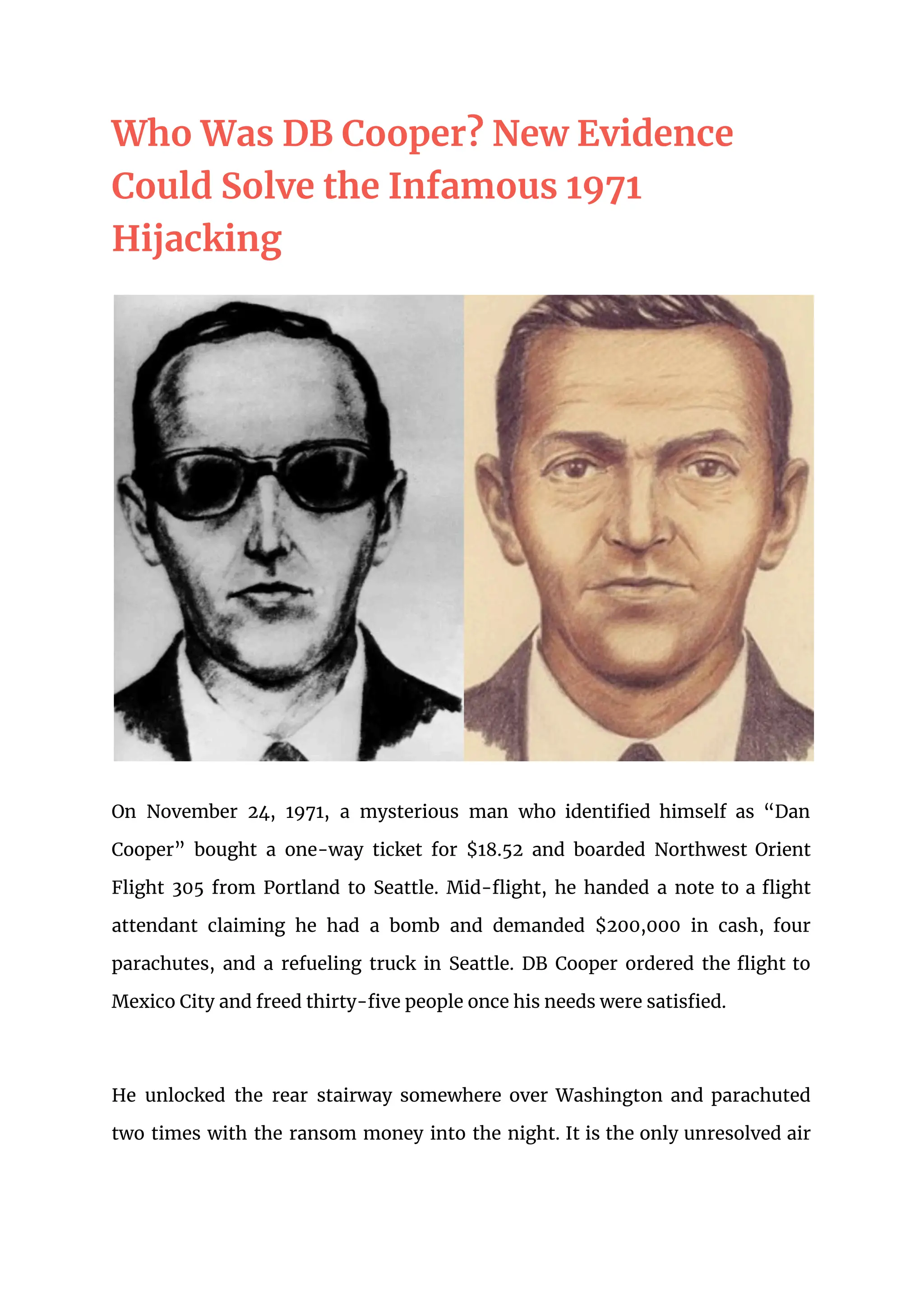
On November 24, 1971, a man using the alias "Dan Cooper" had demanded the money, four parachutes, and a fuel truck in Seattle.
Over southwestern Washington, he jumped from the rear stairway of the aircraft with the cash and two parachutes.
He was never found.
The case remains the only unsolved hijacking in U.S. history.
No one was ever arrested, charged, or indicted in connection with it.
The recovered cash is the only physical evidence ever tied to the crime.
It is a fact of the record, not a solution.
What does the money prove?
That the hijacker survived the jump?
That he lost the bundle, or dropped it, or hid it there?
That someone else carried it to the riverbank?
The record does not say.
The source does not state who left the money on the riverbank, and the identity of the hijacker is not established.
Brian Ingram, the boy, split the $5,800 with the FBI in 1980.
He later sold part of his share at auction.
The rest of the ransom money never surfaced in circulation.
It was lost, destroyed, or hidden.
The pile of cash surfaced nine years later.
It remains what it is: a pile of cash, matched by serial numbers, and nothing more.
THE NOTE AND THE JUMP
He bought the ticket with cash, one-way, Portland to Seattle.
The flight was Northwest Orient Airlines 305, November 24, 1971.
The name he gave was Dan Cooper.
Shortly after takeoff, he handed a note to the flight attendant.
The note said he had a bomb.
He opened his briefcase to show her wires and red cylinders.
He demanded $200,000 in cash, four parachutes, and a fuel truck waiting in Seattle.
The plane landed, and the money and parachutes were delivered.
He released the passengers in exchange for the crew.
He ordered the pilots to fly toward Mexico City at a low altitude.

Somewhere over southwestern Washington, he opened the rear stairway.
He jumped with the money and two parachutes.
He was never found.
The name "D.B. Cooper" came from a wire-service error, a misprint of the alias he gave.
His true identity has never been established.
The source does not state where exactly he landed.
The jump was made over rugged, forested terrain in the dark, in a storm, wearing a business suit and loafers.
He carried no proven survival gear beyond the parachutes he took.
The audacity is the record: a single note, a briefcase of wires, and a clean exit into the night.
The plane landed in Seattle, the money was delivered, and the passengers walked away.
Then he walked away, too.
THE SEARCH AND THE ONLY CLUE
The FBI immediately treated the case as a federal crime.
Agent Ralph Himmelsbach coordinated the search, focused on the area believed to be near the Lewis River in southwestern Washington.
The $200,000 in $20 bills had been photocopied before delivery.
The serial numbers were distributed to banks and financial institutions.
Despite extensive ground searches, no trace of the hijacker or the parachutes was found.
No trace of the man who jumped.
No trace of the two parachutes he carried.
Then, in 1980, a boy named Brian Ingram found a rotting bundle of cash along the Columbia River near Vancouver, Washington.
The bundle held $5,800.
The serial numbers matched the ransom money.
It was the only physical evidence ever recovered.
A child had stumbled on what an army of agents could not find.
The recovered $5,800 was split between Brian Ingram and the FBI in 1980.
Ingram later sold part of his share at auction.
How the money ended up on that riverbank is not established.
Whether the hijacker survived the jump is not established.
The record holds the find.
The record holds the serial numbers.
The record does not hold the man.
SUSPECTS AND THE VIRAL CLAIMS
Several people were publicly suspected over the years.
One man was arrested for a nearly identical hijacking in 1972, but he was never charged in the Cooper case.
Another suspect surfaced in 2000, when his widow claimed he confessed on his deathbed.
The FBI did not substantiate that claim.
A deathbed confession is a claim, not evidence.
The record does not establish that either man was the hijacker.
The FBI interviewed hundreds of suspects over the decades.
None were conclusively linked.
Not because the leads were thin. Because the case never produced a match.
The source does not establish that either suspect was the hijacker.
The FBI closed its active investigation in 2016.
It stated the file remained open to credible leads.
No trial occurred.
No suspect was ever arrested, charged, or indicted.
There was no prosecution to test. There was no defence to answer. There was no judge to rule.
That is the shape of the entire case: a crime without a defendant.
The viral theories fill the gap. The deathbed confessions fill the gap. The record does not.
The record holds the find. The record holds the serial numbers. The record does not hold the man.
That would require evidence.
AND THE STORY STILL ISN'T OVER
The FBI closed its active investigation in 2016.
The file remains open for new leads.
The case remains officially unsolved.
The hijacker's identity remains unknown. No credible suspect has ever been confirmed.
The remaining ransom money has never surfaced in circulation.
Not because it was spent. Not because it was deposited. Because it was lost, destroyed, or hidden.
The source does not state whether the hijacker is alive or dead. The source does not state what happened to the rest of the money.
That would require evidence.
The recovered $5,800 is the only physical evidence ever tied to the case. It was split between the boy who found it and the FBI. The boy later sold part of his share at auction.
The money is real. The man is not.
The case has become a cultural legend. Books examine it. Documentaries explore it. Films dramatize it.
No definitive answer has emerged.
The serial numbers were photocopied before delivery. They were distributed to banks. They matched the bundle found along the riverbank.
They did not match a man.
The FBI interviewed hundreds of suspects over the decades. None were conclusively linked. No one was ever arrested, charged, or indicted.
There was no trial. There was no testimony. There was no defence. There was no verdict.
There was a jump. There was a riverbank. There was a bundle of cash rotting in the mud.
The file stays open. The ache stays quiet. The man stays unnamed.
Advertisement
You may also like
The defense’s claim that McVeigh was a scapegoat — and the witness who testified he built the bomb
The blast at the Alfred P. Murrah Federal Building occurred at 9:02 a.m. on April 19, 1995. It killed 168 people and injured more…
One palm print from the Zodiac's Lake Berryessa attack that no lab could ever match
A palm print and a partial fingerprint were left at the Lake Berryessa scene on September 27, 1969. They are part of the official…
Eleven Branch Davidians on trial: the defense claim of self-defense against a government raid
The warrant was for Mount Carmel Center, a ranch near Waco, Texas, and for the arrest of David Koresh. It was February 28, 1993,…

The truck painter who picked up victims on Pacific Highway South — and the DNA that ended 20 years of silence
He painted trucks for a living, the same job for decades. He lived in Auburn, a Seattle suburb, and went to church. He was…
The fishing trip Scott Peterson said he took — and the evidence that says otherwise
He told investigators he spent the morning of December 24, 2002, fishing alone at the Berkeley Marina. That was the claim. It became the…
The carjacking victim who escaped — and what he told police about the Tsarnaev brothers
The Mercedes SUV was stopped on a Boston-area street on the night of April 18, 2013. Dun Meng was inside it. Two brothers took…