The $5,800 in serial-matched ransom cash that a boy found by the Columbia River
The bundle was rotting when the boy found it.
Brian Ingram was a child that day in 1980, playing along the Columbia River near Vancouver, Washington.
He pulled out $5,800 in cash, waterlogged and decayed.
The serial numbers on those bills were not random.
They matched the $200,000 ransom paid to the hijacker who called himself Dan Cooper on November 24, 1971.
The FBI had recorded every serial number before the money was delivered.
That made the match exact.
The discovery is often cited online as proof the hijacker survived the jump.
That is a theory circulating online, not a fact established by the record.
What the record establishes is narrower: the money was there.
It was in the river, in a rotting bundle, in the hands of a boy.
Whether the hijacker survived the jump is not established by the record.
The discovery only confirms the money was there.
How it got there is a question the evidence leaves open.
It could have been dropped from the air.
It could have been buried and washed out.
It could have been placed there by someone else entirely.
That would require evidence.
The serial numbers are documented fact.
What they prove about the hijacker's fate is not.
She was a flight attendant who handled the note; she has no name in this record beyond her role.
The boy kept some of the bills.
The FBI kept the rest.
The money was real.
The story around it was not yet written.
THE HIJACKING

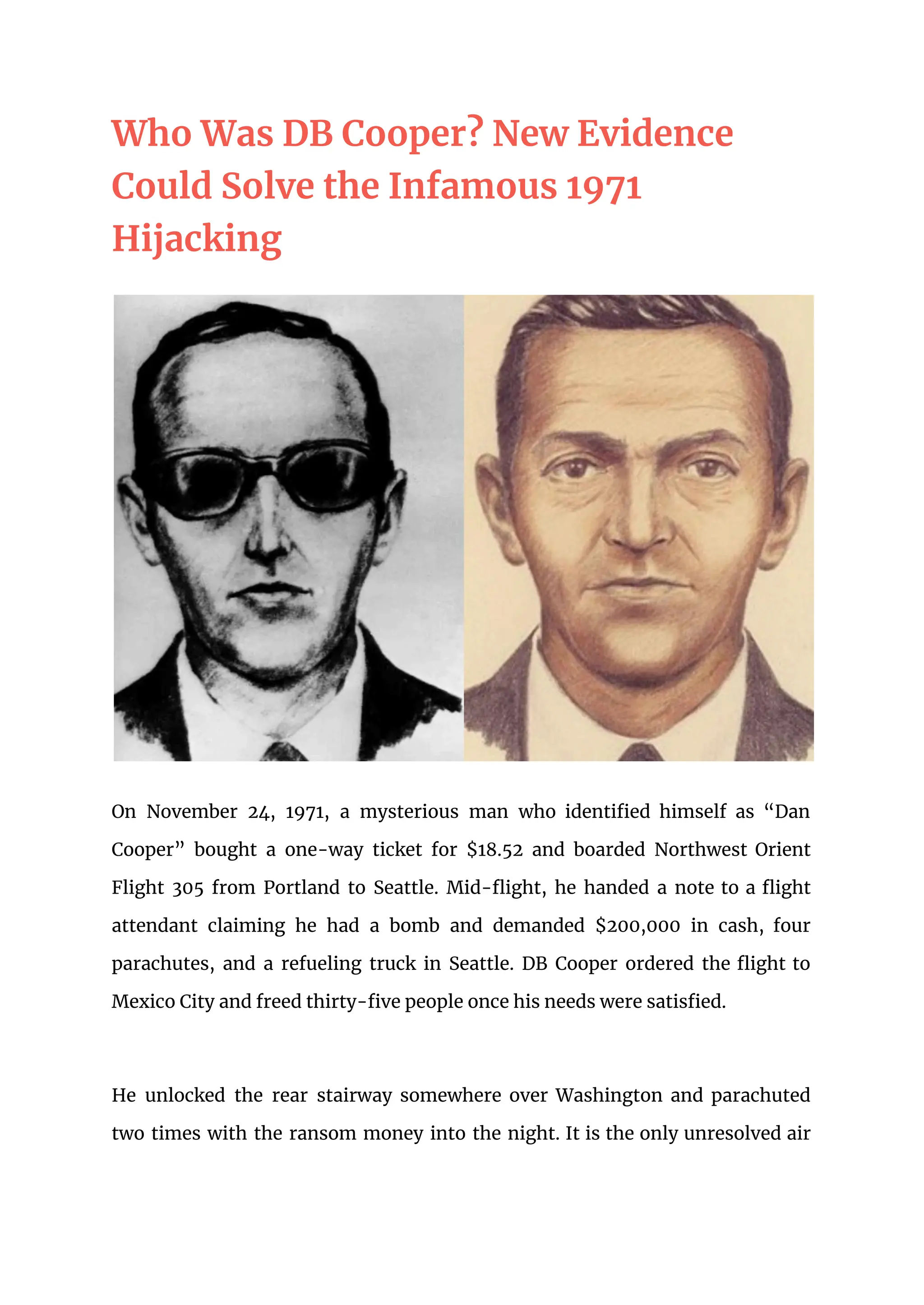
The man bought a one-way ticket on November 24, 1971.
He used the alias "Dan Cooper" on Northwest Orient Airlines Flight 305, from Portland, Oregon, to Seattle, Washington.
Shortly after takeoff, he handed a flight attendant a note.
The note claimed a bomb in his briefcase.
He demanded $200,000 in cash, four parachutes, and a fuel truck waiting in Seattle.
The bomb was never proven real; that is not established.
After landing at Seattle-Tacoma, the passengers were released.
The ransom and the parachutes were delivered.
Cooper then ordered the crew to fly toward Mexico City at a low altitude.
Somewhere over southwestern Washington, he opened the rear stairway of the Boeing 727.
He jumped into the night.
The plane landed in Reno, Nevada, with Cooper gone.
He was never identified.
He was never captured.
The FBI treated the hijacking as a federal crime from the start.
The lead agent was Ralph Himmelsbach, who worked the case for years.
Investigators recorded the serial numbers on all $200,000 in $20 bills before the money was handed over.
They distributed those numbers to banks nationwide.
None of the bills surfaced in circulation.
The man's true identity remains unknown; that is also not established.
The audacity was the evidence problem.
A hijacker who demands exact bills, exact parachutes, exact fuel — and then steps out of a moving jet into a storm — leaves a trail of numbers, not names.
The plane landed with Cooper gone.
The case file would stay open for decades.
THE SERIAL NUMBERS AND THE TIE
The FBI treated the hijacking as a federal crime from the first hour.
Agents recorded every serial number on the $200,000 in $20 bills before the money was handed over.
Those numbers went out to banks and financial institutions nationwide.
None of the bills surfaced in circulation.
Not one.
In 1980, a boy named Brian Ingram pulled a rotting bundle of cash from the mud along the Columbia River.
The serial numbers matched the ransom list.
That match confirmed the money was part of the payoff.
What it did not confirm was where the hijacker went after the jump.
The FBI also had the clip-on tie.
Cooper left it on the airplane, and agents recovered it at the Seattle airport.
In 2001, laboratory analysis found microscopic fragments of beryllium, titanium, and other materials on the tie.
That suggested aerospace or metallurgy work.
It did not produce a name.
The analysis led to no identification, the record states plainly.
The parachutes were examined too.
One was missing its reserve chute.
No forensic trace from any of the chutes ever matched a suspect.
The FBI interviewed hundreds of persons of interest over the decades.
A man who committed a nearly identical hijacking in 1972 was ruled out.
No one was ever arrested.
No one was ever charged.
No one was ever convicted.
The numbers on the bills were exact.
The tie held traces of an industry, not an identity.
The parachutes yielded nothing.
It is a file of near-misses.

It is also a file with no final page.
WHAT THE MONEY PROVES — AND DOESN'T
The serial numbers are documented fact.
What they prove about the hijacker’s fate is not.
The match confirms the money was part of the $200,000 ransom.
It also places the bills, or someone carrying them, near the Columbia River.
That is what the investigation evidence establishes, and that is all it establishes.
The find does not prove Cooper survived the jump.
The money could have been dropped by someone else.
It could have been buried by someone else.
It could have been carried by the river itself.
Those are inferences from the record, not statements in it.
Whether Cooper survived, or whether anyone else handled the money, is not established by the record.
There was no trial.
No suspect was ever arrested.
No suspect was ever charged.
No suspect was ever indicted.
No one was ever convicted.
The FBI never confirmed a single suspect, despite decades of names.
Several suspects were proposed over the years.
One man confessed on his deathbed.
One former airline employee was examined closely.
The FBI never confirmed either.
The case remains the only unsolved air piracy in American history.
What does the money prove?
That it was ransom money.
That it was found where it was found.
That is the whole of it.
The rest is a jump the record does not make.
AND THE STORY STILL ISN'T OVER
The FBI formally closed its active investigation in July 2016, after 45 years.
The bureau cited a lack of new leads.
The case file remains open for new tips, but no active work is being done.
Tips are still reviewed. No hearing is pending. No motion is pending. No decision is pending.
The next concrete step is simply waiting for a call that may never come.
The recovered $5,800 was split between Brian Ingram and the FBI.
Ingram later sold some of the bills at auction.
The rest of the ransom has never surfaced.
Not a single bill from the remaining $194,200 has ever been reported in circulation.
The case has spawned books, documentaries, and films.
No credible identification has ever been made.
Several suspects were proposed. One man confessed on his deathbed. The FBI never confirmed him. A former airline employee was examined closely. The FBI never confirmed him either.
No new leads are known. That is not established by any document or testimony.
The case remains officially unsolved.
It is the only unsolved air piracy in American history.
The serial numbers on those bills are documented fact.
What they prove about the hijacker's fate is not.
The money was found. The money was split. The money was sold.
The rest is a jump the record does not make.
Advertisement
You may also like
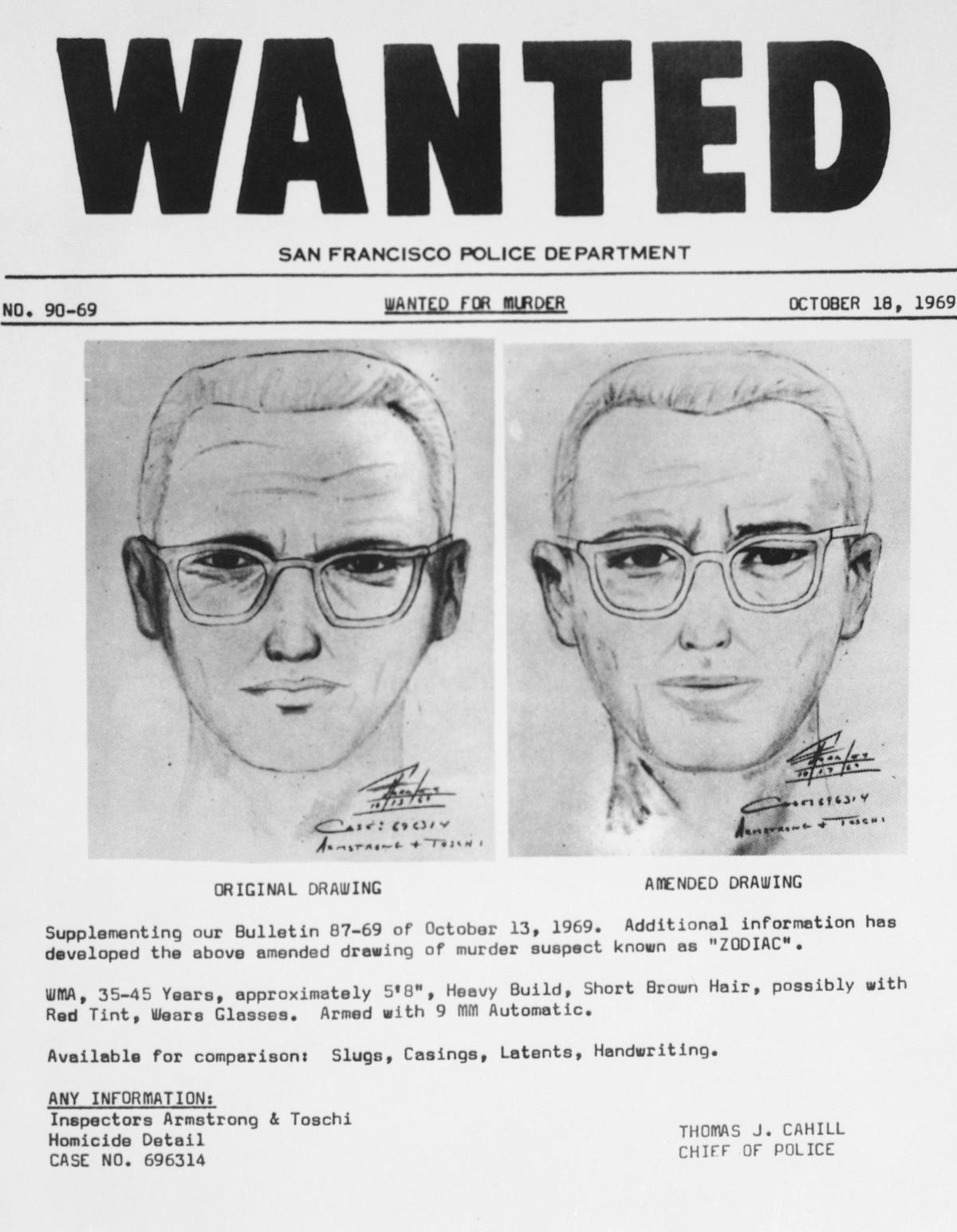
The 408-symbol cipher a schoolteacher solved — and what it said about the afterlife
The 408-symbol cipher sat in the newspaper office, a grid of letters and shapes that looked like a child's game. A Vallejo schoolteacher and…

The left-luggage ticket that cracked the Moors murders case
October 7, 1965. Police searched a house in Manchester and found a left-luggage ticket. Not a weapon. Not a confession. A ticket for Manchester…

The hatchet head in the cellar that never matched the timeline
The cellar was damp and close on the morning of August 4, 1892. In Fall River, Massachusetts, the bodies of Andrew Jackson Borden and…
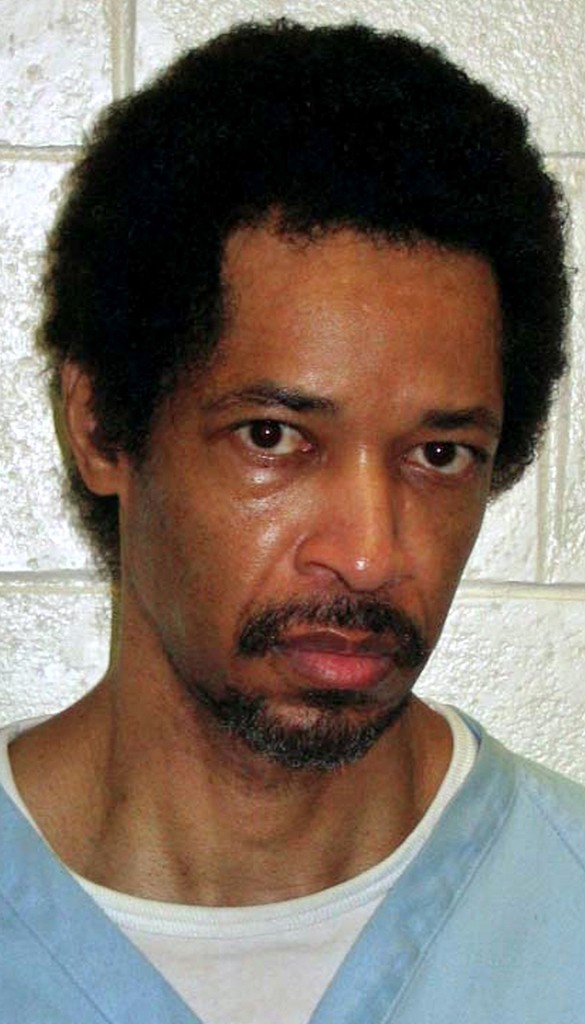
The 2002 sniper shootings: a tip about a Caprice at a rest stop, and the rifle that changed everything
The caller reached the hotline on October 24, 2002. The caller gave a description of a Chevrolet Caprice. Police found the Caprice parked at…
The Thompson submachine gun found in Fred Burke's Michigan home that tied him to the massacre
The Thompson submachine gun sat in a Michigan home, miles from the Chicago garage. Investigators found it in the residence of a man named…
The kennel video that placed Alex Murdaugh at the scene minutes before the murders
On June 7, 2021, Paul Murdaugh’s phone recorded video at the dog kennels on the family estate. The timestamp on that video placed Alex…