The 911 call that ended a decade of captivity on Seymour Avenue
🚨 THE 911 CALL THAT ENDED A DECADE OF CAPTIVITY…
She was on the ground outside.
Amanda Berry had come through the front door of the house on Seymour Avenue, and she was out.
It was May 6, 2013, and she called 911.
The call brought police to the house within minutes.
Inside, they found Berry, Gina DeJesus, and Michelle Knight.
They also found Berry’s daughter, born during the years she was missing.
Ariel Castro, a 52-year-old former school bus driver, was arrested at the scene.
The call is the hinge.
Before it, there were three disappearances spread across two years, and a decade of unanswered questions.
After it, the world learned what had been inside that house.
The exact contents of the 911 call are not detailed in the source.
What the record shows is the call’s existence, the response, and the rescue.
Berry was twenty-nine when she escaped.
She had disappeared in April 2003.
DeJesus had vanished in April 2004.
Knight was taken first, in August 2002.
Three women, one house, one call.
Police arrived within minutes.
Castro was there.
He was taken into custody that day.
What happened inside the house before that call is not something the record lays out in a single line.
It is pieced together from what the women said later, from the locks and chains found inside, from a confession that came after an initial denial.
But on that morning, there was only the call.
And then there were the sirens.
A decade of captivity ended at a front door on Seymour Avenue.
AUGUST 2002 — MICHELLE KNIGHT DISAPPEARS
It is August 2002.
Michelle Knight is kidnapped, the first of the three abductions.
She is taken to the house on Seymour Avenue.
The source does not provide details of the abduction itself.
The circumstances of her abduction are not in the record.
No one knows yet that she is the beginning of a pattern.
Her disappearance is not immediately linked to the later cases.
It is a quiet beginning.
It is a nightmare no one yet knows about.

There is no call yet.
There are no sirens yet.
There is only a missing young woman, and a family waiting.
The record starts there, with an absence.
The record does not say how she was taken.
The record does not say where she was taken from.
The record says she was held.
That is what the record establishes.
August 2002 is the first date.
The other dates will come later.
But for now, there is only this one.
APRIL 2003 — AMANDA BERRY VANISHES
April 2003 is the second date.
Amanda Berry disappeared in April 2003, eight months after Michelle Knight.
She was taken to the same house on Seymour Avenue.
The source does not specify how she was abducted.
The method of her abduction is not detailed in the record.
Berry was sixteen years old when she vanished.
She was on her way home from her job at a Burger King.
The source does not confirm that detail; it is not established.
Berry's family campaigned for years for her return.
They held vigils. They distributed flyers. They never stopped asking.
The years passed, and the asking continued.
She was gone, and the house on Seymour Avenue held its secret.
Two disappearances now. Two families waiting.
The pattern was not yet a pattern.
It would become one.
APRIL 2004 — GINA DEJESUS GOES MISSING
Gina DeJesus disappeared in April 2004.
She was fourteen years old.
She was taken to the same house on Seymour Avenue.
The pattern was now three.
Police searched the Seymour Avenue property in 2004 while looking for DeJesus.
They did not find her.
What the police saw or did during that search is not specified in the record.
Neighbors had reported suspicious activity at the house.
:max_bytes(150000):strip_icc():focal(867x0:869x2)/gina-dejesus-2000-d958d8a5c900452eb149ba531ba2e40f.jpg)
No action was taken.
A house with locks on interior doors, chains, and restraints.
A house where a young woman was being held.
A search that came to the door and left.
The frustration is in the gap between what was reported and what was done.
It is a gap the record does not close.
It is a gap the families would live with for nine more years.
DeJesus was held in the same house.
She was not found.
The search happened.
The search ended.
The house remained.
THE YEARS INSIDE
They were imprisoned in the home of Ariel Castro.
Locked rooms, and restraints.
The source does not detail the specific conditions beyond that.
They were bound.
They were subjected to years of physical and sexual abuse.
Berry’s daughter was born during captivity.
The child grew up inside the house on Seymour Avenue.
The families did not stop.
Amanda Berry’s family campaigned for years for her return.
Gina DeJesus’s family campaigned for years for her return.
Michelle Knight’s family campaigned for years for her return.
The campaigns ran while the women were held blocks away.
The searches happened.
The searches ended.
The house remained.
What the record does not establish is the full texture of those years.
It establishes locked rooms.
It establishes restraints.
It establishes abuse.
It does not establish the daily specifics of the captivity.
That would require testimony the source does not reproduce.
The years passed in the house.
The women were there together.

The child was there too.
The families kept hoping outside.
Inside, the doors stayed locked.
MAY 6, 2013 — THE ESCAPE AND THE CALL
The front door opened.
Amanda Berry came through it, and she was out.
She called 911.
The call brought police to the house on Seymour Avenue within minutes, according to the record.
They found Berry, Gina DeJesus, and Michelle Knight inside.
They found Berry’s daughter, born during the captivity.
They found Ariel Castro, and they arrested him at the scene.
The house was no longer a locked room.
It was a crime scene, then a demolition, then a garden.
The exact sequence of the escape is not in the record.
Not how she got the door open.
Not who was where in the house at that moment.
Not what was said in the first seconds of freedom.
That would require evidence the source does not provide.
What is documented is the call, the response, the rescue.
What is documented is the arrest.
What is documented is that a decade of captivity ended on a Monday afternoon in May.
Berry spoke to the dispatcher, and the dispatcher sent police.
Police arrived within minutes, and the women walked out.
Castro stood there, and he was taken.
The families who had kept hoping outside were told their daughters were alive.
The story shifted from missing to found.
It shifted from locked to open.
It shifted from captivity to freedom, and the shift took minutes.
THE EVIDENCE AND THE CONFESSION
They found the locks first.
Locks on the interior doors, chains, and other restraints, according to the police evidence. The house on Seymour Avenue was not a home; it was a container.
Castro was arrested at the scene, and he initially denied holding the women. He said the opposite of what the locks suggested.
Then he changed.
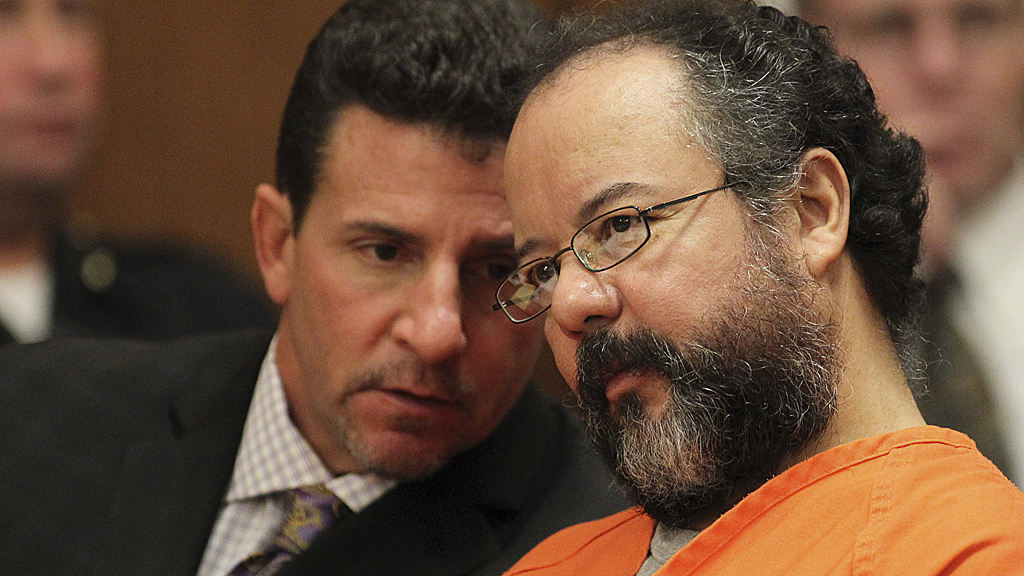
He later admitted to the kidnappings and the abuse, according to the investigation. His confession to police and prosecutors marked the turning point in the case. It was the moment denial gave way to something the record could hold.
The victims themselves provided detailed accounts of their captivity. Their testimony was part of the evidence, and it was corroborated by the physical findings. The chains matched the stories. The locks matched the rooms.
What the confession contained in full is not detailed in the record. The exact words, the order of admissions, the depth of what he said — none of that is established here. What is established is that he confessed.
It is a heavy weight, the admission. It is also a simple one: he said he did it.
The evidence did not need to speak louder. It had already locked the doors.
THE PROSECUTION AND THE PLEA
The number 977 is a count of acts, not a measure of them.
Each count was a separate charge: kidnapping, rape, aggravated murder.
The aggravated murder charge came from the termination of a pregnancy of one of the victims.
Prosecutors said the case demanded the death penalty.
Castro faced that possibility.
In July 2013, he pleaded guilty to 937 counts.
The plea agreement was struck to avoid the death penalty.
It was a trade: a full admission for a life in prison.
The prosecution, led by Timothy McGinty, agreed to the deal.
The defense, led by Jaye Schlachet, agreed to the deal.
Judge Michael Russo accepted it.
He sentenced Castro to life without parole, plus 1,000 years.
The sentence is a number with a weight of its own.
Life without parole. Plus a thousand years.
The thousand years are symbolic; the life is literal.
What the defense argued in that negotiation is not detailed in the record.
The strategy, the reasoning, the alternatives weighed — none of that is established here.
What is established is the result: 937 guilty pleas.
It is a resolution. It is also a ledger.
The trial never happened.
The confession had already spoken. The plea made it official.
THE VIRAL CLAIM AND THE RECORD
The 911 call is the pivot of the story, the moment the decade tipped.
It is also the part the record holds at arm's length.
The source does not provide the call's transcript or its audio.
What it establishes is the sequence: the escape, the call, the response, the rescue, the arrest.
Amanda Berry escaped through the front door on May 6, 2013, and she called 911.
Police arrived within minutes.
They found Berry, Gina DeJesus, and Michelle Knight, along with Berry's daughter.
They arrested Ariel Castro at the scene.
That is the documented record.
The content of the call itself is not in the record.
What words were spoken, what was said to the dispatcher, how the voice sounded—none of that is established.

Online theories about the case are not mentioned in the source at all.
The source does not address them, does not confirm them, does not deny them.
It simply leaves them outside the record.
So what remains is a shape.
A call was made.
It was made from a house on Seymour Avenue.
It brought police to that address.
It ended a captivity that had lasted from August 2002 to May 2013.
That is the fact.
What was said in that call?
That would require evidence.
What theories circulate about it?
That would require a source.
The call exists.
The response happened.
The women were rescued.
The man was arrested.
The record holds the beginning and the end of that moment, and not the voice in between.
It is a resolution.
It is also a limit.
AND THE STORY STILL ISN'T OVER
Castro was found dead in his prison cell on September 3, 2013.
The coroner ruled it a suicide by hanging.
He had been sentenced about two months earlier.
He did not appeal.
The house on Seymour Avenue was demolished in August 2013.
The site became a memorial garden.
Berry and DeJesus have published books.
They have become advocates for missing persons.
Knight, now Lily Rose Lee, has written a memoir.
She has spoken publicly about her ordeal.
The Cleveland police reviewed their handling of the missing persons investigations.
The outcome of that review is not specified in the record.
No formal charges were brought against police.
No other arrests were made.
The families have continued to speak.
The story holds its aftermath, not its closure.
It is a resolution.
It is also a limit.
Advertisement
You may also like

The DNA under her fingernails that cracked a 17-year cold case — but left one question open
🚨 THE NEIGHBOR'S CALL THAT OPENED A 17-YEAR WAIT… A neighbor in Bellaire, Texas, called police about a break-in at a home on June…

The 4-day gap between a 5-year-old's abduction and a suspect's arrest in her murder
🚨 THE 4-DAY GAP July 15, 2002, in Stanton, California: a man asks a five-year-old for help finding a lost dog. The friend runs…
The grandmother's 911 call that started it all — and the family story that never fit
🚨 THE 911 CALL THAT DIDN'T MATCH THE FAMILY'S STORY The 911 call came on July 15, 2008, from a grandmother named Cindy Anthony.…
The missing boy's ring found in a crawl space — 27 bodies later
🚨 THE RING IN THE CRAWL SPACE The ring was small, gold, and it belonged to a missing 15-year-old boy. Police found it on…
The 2005 Aruba nightclub exit that left three men with stories that never matched
🚨 THE EXIT THAT STARTED EVERYTHING The club was called Carlos'n Charlie's, a bar and nightclub in Oranjestad, Aruba. Natalee Holloway, 18, from Mountain…

The tarot card message that turned a random killing spree into a hunt for 'God'
🚨 THE TAROT CARD THAT READ 'CALL ME GOD' The card was a piece of evidence, found at a crime scene during the investigation…