Buried in a Sacramento backyard: the Social Security checks that told on Dorothea Puente
The last check arrived in November 1988.
A social worker phoned the Sacramento police about a missing client, an elderly tenant of the boarding house at 1426 F Street.
The tenant had vanished, but his Social Security check had not.
Between 1982 and 1988, at least seven tenants of that house disappeared, according to the case record.
Their checks kept coming.
Investigators found the payments were cashed and deposited into the accounts of the boarding house owner, Dorothea Puente, according to investigation findings.
Detectives also found that Puente had used the aliases of some victims to collect their benefits, according to detective findings.
The exact number of checks cashed after each tenant's death is not specified in the record.
So the question hangs over the case file: how long did the paper trail run before anyone noticed the people had stopped?
A month?
A year?
Seven years?
That would require evidence the record does not supply.
What the record does supply is the eerie disconnect itself.
People vanished.
Paper persisted.
The checks kept coming.
THE BACKYARD EXCAVATION
A social worker reported a missing client.
Police went to the boarding house at 1426 F Street.
Officers found one body buried in the backyard.
They dug.
Subsequent excavation uncovered six more.
Seven bodies in all.
The remains were in advanced stages of decomposition.
Identification was difficult.
Forensic odontology and dental records were used to identify several victims.
The exact timeline of the excavation is not in the record.
How long the digging took is not in the record.
The bodies were there, and then they were counted.
The boarding house stayed up for two more years.
It was demolished in 1990.
The property was cleared.
The ground gave up what it held.
Then it was leveled.
That is what the record shows.
Nothing more.
THE HANDYMAN'S SHOVEL
The live-in handyman helped with maintenance at the boarding house.
He later testified at trial.
He said he dug graves at Puente's request.
He believed they were for pets.
That is what the trial testimony records.
His name is not used here.
His exact relationship with Puente beyond employment is not detailed in the record.
The digging was work.
The digging was normal.
The digging was done with a shovel, in the backyard, under a standing instruction from the woman who paid him.
No direct witness to the killings was produced.
The investigation produced no one who saw a death.
It produced no one who saw a body being buried.
What it produced was a pattern.
Missing tenants.
Buried bodies.
Cashed checks.
The checks kept coming after the tenants stopped being seen.
The handyman's testimony placed the graves in the ground.
The forensic work placed the bodies in the graves.
The financial records placed the money in Puente's accounts.
Each piece was circumstantial.
Each piece pointed the same way.
The pattern was overwhelming.
That is what the record shows.
Nothing more.
TWO STORIES, ONE JURY
The state’s case was a stack of checks, a shovel, and a pattern.
The prosecution argued that Puente killed her tenants to steal their Social Security checks.
The defense argued that the deaths were accidental or natural, and that Puente panicked and buried the bodies.
Two stories, one jury.
Puente was charged with nine counts of first-degree murder.
Two of those counts were later dropped.
The trial began in 1992.
The prosecution pointed to the cashed checks, the aliases, the bodies in the yard.
The defense pointed to the absence of a direct witness.
No one saw a killing.
The handyman testified that he dug graves at Puente’s request, believing they were for pets.
That was the closest the record came to a confession.
In 1993, the jury convicted Puente of three counts of first-degree murder.
They acquitted her of three others.
The specific evidence that led the jury to convict on three counts and acquit on three others is not detailed in the record.
That is not established.
What is established is the sentence: life in prison without the possibility of parole.
The judge imposed it.
The pattern was overwhelming.
The verdict was partial.
The record holds both.
AND THE STORY STILL ISN'T OVER
Dorothea Puente died in prison on March 27, 2011, at age 82.
She was serving her life sentence at the Central California Women's Facility in Chowchilla.
The case record states she died there.
The boarding house at 1426 F Street was demolished in 1990.
The case remains one of the most notorious serial murder cases in Sacramento history.
The record says that, too.
Family members of the victims have spoken publicly over the years about the loss.
They spoke about the slow process of identification.
They spoke about the slow process of justice.
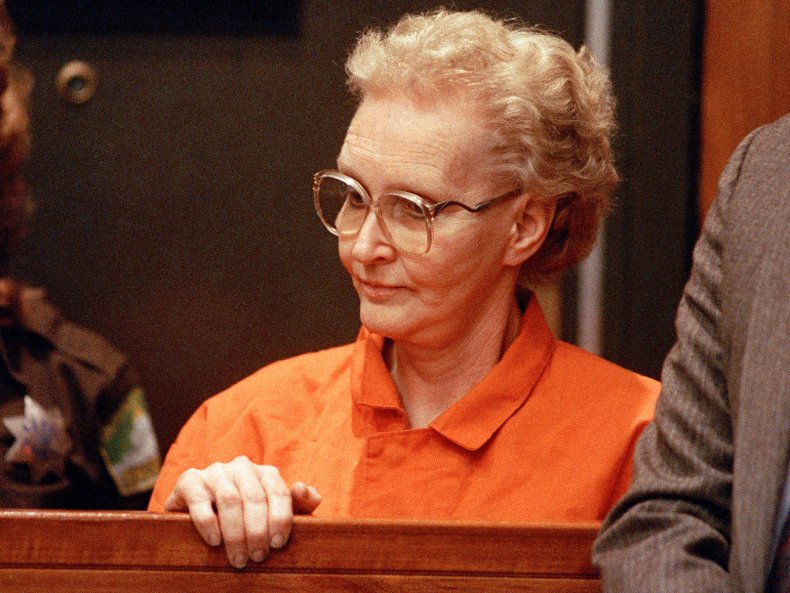
Was every body identified?
The record does not say.
Were all the counts answered?
The record holds the acquittals.
The jury convicted Puente of three counts of first-degree murder and acquitted her of three others.
Two counts were dropped before trial.
The verdict was partial.
Something ended in 2011.
Something else did not.
Whether any further legal proceedings or investigations are ongoing is not stated in the record.
The checks stopped coming.
The backyard was cleared.
The graves were opened, and the bodies were taken out.
Seven bodies were exhumed from the property.
The identification took time, and the record says it was difficult.
The remains were in advanced stages of decomposition.
The families' grief is in the record.
The closure is not.
Puente's death closed the case file.
It did not close the questions.
The pattern was overwhelming.
The verdict was partial.
The record holds both.
It still holds them.
Advertisement
You may also like
The bite marks on Lisa Levy that tied Ted Bundy to the Chi Omega murders
The bite marks were on the buttocks of Lisa Levy. They were found at the Chi Omega crime scene, in the sorority house where…
The smiley-face confession letter that exposed a truck driver's killings
In March 1995, the body of a woman was found near a rest stop in Oregon. She had been strangled. Her body was left…
The discarded coffee cup that unmasked the Golden State Killer after 40 years
In April 2018, investigators picked up a coffee cup a man had thrown away. They took it, bagged it, and ran the DNA against…
The cellphone confession found in the boat where Dzhokhar Tsarnaev hid
The boat sat in a Watertown backyard, under a tarp, on the morning of April 19, 2013. The city had been locked down. The…
The ladder plank in Hauptmann's attic that sealed his fate
The plank had a name, or at least a number, before it had a story. In September 1934, police searched Bruno Richard Hauptmann's home…
The love letters scattered beneath a crabapple tree that investigators could not trace
The crabapple tree stood in a secluded lane called Lovers' Lane, near St. John's Episcopal Church in New Brunswick, New Jersey. On the night…