The bushy-haired intruder Dr. Sam Sheppard said he saw — but the blood spatter told a different story
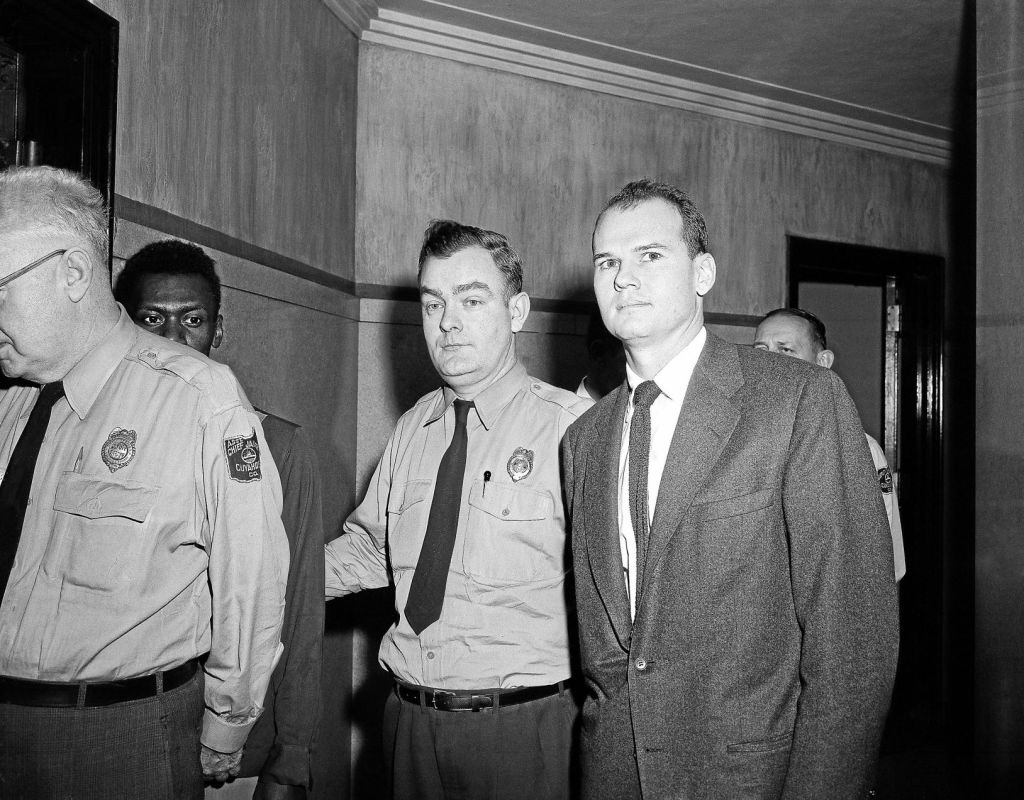
The neighbor found him calling out on the lawn.
It was July 4, 1954, in Bay Village, Ohio, a lakeside suburb of Cleveland.
Dr. Sam Sheppard, a 29-year-old osteopathic physician, told police he had been asleep on a downstairs couch.
He said his wife's screams woke him.
He said he saw a "bushy-haired" intruder fleeing the house.
He said he struggled with the man and was knocked unconscious.
When he came to, he said, he found his wife Marilyn, 31, dead in the upstairs bedroom.
The couple's 7-year-old son, asleep in another room, was unharmed.
The neighbor, alerted by Sam Sheppard's calls, placed the call to authorities.
Police found no sign of forced entry.
The murder weapon—a blunt instrument, possibly a flashlight—was never found.
It is not established that any bushy-haired intruder existed.
That is Sam Sheppard's account, not a documented fact.
He told it to police that night.
He would keep telling it.
The record holds his words, and the blood spatter, and little else that matches.
THE SCENE AND THE BLOOD SPATTER
Police found no sign of forced entry at the lakeside home.
The Cuyahoga County coroner, who performed the autopsy, concluded the killer struck Marilyn with a heavy object, possibly a flashlight.
He testified that the attack was violent and personal.
He testified that the blood spatter in the bedroom indicated the killer was not the "bushy-haired intruder" Sam described.
The blood spatter indicated someone who knew the layout of the house.
Investigators noted Sam Sheppard's inconsistent statements about his movements that night.
They noted his failure to call police himself; a neighbor placed the call after Sam's cries for help.
The case against him was largely circumstantial.
It was built on motive—allegations of an extramarital affair—and on the coroner's forensic testimony.
The murder weapon was never found.
The investigation was criticized for sloppy handling of the crime scene.
It was criticized for failing to preserve evidence.
It was criticized for the lack of a thorough search for the weapon.
The coroner's testimony contradicted the intruder story.
The missing weapon left the gap open.
Was the killer someone who knew the house, as the spatter suggested?
Was it a stranger who left no sign of entry?
That would require evidence.
The record holds the coroner's words, and the blood spatter, and little else that matches.
The identity of the killer is not established by physical evidence.
THE TRIAL AND THE VERDICT
The indictment came down in August 1954.
The trial opened in October before a judge who would later draw criticism for how he managed the courtroom.
The prosecution called the coroner, who repeated his blood-spatter testimony on the stand.
The prosecution also put a nurse on the witness stand; she testified about her relationship with Sam Sheppard.
The motive, prosecutors argued, was rage over that affair.
The defense answered that the investigation had been botched from the first night.
The defense said the bushy-haired intruder was plausible, that police had never searched properly for the weapon, that the crime scene had been handled carelessly.
The case against Sheppard was circumstantial.
No direct evidence placed him at the murder scene beyond his own account of the night; that is not established by the record.
The jury deliberated for three days.
On December 21, 1954, they returned a guilty verdict.
Sheppard was sentenced to life in prison.
The conviction was upheld on appeal.
Not because the evidence was overwhelming.
But because the appeals courts, at that time, found no reversible error.
The blood spatter had carried the prosecution's case.
The bushy-haired intruder had carried the defense's.
The jury chose the blood spatter.
That would require evidence, and the evidence was the coroner's word against a story no one could confirm.
THE SUPREME COURT AND THE RETRIAL
Ten years after the verdict, Sam Sheppard had a new lawyer.
F. Lee Bailey filed a habeas corpus petition in 1964.
He argued that pretrial publicity and the judge's failure to sequester the jury had denied Sheppard a fair trial.
In 1966, the U.S. Supreme Court agreed.
The Court ruled in *Sheppard v. Maxwell* that the trial had been tainted by a "carnival atmosphere."
The conviction was thrown out.
Sheppard was retried in 1966.
His defense team, led by Bailey, argued the evidence was insufficient.
They did not need the bushy-haired intruder this time.
They needed the record to fail, and the record failed.
The jury acquitted him on November 16, 1966.
The acquittal did not establish innocence.
It established that the evidence was insufficient.
That is a legal fact, not a moral one.
Sheppard returned to medicine.
He struggled with alcoholism.
He faced legal troubles.
He died of liver failure on April 6, 1970, at age 46.
The blood spatter had won the first trial.
The Supreme Court had won the second.
The question of who killed Marilyn Sheppard was never answered by any jury, any coroner, or any court.
It remains a question.
AND THE STORY STILL ISN'T OVER
In 1995, Sam and Marilyn’s son, Sam Reese Sheppard, filed a wrongful-death lawsuit against the state of Ohio.
He was seeking to have his father declared innocent.
The case went to trial in 2000.
A jury found that Sam Sheppard had not proven his innocence.
The suit was dismissed.
DNA testing on evidence from the crime scene, conducted in the late 1990s, was inconclusive.
It is not established who killed Marilyn Sheppard.
The record does not resolve it.
The murder of Marilyn Sheppard remains officially unsolved.
It is a famous case.
It is also an open one.
The Supreme Court ruling reshaped standards for pretrial publicity.
That ruling is why the case is widely considered one of the most famous in American legal history.
But the ruling answered a legal question, not a forensic one.
The bushy-haired intruder was never found.
The blood spatter pointed away from him, according to the coroner’s testimony.
No physical evidence ever confirmed who actually struck the blows.
The son spent years trying to clear his father’s name.
He did not succeed in court.
He did not succeed with the DNA.
What remains is the question.
It remains a question.
Advertisement
You may also like
A tip from a truck driver led police to a parked Chevrolet Caprice — what they found inside
A truck driver made a call on October 24, 2002. The tip led police to a rest stop on Interstate 70 near Myersville, Maryland.…
The cellphone pings that placed Adnan Syed near Leakin Park — and the defense that never called one key witness
The cellphone records put Adnan Syed near Leakin Park around the time of the burial, according to the prosecution's case. A ping, a tower,…
The 1993 slumber party abduction that would take 64 days to resolve
The window was unlocked. On the night of October 1, 1993, an intruder entered through it at a home in Petaluma, California. Inside, twelve-year-old…
The cell tower data and Jay Wilds's story that freed Adnan Syed
She left Woodlawn High School on January 13, 1999, and never came home. Hae Min Lee was 18, a senior, and her body was…
The tip from a cellmate that sent two ex-cons to a Kansas farmhouse — but the safe was a lie
In 1959, a man in a prison cell told Richard Hickock about a safe. The man said he had once worked for Herbert Clutter,…
The 31-day gap and the nanny who never existed: Casey Anthony's first lie
She had a name before she had a body. On July 15, 2008, a two-year-old girl named Caylee Anthony was reported missing by her…