The 'bushy-haired' intruder Sheppard said he chased — and the question that haunted a courtroom
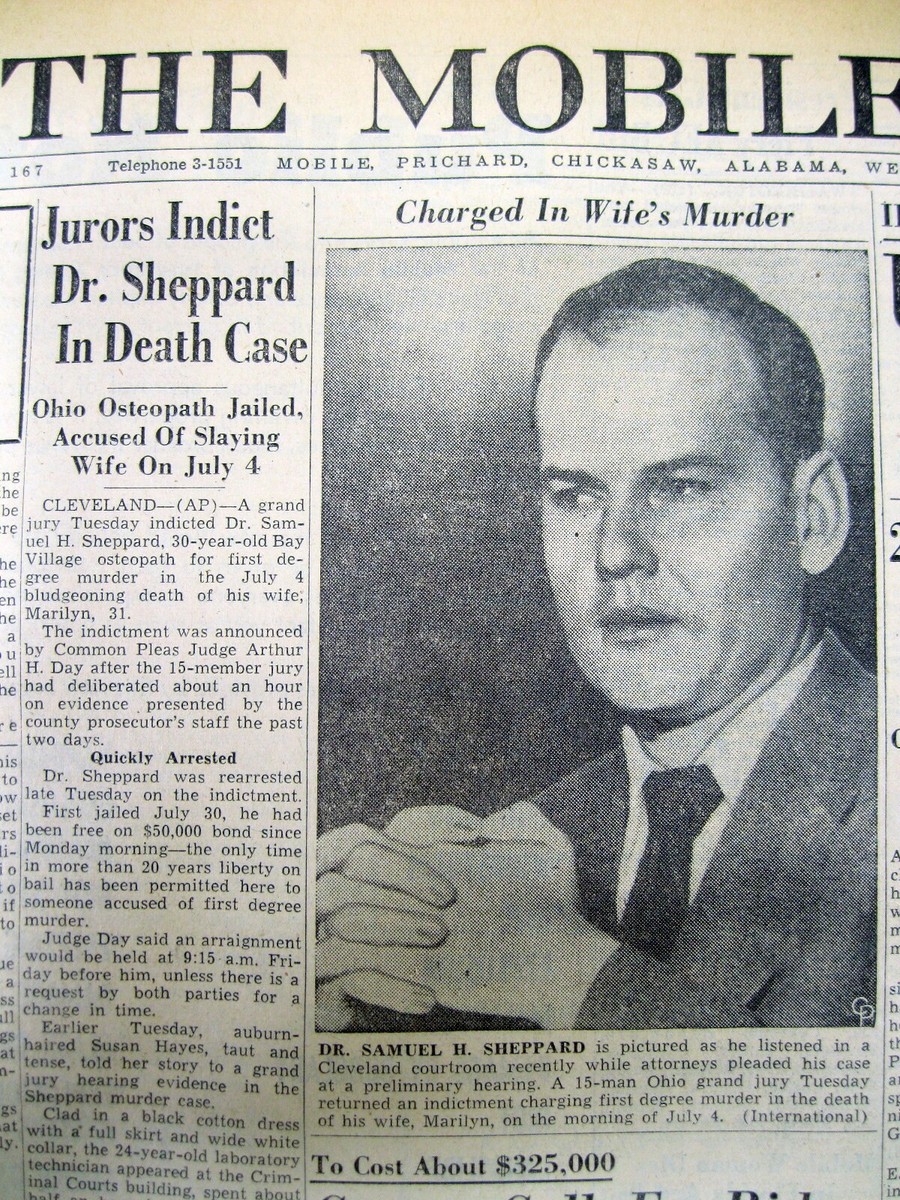
He told police he was asleep on a downstairs daybed when he heard noises.
Dr. Sam Sheppard said he went upstairs, struggled with an intruder, and was knocked out.
When he came to, he said, his wife Marilyn was dead in their upstairs bedroom.
He said he chased the intruder — a "bushy-haired" man — out of the house and down to the Lake Erie lakefront.
That was the story he gave on July 4, 1954, in Bay Village, Ohio.
Police found no sign of forced entry at the lakeside home.
The weapon was never recovered.
Whether any intruder existed was never established.
The record does not establish that the weapon was a surgical instrument, though prosecutors later theorized it was.
The chase ended at the water.
There was no intruder in handcuffs.
There was no weapon on the sand.
There was only a doctor's account of a man who vanished into the lakefront dark.
The case drew intense media attention immediately.
Newspapers picked up the story within hours.
A prominent physician, a beautiful wife, a holiday weekend, a lakeside house.
The details were made for front pages.
And the questions were made for a courtroom that would not convene for months.
How does a chase end with no one caught?
How does a break-in leave no broken lock?
That would require evidence.
THE DAYBED AND THE 911 CALL
He said he was asleep on a downstairs daybed when he heard noises.
He went upstairs, he said, and struggled with the intruder.
He was knocked out, he said.
When he regained consciousness, he found Marilyn dead in their upstairs bedroom.
Then he chased the intruder to the lakefront.
The couple's 7-year-old son was asleep in another room.
The boy was not harmed.
Sheppard's brothers, both physicians, arrived at the scene early.
They supported him publicly.
He told the story with a frantic urgency.
A chase, a struggle, a knockout, a discovery.
The sequence feels both frantic and oddly calm.
Why no forced entry?
Why no sign of anyone else?
Why was the boy untouched?
The exact sequence of events inside the house is not established.
Whether Sheppard was actually unconscious is not established.
He said he was.
That is what he said.
THE CIRCUMSTANTIAL CASE
Police found no sign of forced entry.
That was the first fact, and it pointed one way.
They focused on Sheppard almost immediately.
The coroner did not wait for the trial. He held press conferences. He released details. He told reporters, before any jury heard a word, that Sheppard had done it.
The prosecution's case was built on what was not there.
No weapon was ever found. The murder weapon was never identified, then or later. Prosecutors theorized it was a surgical instrument; that was theory, not evidence.
They argued Sheppard beat his wife with that instrument. They argued his intruder story was implausible. They argued an alleged affair showed motive.
The affair was alleged. It was never proven in court.
The defense answered with the scene itself. The murder was committed by an intruder, they argued. Police mishandled the scene. They pointed at the doors, the windows, the lack of forced entry the police had already noted.
The trial began in October 1954.
It lasted eight weeks.
The courtroom was full of cameras. The judge allowed them. The jury was not shielded from the press. The coroner's press conferences had already filled the papers before a single witness testified.
On December 21, 1954, the jury found Sheppard guilty of second-degree murder.
He was sentenced to life.

The case rested on suspicion. It rested on a story the prosecution called implausible. It rested on a weapon that did not exist in the record.
It rested on a man saying he was innocent.
That would require evidence.
THE CARNIVAL ATMOSPHERE
The courtroom had cameras.
The judge allowed them in, and he made no effort to shield the jury from the press.
The trial ran for eight weeks under what the Supreme Court would later call a “carnival atmosphere.”
Newspapers printed theories before witnesses testified. The coroner held press conferences, releasing details that fed the frenzy.
Journalist Dorothy Kilgallen covered the trial and publicly criticized the verdict.
She was not alone in her doubts, but the jury had already spoken.
On December 21, 1954, they found Dr. Sam Sheppard guilty of second-degree murder.
The conviction was upheld on appeal in 1956.
In 1964, the U.S. Supreme Court declined to hear the case.
But a federal habeas corpus petition succeeded.
In 1966, the Supreme Court ruled in *Sheppard v. Maxwell* that the trial had been fundamentally unfair.
The media had created the carnival. The judge had failed to control it.
Sheppard was released on bail. A retrial was ordered.
The Supreme Court did not rule on guilt. It ruled only on the fairness of the trial.
Whether the original verdict was correct — that was not established.
The system itself was on trial that day. How could the media be allowed to dictate justice?
The cameras had filmed the circus. The law had to clean up the ring.
Sheppard walked out on bail, waiting for the second chance the Court had given him.
AND THE STORY STILL ISN'T OVER
The retrial began eleven years after the first verdict.
The prosecution's case collapsed.
On November 16, 1966, a jury acquitted Sam Sheppard of murdering his wife.
He walked out of the courtroom a free man.
The cameras that had once filmed the circus now filmed his release.
The "bushy-haired" intruder remained a ghost.
No evidence of such an intruder was ever found.
The weapon was never recovered.
Who actually killed Marilyn Sheppard was not established.
Sheppard returned to medicine briefly.
His medical license was suspended.
He became a professional wrestler for a time.
He struggled with alcoholism.
He died on April 6, 1970, of liver failure, at age 46.
The man who spent a decade fighting for his name spent his last years in the ring.
In 1998, his son filed a wrongful-death lawsuit against the state of Ohio.
He sought to have his father declared innocent.
In 2000, a jury found that Sam Sheppard had not murdered his wife.
The ruling did not formally exonerate him.
It was a finding, not a verdict.
It was a conclusion, not a pardon.
The record still does not establish who killed Marilyn Sheppard.
The case remains a landmark in American legal history.
It is cited in debates about media influence on trials.
It is cited in debates about the right to a fair trial.
The carnival atmosphere had a name now.
The law had cleaned up the ring.
But the ghost of the bushy-haired man still haunted the lakeside house.
Was justice ever truly served?
That would require evidence.
That would require a weapon.
That would require a name.
The record offers none of these.
Advertisement
You may also like
The parking ticket that led police to Son of Sam's door
The ticket was for parking, issued near one of the attacks. It led officers to a car registered to David Berkowitz, a 24-year-old postal…
The 1999 drive home from Woodlawn High — and the ride request that still haunts the timeline
The ride request was made on a Wednesday. January 13, 1999, was the day Hae Min Lee, an 18-year-old senior at Woodlawn High School,…
The 911 call that started it, and the search that missed Caylee's remains for months
The 911 call came on July 15, 2008. Cindy Anthony told the dispatcher that her 22-year-old daughter, Casey Anthony, and her 2-year-old granddaughter, Caylee…
Why the FBI's tear gas assault on Waco preceded a fire that killed 76 — and who started it remains unknown
On April 19, 1993, FBI armored vehicles punched holes into the walls of the Mount Carmel Center compound near Waco, Texas, and inserted tear…
The desert graves that were found three years after a family vanished
The television was still on. Uneaten dinner sat on the table. The family dog was in the backyard. Both vehicles were still at the…
The false babysitter story that unraveled Casey Anthony's defense
She gave them a name. A babysitter named Zenaida Fernandez-Gonzalez, she told investigators, had taken her daughter. The name was repeated in news coverage.…