The escalator in an Ohio bar that a medical student never walked away from

🚨 THE 2 A.M. FRAME THAT NEVER RESOLVES
The escalator in the Ugly Tuna Saloona was still under renovation that night.
At approximately 2 a.m. on April 1, 2006, surveillance video inside the Columbus bar captured Brian Shaffer, a 27-year-old medical student, walking toward the main entrance.
He is never seen leaving through any exit.
The footage shows him on a second camera near the escalator, a moment that has become the focus of online scrutiny.
A theory circulating online suggests he never left the building via normal exits — a claim, not a fact established by the record.
What happened to Shaffer after the 2 a.m. frame is not established.
No body was ever found.
No crime scene was ever identified.
The frame itself is documented. The escape is not.
Was there a second way out? Was there a third camera the police missed? Was there a door that did not exist on the blueprints?
That would require evidence.
Police reviewed the surveillance footage from the Ugly Tuna Saloona, per the Columbus Division of Police.
They saw him enter. They saw him near the escalator. They never saw him leave.
He was 27. He was a medical student at Ohio State University. He had been out with friends, and after a brief separation, he never returned to his apartment.
The escalator hummed. The bar closed. The cameras kept recording.
And Brian Shaffer was on the ground below, or above, or somewhere the lenses never caught — that is what the record does not say.
THE NIGHT OUT
He was 27 years old. He was a medical student at Ohio State University.
On the night of March 31, 2006, Shaffer went out with friends in the Gateway district near campus, according to the case summary. He was with his friend William "Billy" Flanagan.
Flanagan was interviewed by police. He was never named as a suspect.
The night was ordinary. Drinks, conversations, a bar full of people.
Then came a brief separation from his group. The exact circumstances of that separation are not detailed in the record.
Shaffer never returned to his apartment. That much is established.
His disappearance was reported to police on April 3, 2006. He had failed to show up for a planned trip. He had missed classes.
Two days passed between the night out and the report. Two days of unanswered calls. Two days of an empty apartment. Two days that the record does not fill in.
His father, Randy Shaffer, and his girlfriend, Alexis Waggoner, made the report. They were the first to say he was gone.
The bar closed. The cameras kept recording. He was last seen on surveillance video at approximately 2 a.m. inside the Ugly Tuna Saloona.
No body was ever found. No crime scene was ever identified. No suspect was ever named.
That is what the record establishes. It establishes a night out, a separation, and a silence that followed.
THE 911 CALL AND THE FIRST REPORT
Two days passed before anyone filed the report.
On April 3, 2006, Brian Shaffer's father, Randy Shaffer, and his girlfriend, Alexis Waggoner, were the first to report him missing to the Columbus Division of Police.
The report came after Shaffer failed to show up for a planned trip and missed classes.
He was a 27-year-old medical student at Ohio State University.
A man who kept appointments did not keep this one.
The exact content of that 911 call or the missing person report is not in the record.
It is not established what was said, how long the call lasted, or which words were used to describe the fear.
What the case summary establishes is the date: April 3.
What it establishes is the action: a father and a girlfriend walked into a police station, or picked up a phone, and named a missing man.
The lead detective assigned to the case was Sergeant John Hurst of the Columbus Division of Police.
He inherited a timeline that began at 2 a.m. on April 1 and ended with a silence.
The silence had lasted roughly 48 hours before anyone official heard about it.
Two days is a long time in a missing person case.
It is also a short time for a grown man to be away from his apartment.
Sergeant Hurst would have to decide which one this was.
The family believed it was the first kind.
The record does not say what Sergeant Hurst believed at that moment.
It says only that he took the case.
The report was filed.
The investigation began.
It began late enough that the first question was already obvious: where had the two days gone?
THE SURVEILLANCE TAPES
Police pulled the tapes from the Ugly Tuna Saloona and started watching.
The footage showed Shaffer entering the bar.
It showed him later on a second camera near an escalator.
It showed him walking toward the bar's main entrance.
It never showed him leaving through any exit.
Every exit was covered by the cameras, according to police review.
Every exit was watched.
No departure was recorded.
That sent investigators toward the construction area inside the bar, where an escalator and stairwell were under renovation.
The case summary says they focused there because the cameras stopped telling the story.
Police searched the escalator machinery.
They searched a nearby parking garage.
They found no trace of Shaffer.
The tapes ended at a door he never reached on film.

The question hung in the room: if he did not leave through an exit, where did he go?
Whether Shaffer actually left through an exit not covered by cameras is not established.
The record does not say.
The cameras do not say.
The escalator does not say.
He was there at 2 a.m., walking toward the entrance.
Then the frame goes quiet.
THE CONSTRUCTION SITE
The escalator and stairwell were under renovation.
Inside the Ugly Tuna Saloona, that construction area became the focus.
Investigators believed it was the one place Shaffer could have gone without being seen on camera.
Police searched the escalator machinery.
They searched a nearby parking garage.
They found no trace of Shaffer.
The mistake, widely reported, was the delay.
The construction site was not immediately secured and fully examined.
It was sealed, then opened to the public before a complete forensic search was conducted.
That delay has become the case’s quiet what-if.
Could the site have held answers if searched sooner?
Could the machinery have held something that was later lost?
Could the public have walked through the only unexamined ground?
That would require evidence.
No evidence of foul play was ever established.
No crime scene was ever identified.
No body was ever found.
Whether the construction site contained any evidence is not established.
The frame shows him near the escalator at 2 a.m.
He was walking toward the entrance.
The escalator does not say what happened next.
THE SILENT PHONE AND BANK ACCOUNTS
The phone stopped moving first.
No calls, no texts, no pings from a tower.
The bank accounts went still too.
No card swipes, no withdrawals, no purchases at a register.
That stillness is a documented fact, according to the case summary.
Shaffer's cell phone and bank accounts showed no activity after that night.
Some have read that silence as evidence he met with foul play.
Police have not confirmed that theory.
The case summary says the silence is a fact, but its meaning is not established.
Why the phone went dark is not established.
Why the accounts never moved is not established.
A phone can be turned off.
A phone can be destroyed.
A phone can sit in a pocket, untouched, for nineteen years.
A bank account can sit the same way.
No weapon was widely reported in connection with the case.
No vehicle was widely reported either.
There was no car to trace, no gun to ballistics, no knife to test.
There was only the absence.
The absence of activity.
The absence of a purchase, a call, a signal.
The absence that some call proof and police call unexplained.
The record does not resolve it.
The phone does not say.
The bank does not say.
No one has said.
She was on the ground below — no, that is not this section.
The silence is the only answer the record offers.
It is a fact.
It is also a question.
THE SEARCHES AND TIPS
In 2008, police conducted a search of a property in rural Ohio after a tip.
Nothing was found.
In 2016, the Columbus Police announced a renewed review of the case.
A new look at old facts.
In 2018, they executed a search warrant on a property in Mount Vernon, Ohio.
Again without results.
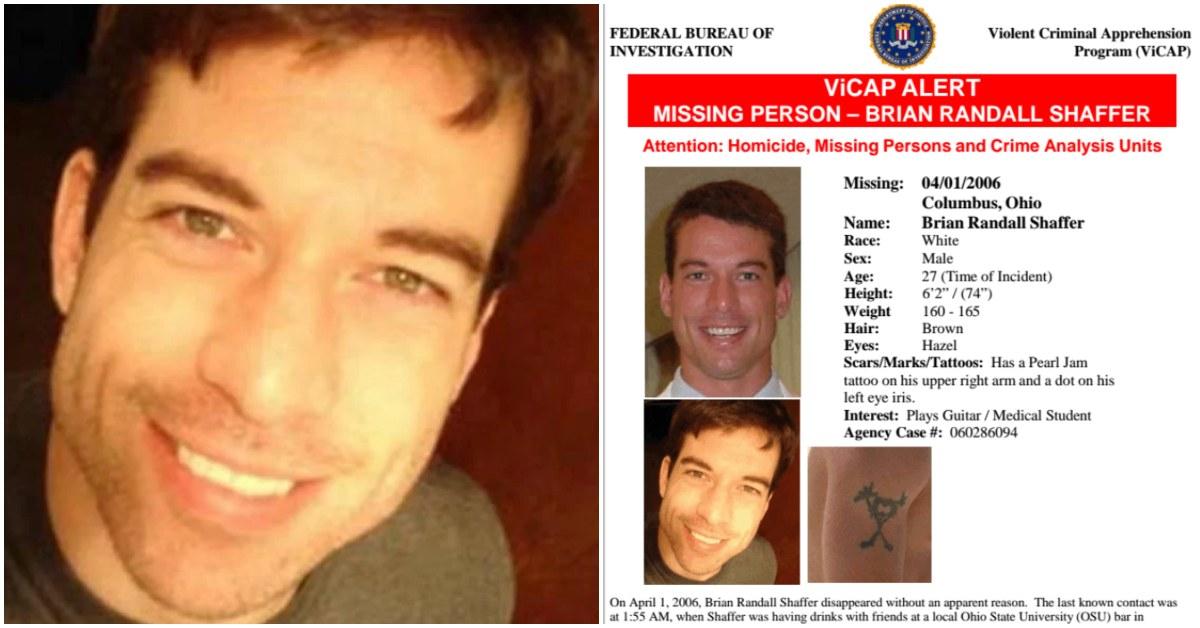
A later search in Knox County, Ohio, based on a tip, also yielded no remains or evidence.
Each search followed a tip.
Each tip pointed somewhere.
Each somewhere came back empty.
The nature of the tips that led to these searches is not detailed in the record.
That is not established.
It is a pattern.
It is also a question.
What made a property in rural Ohio worth digging?
What made a property in Mount Vernon worth a warrant?
What made a property in Knox County worth another trip?
The record does not say.
The searches happened.
The searches ended.
The ground was turned, the records were checked, the officers went home.
Brian Shaffer was not there.
He was not anywhere the tips pointed.
The case summary reports the searches and the silences.
It does not report what the tips claimed.
It does not report who gave them.
It does not report why they were believed.
Hope arrived in the form of a phone call.
Hope left in the form of an empty hole.
The rhythm is steady.
A tip.
A search.
A nothing.
A family waits.
A detective files the report.
A case remains open.
The searches are documented.
The findings are not.
That is the record.
That is also the weight.
TWO THEORIES, ONE MAN
The family has consistently maintained that they believe Brian was the victim of foul play.
That is their conviction.
Police have consistently stated that they have no evidence of a crime.
That is their position.
They have also never closed the case.
The case remains officially classified as a missing person investigation.
Authorities have acknowledged the possibility of foul play.
No suspect has ever been named.
No charges have been filed.
There was no trial.
There was no verdict.
There was no acquittal.
There was only the absence of an answer.
The family believes something happened to Brian.
The police say they cannot prove it.
The record says neither.
Whether foul play occurred is not established by the record.
It is a missing person case with no body.
It is a missing person case with no crime scene.
It is a missing person case with no charges.
The family holds to their belief.
The police hold to their uncertainty.
The two do not meet.
The case sits between them.
It remains open.
THE VIRAL FRAME AND THE RECORD
The frame is a face, a jacket, a man on a moving staircase at 2 a.m.
Online, the image has been pulled apart, magnified, looped.
The theory runs that Brian Shaffer never left the building through any normal exit.
That the escalator, or the construction around it, swallowed him whole.
That is a claim.
It is not a fact established by the record.
What the record establishes is narrower.
Police reviewed the surveillance footage and saw Shaffer walking toward the main entrance at approximately 2 a.m.
They never saw him leave through any exit.
That is what the footage shows.
What the footage does not show is what happened after the frame.
Whether he turned back, whether he found another way out, whether he never left at all.
The case summary does not answer that.
The validity of the online theory is not established.
Not because it is impossible.
Because the record ends where the frame ends.
The escalator machinery was searched, the parking garage was searched, a rural property was searched, a Knox County property was searched.
No trace.
The theory fills a gap the record leaves open.
That is what theories do.
That would require evidence.
THE ORDINARY MOMENT: THE ESCALATOR
The escalator in the Ugly Tuna Saloona was under renovation, part of a construction area that became a focus of the investigation, according to the case summary.
Shaffer was last seen on a second camera near that escalator, walking toward the main entrance, according to the police review of the surveillance footage.
The escalator machinery was searched by police.
No trace of Shaffer was found, the case summary states.
Whether Shaffer ever used the escalator is not established.
He was seen near it.
He was seen walking toward the main entrance.
The cameras did not show him leaving through any exit.
That gap is what the construction area was meant to fill.
It was meant to explain how a man could vanish from a bar without walking out a door.
The escalator itself was a machine under repair, a stairway that moved and then stopped moving.
Police searched its machinery.
They searched a nearby parking garage.
They found nothing, the case summary states.
The construction site was sealed and later opened to the public before a complete forensic search was conducted, a mistake widely reported.
Now, with the knowledge of the disappearance, that ordinary escalator ride — or the moment he passed it — carries an unbearable weight, the case summary acknowledges.
It is a moving stairway that became a fixed point in the record.
It is a machine that was searched and yielded nothing.
It is the last place the cameras placed him, and it is not an answer.
It is a location, not a resolution.
That would require evidence.
AND THE STORY STILL ISN'T OVER
Randy Shaffer died in 2014.
His death was reported as natural causes.
Renee Shaffer died in 2007, a death widely reported as a suicide.
The parents who reported Brian missing are both gone now.
Alexis Waggoner, his girlfriend, has spoken publicly over the years.
She urged anyone with information to come forward.
The case has been featured on national television programs.
No definitive resolution has been reached.
As of the most recent widely reported updates, Brian Shaffer remains missing.
The case is still open with the Columbus Division of Police.
No charges were ever filed.
No suspect was ever named.
No body was ever found.
The next concrete step in the investigation is not specified in the record.
That would require evidence.
It is a missing person case without a person.
It is an open case without an answer.
The escalator still stands in the bar, or it does not — the record does not say what became of it.
What the record says is simpler.
Brian Shaffer walked toward the main entrance at approximately 2 a.m.
The cameras placed him there.
They placed him nowhere else.
His phone went silent.
His bank accounts went still.
The searches went on for years — 2008, 2016, 2018.
Each one ended the same way.
Nothing was found.
The story is not over because the case is not closed.
It is not closed because there is no resolution.
There is only the frame, the escalator, and the silence after it.
That is where the record stops.
It has stopped there since 2006.
Advertisement
You may also like
The Zodiac letter that detectives still cannot explain
A second cryptogram arrived in November 1969. It came to the newspapers, signed by the Zodiac. It was never definitively solved. The meaning of…
The knife sheath found beside a victim that led police to a PhD student
It was found on the bed beside Madison Mogen’s body. A fixed-blade knife sheath, made of leather, lying in the room where a young…
The bullet from Berardelli's body that prosecutors said matched Sacco's Colt — but defense experts disputed
April 15, 1920, in South Braintree, Massachusetts. A paymaster and a guard were walking along Pearl Street, carrying two boxes of payroll cash. About…
The handleless hatchet in the Borden cellar that never matched the wounds
The handleless hatchet sat in the cellar of 92 Second Street, Fall River, Massachusetts, and it never matched the wounds. The wounds on Andrew…

The winter flight that took Buddy Holly and two rising stars — and the question that still haunts their families
The cornfield was flat and frozen, and the wreckage was still burning when the farmer found it. He had gone out the morning of…
Three weeks, ten deaths: the 2002 sniper spree that terrorized DC
October 2, 2002, a Thursday, and a man walked out of a grocery store in Wheaton, Maryland. He was 55 years old. He was…