The fisherman's 1935 discovery that opened a three-year hunt for a killer who left no name
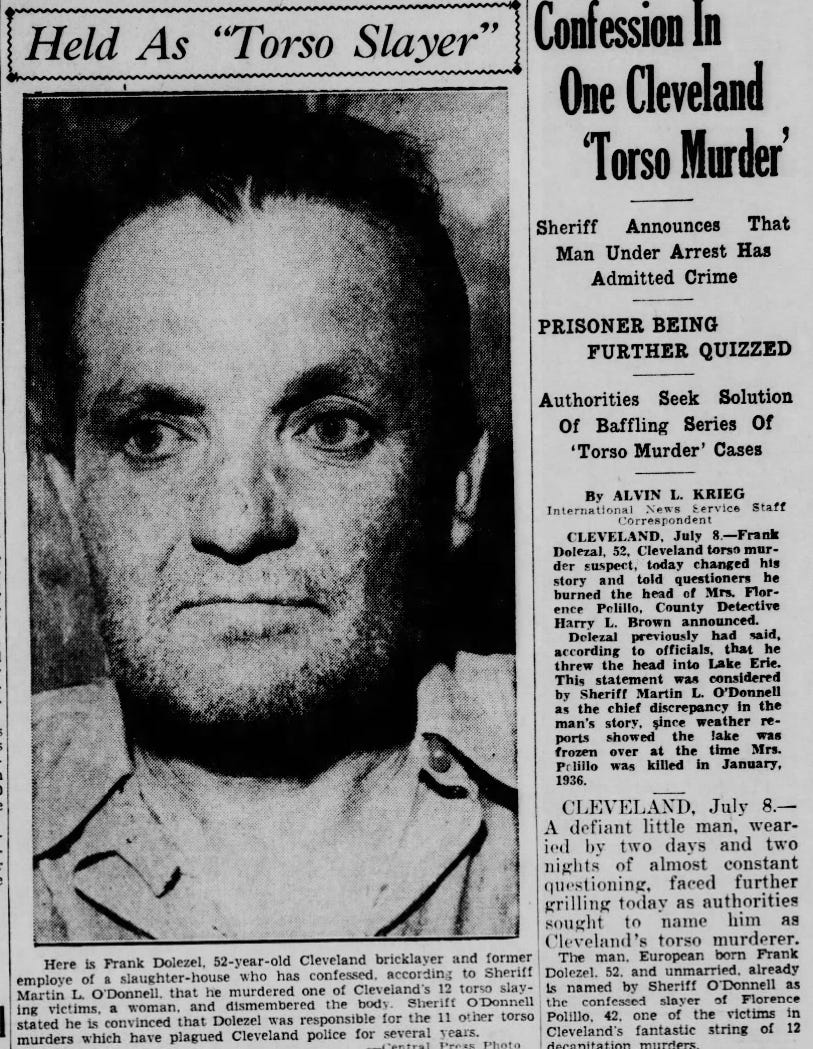
The fisherman reached down and pulled up what he first thought was a broken mannequin.
It was a torso, male, headless and legless, dumped near a pile of refuse on the city's east side.
The date was September 23, 1935, and the place was near Kingsbury Run, a ravine and shantytown carved through Cleveland.
The fisherman did not know the man's name.
Nobody ever would.
The victim was never identified, and the source does not name him.
That identity is not established.
What is established is the find itself, and what it began.
This was the first body widely attributed to a series that would become known as the Cleveland Torso Murders.
One discovery, nameless and incomplete.
It is a single fact in a case that would soon hold more.
But on that September morning, it was just a fisherman, a dump, and a body that had no name to give.
The chill is not in what was found.
The chill is in what the record leaves open: who he was, and how he came to be there.
That would require evidence.
The record holds none for him.
THE THREE-YEAR HUNT
It is 1935. The first body is found. The hunt begins.
Between 1935 and 1938, at least a dozen more victims were found in similar states of mutilation. Typically dismembered. In many cases decapitated.
The victims were mostly transients. Drifters. Residents of the shantytown that lined Kingsbury Run. Many were never identified.
The exact number of victims is not established. The identities of most are not established. The record holds neither.
Eliot Ness, Cleveland's Safety Director, oversaw the police investigation. He was the famous face. The Untouchable of Prohibition lore, now chasing a killer who left no name.
The lead detective was Peter Merylo. He pursued the case for years. He kept files. He kept lists. He kept going.
Merylo clashed with Ness over resources and strategy. Ness wanted results. Merylo wanted men. The argument repeated itself. The bodies kept arriving.
In 1936, under political pressure, Ness ordered a raid on the Kingsbury Run shantytown. Police burned the makeshift homes. The goal was to displace potential victims and witnesses. The goal was to starve the killer of targets.
It did not stop the murders.
The shantytown's people scattered. The victims became harder to find. Not because they were hidden. Because they were anonymous.
A headless torso does not carry a name. A hand without a fingerprint does not carry a history. The investigation kept losing its victims to anonymity.
Merylo questioned suspects. Ness pushed for progress. The coroner noted the precision of the cuts. That would require anatomical knowledge. That would require a trained hand.
No physical evidence ever linked any suspect conclusively to the crimes. The hunt ground on. The years passed. The ravine kept its silence.
THE MEDICAL QUESTION
The coroner who performed the autopsies noted the precision of the dismemberments.
He said the cuts suggested anatomical knowledge.
That pointed to a medical professional.
That suspicion shaped the investigation.
It narrowed the questioning.
It guided the leads.
No physical evidence ever linked any suspect conclusively to the crimes.
The lead detective continued his work.
The Safety Director pushed for progress.
The victims remained unidentified.
A transient leaves no paper trail.
A drifter leaves no next of kin.
The case stalled as the names stayed unknown.
Was the killer a surgeon?
Was the killer a butcher?
Was the killer someone who simply learned where the joints bend?
That would require evidence.
Whether the killer actually had medical training is not established.
The record shows only the suspicion.
The record shows no charge.
No trial ever took place.
No one was ever charged with the Cleveland Torso Murders.
The hunt went on.
The ravine kept its silence.
THE CONFESSION THAT WASN'T
In 1939, a tip brought police to a former wrestler and handyman.
He was arrested.
He confessed to two murders.
Then he recanted, claiming the confession was coerced.
He was found dead in his jail cell, reportedly by suicide, before trial.
His death in custody ended the only formal proceedings in the case.
There was no trial.
There was no verdict.
There was only a cell, and a body, and a case that went quiet.
Not because the confession was proven true.
Not because it was proven false.
Because the man who made it was gone.
The circumstances of his death are disputed.
The validity of his confession is not established.
What the record does establish is that no one was ever charged.
Another suspect, a physician, was questioned by police and by the Safety Director personally.
He was never charged.
He was institutionalized for alcoholism.
He died in 1964.
The ravine kept its silence.
The hunt went on.
Then the hunt stopped.
AND THE STORY STILL ISN'T OVER
The case remains officially unsolved.
No one was ever charged.
Theories filled the silence. Authors and researchers proposed that the killer was a specific physician. Others argued the murders were committed by multiple people. These are theories. The record does not establish the identity of the killer.
Eliot Ness's reputation was later scrutinized for his handling of the case. The Safety Director who oversaw the hunt faced questions about resources, strategy, and the burning of the shantytown. The scrutiny came after. The case stayed cold.
Kingsbury Run was eventually redeveloped. The shantytown disappeared. The ravine was filled, graded, and built over. The ground that held the bodies now holds something else.
The Cleveland Police Department has not reopened the investigation in any substantive way. The files sit. The identities of several victims remain unknown. They have no names on the record. They have no next of kin in the files.
What remains is the weight of a century-old silence.
The silence is not empty. It holds the unanswered questions: Who was the killer? How many hands did the work? Why did the hunt stop when it did? That would require evidence. The evidence was never found.
The ravine kept its silence.
The city moved on. The case did not.
Advertisement
You may also like
The false confession that sent two innocent people to prison for Taunja Bennett's murder
A postcard arrived at the Oregonian newspaper, signed with a single smiley face. It was a taunt, not a confession. The smiley face became…

The bloody glove on Bundy Drive that matched a glove at O.J. Simpson’s estate
A white Akita was found wandering the neighborhood with blood on its paws on the night of June 12, 1994. The dog led a…
43 died in 5 days — who ordered the troops that changed Detroit forever?
The raid came in the earliest hours of Sunday, July 23, 1967. Police officers from the Detroit Police Department's 10th Precinct moved on an…
The 1980 phone call that let a killer walk for 38 years
In 1980, a phone call was made to police. According to a theory circulating online, that call could have led to the Golden State…
The eighth birthday that ended in a flash — and the parents who still speak
The finish line was still decorated with balloons when the first bomb went off. April 15, 2013, Patriots' Day in Boston, a public celebration…
The love letters that made a choir singer's affair the talk of 1920s New Jersey
The letters were under the crabapple tree, next to the bodies. On September 14, 1922, the bodies of Reverend Edward Wheeler Hall and Mrs.…