The LAPD officer's corruption scandal that reignited Biggie's murder probe
The SUV stopped at a red light, and that was the moment.
Wilshire Boulevard and South Fairfax Avenue, just past midnight on March 9, 1997.
Christopher Wallace, the Notorious B.I.G., was leaving a party hosted by Vibe magazine and Qwest Records at the Petersen Automotive Museum.
A black Chevrolet Impala pulled up alongside.
An unknown gunman fired multiple shots into the vehicle.
Wallace was struck four times.
He was pronounced dead at Cedars-Sinai Medical Center shortly after arrival.
No one else in the vehicle was injured.
It was a drive-by, the same kind of violence that had killed Tupac Shakur six months earlier in Las Vegas.
The rivalry between East Coast and West Coast hip hop hung over the scene like exhaust.
But the gunman's identity was not established then.
It has not been established since.
No one has been charged.
The weapon was never recovered.
The Impala was later found abandoned and burned.
Witnesses in the hip hop community did not cooperate.
That would become the shape of the case: a sudden red light, a black car, and a silence that stretched for years.
The questions come in a run.
Who pulled the trigger?
Who sent him?
Who knew the route that night?
The record does not answer.
The record does not even name a suspect the LAPD has officially acknowledged.
Wallace's bodyguard was at the wheel.
His entourage was in the car behind.
They saw the Impala, the flash, the smoke.
Then the light turned green, and the night went on without him.
THE RIVALRY
The LAPD investigation, led by detectives from the Robbery-Homicide Division, initially focused on the rivalry between Wallace's label, Bad Boy Records, and Death Row Records.
That feud was part of the East Coast–West Coast hip hop rivalry, particularly Wallace's feud with rapper Tupac Shakur.
Tupac Shakur had been killed in a drive-by shooting in Las Vegas six months earlier.
The detectives interviewed witnesses at the scene.
They examined the vehicle, which was later found abandoned and burned.
The investigation was hampered by a lack of cooperation from witnesses in the hip hop community.
Witnesses who saw the Impala pull up.
Witnesses who saw the gunman lean out.
Witnesses who heard the shots.
The exact motive for the shooting is not established in the record.
Not because the rivalry was a secret.
But because the wall of silence held.
The detectives pushed into a community that did not trust them.
They came back with descriptions, with timelines, with the burned shell of a car.
:max_bytes(150000):strip_icc():focal(999x0:1001x2)/notorious-big-kids-tyanna-3-4f5f413bfd4541c1bcdaf6a25d1fa564.jpg)
They came back without a name.
The feud itself was public, played out in lyrics and interviews, in the deaths that preceded Wallace's own.
Tupac had been gunned down in Las Vegas in September 1996.
Wallace was in Los Angeles six months later.
The pattern seemed to write itself.
The record does not establish that it did.
THE CORRUPTION SCANDAL
In 2002, a corruption scandal inside the LAPD's Rampart Division pulled the murder investigation into a new light.
Officer Rafael Perez, already at the center of that scandal, claimed that another LAPD officer, David Mack, had been involved in the murder.
It was a stunning allegation: a police officer named in the killing of a rap star.
The claim was never proven.
Mack was never charged.
The record does not establish that Mack had any role in the murder.
But the allegation landed inside an investigation that was already under criticism.
The probe had been faulted for failing to pursue leads.
It had been faulted for possible suppression of evidence.
Voletta Wallace, the victim's mother, filed a federal civil suit against the city of Los Angeles in 2002.
She alleged that rogue LAPD officers were involved in the murder.
She alleged that the department covered it up.
Her attorney in the case was Perry Sanders Jr., who represented her in the civil proceedings.
The suit went to trial in 2006.
The jury deadlocked.
The case was settled out of court in 2010 for a reported $1.1 million, with the city admitting no wrongdoing.
Was a police officer involved in the killing?
Was evidence hidden?
That would require proof.
The allegation from the corruption scandal remained just that: an allegation.
THE CIVIL TRIAL
The former detective took the stand in 2006.
He testified that the department had withheld evidence.
He testified that the investigation had been compromised.
The jury heard it.
The jury deadlocked anyway.
Voletta Wallace's civil suit against the city went nowhere in that courtroom.
It settled out of court in 2010 for a reported $1.1 million.
The city admitted no wrongdoing.
That admission is not in the record.
It is a settlement, not a verdict.
It is a payment, not a confession.
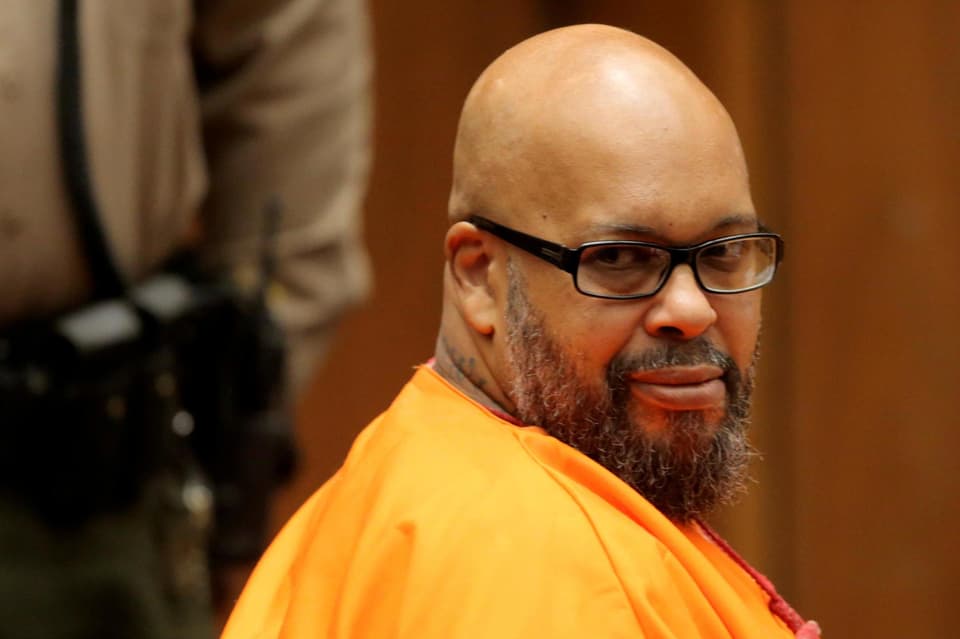
Marion "Suge" Knight was named as a suspect in the civil proceedings.
He was never charged.
Knight, co-founder of Death Row Records, is serving a prison sentence for a 2015 hit-and-run killing.

That conviction is unrelated to Wallace's murder.
No criminal charges have ever been filed in the death of Christopher Wallace.
Not against Knight.
Not against anyone.
The case remains officially unsolved.
The LAPD has not closed it.
No arrests have been made.
Was evidence hidden?
That would require proof.
Did the department compromise the probe?
The former detective said so.
The jury could not agree.
The city paid money and admitted nothing.
That is what the record shows.
That is all it shows.
AND THE STORY STILL ISN'T OVER
The murder of the Notorious B.I.G. remains officially unsolved.
The LAPD has not closed the case, but no arrests have been made.
That is where the record stands.
That is where it has stood for decades.
Voletta Wallace continued to advocate for justice until her death in 2024.
She filed the federal civil suit. She pushed the department in public. She carried the case longer than the investigation ever did.
Faith Evans has spoken about her husband's legacy and the unresolved case.
She has described the weight of it. She has described the absence of an answer.
The case has been the subject of numerous documentaries, books, and films.
Randall Sullivan wrote "LAbyrinth." The book was adapted into the 2021 film "City of Lies."
The story gets retold. The ending never changes.
The LAPD has periodically stated that the investigation remains active.
No new leads have been publicly disclosed.
That is not established anywhere in the record.
The file stays open. The Impala was never found. The weapon was never recovered.
No one has been charged. No one has been named by the department.
The city paid money and admitted nothing. That was in 2010.
The case remains what it has always been: an open wound with no closure in sight.
It is a cold case.
It is also a live one.
The difference is paperwork.
Voletta Wallace is gone. The advocates change. The questions do not.
What would solve it? A witness. A confession. A lead the department has not disclosed.
None of that has come.
That would require evidence.
The red light at Wilshire and Fairfax still turns green.
Advertisement
You may also like
The tarot card left at the first D.C. sniper shooting — and the trunk hole that cracked the case
The first shooting happened on October 2, 2002, outside a Michael's craft store in Aspen Hill, Maryland. Not in a parking lot. Not at…
The radio and boots that broke the Clutter case — but the shotgun never surfaced
The radio sat on a table in a Las Vegas apartment, months after four people were bound and shot in a Kansas farmhouse. It…
Two men in police uniforms, one Thompson submachine gun, and a garage wall that gave way to silence
Seven men were dead against the garage wall by the time the echo of the guns stopped. It was February 14, 1929, a little…
The typewriter in a Montana cabin that matched the Unabomber's 35,000-word manifesto
Agents found the typewriter inside a 10-by-14-foot cabin near Lincoln, Montana, in 1996. The machine matched the one used to produce a 35,000-word manifesto.…
The cotton gin fan that pulled a body from the Tallahatchie — and the DNA test that settled it
A cotton gin fan came up with the body on August 31, 1955. It was tied to the neck with barbed wire, and it…
The bullet that tied Sacco to the crime — and the expert who couldn't agree
The bullet came out of a guard's body on a stretcher, passed from hand to hand, and ended up in a courtroom as the…