The love letters found beside a minister and choir singer — and the wife who was charged but never convicted
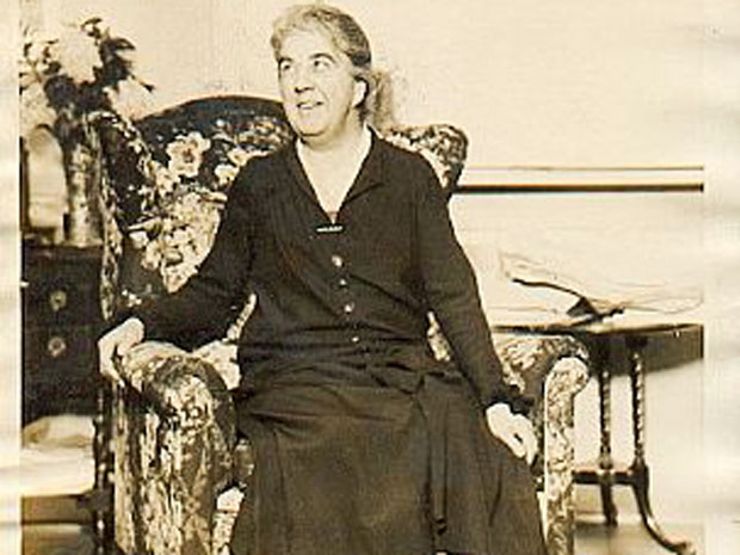
On September 16, 1922, the bodies of Reverend Edward Wheeler Hall and Mrs. Eleanor Reinhardt Mills were found beneath a crabapple tree in De Russey's Lane, near Phillipsburg, New Jersey.
The couple, both married, had been shot.
The bodies were arranged in a posed manner, with love notes and calling cards scattered nearby.
The murder weapon was a .32-caliber pistol, never recovered.
The case became one of the most sensational murder mysteries of the 1920s, drawing national press attention.
Who posed the bodies?
What do those love notes really say?
The content of the love notes is not specified in the record.
The identity of the killer is not established.
The scene holds an eerie intimacy, a deliberate arrangement no one has explained.
THE AFFAIR AND THE WIFE
Reverend Edward Wheeler Hall was the married pastor of St. John's Episcopal Church in New Brunswick, New Jersey.
Eleanor Reinhardt Mills was a married choir singer in his congregation.
The couple had been carrying on an extramarital affair, and those close to them knew it.
The affair was not a secret kept from the congregation's inner circle.
It was a fact of the parish, spoken of in low tones.
Hall's widow, Frances Noel Stevens Hall, was the prime suspect.
She was charged with first-degree murder, along with three relatives.
The exact nature of Frances Hall's knowledge or involvement before the murders is not in the record.
Did she know about the affair?
Did she know how far it had gone?
Did she know what would happen on De Russey's Lane?
That would require evidence.
The initial investigation was led by the Somerset County prosecutor's office.
It was marred by confusion and missteps.
The scene was disturbed before authorities arrived.
The bodies were found beneath a crabapple tree, arranged in a posed manner.
Love notes and calling cards were scattered nearby.
The identity of the killer is not established.
Frances Hall's world had already unraveled before the shots were fired.
The question is what she knew when it did.
THE REOPENING AND THE PIG WOMAN
For four years, the case sat still.
Then, in 1926, a grand jury reopened it.
They heard from a farmer the press called the "Pig Woman."
She claimed she had watched the murders from a distance while tending her pigs.
She was ill, and she testified from a hospital bed.
Her testimony was dramatic.
It was also widely considered unreliable.
The prosecution built its case on her account anyway.
It added circumstantial evidence linking the Stevens family to the crime scene.
What exactly that evidence was, the record does not detail.
That is not established.
The defense attacked the Pig Woman's credibility.
They pointed to the lack of physical evidence.
They pointed to a crime scene that had been disturbed before authorities arrived.
They pointed to early reports of evidence lost or contaminated.
The investigation had been marred from the start.
The bodies were found by a local man, and the scene was not preserved.
Was the case ever solid?
Or was it always this shaky?

That would require evidence.
The prosecution believed it had enough.
The grand jury believed it too.
They indicted Frances Hall and three relatives.
All four were charged with first-degree murder.
The Pig Woman's testimony was the hinge.
Everything else was circumstance, and circumstance can bend.
THE TRIAL AND ACQUITTAL
The trial began in November 1926 in Somerville, New Jersey.
Alexander Simpson, the Somerset County Prosecutor, led the prosecution.
He argued the four defendants conspired to kill the couple out of jealousy and to protect the family's reputation.
The defense was led by Clarence E. Case, who later became Governor of New Jersey, and his law partner.
They presented a vigorous case.
They highlighted the lack of direct evidence.
They attacked the credibility of the prosecution's key witness, the farmer known as the Pig Woman, who had testified from a hospital bed.
The trial lasted several weeks.
On December 3, 1926, all four defendants were acquitted.
The verdict was met with public surprise.
How did the accused walk free?
What did the jury see that the press did not?
What evidence failed to convince them?
The specific arguments that convinced the jury are not detailed in the record.
The true perpetrator remains unknown.
The case was never reopened.
No one else was ever charged.
The acquitted returned to their private lives.
The murders of the reverend and the choir singer remain officially unsolved.
It is a verdict of not guilty.
It is not a verdict of innocence.
AND THE STORY STILL ISN'T OVER
Frances Noel Stevens Hall returned to a quiet life after the verdict.
She lived until 1942, and the public mostly let her be.
The case remains officially unsolved.
No one else was ever charged.
The crabapple tree where the bodies were found became a morbid tourist attraction for years.
It has since been removed.
The murders of the reverend and the choir singer have been the subject of numerous books, articles, and documentaries.
No definitive resolution has ever been reached.
The love notes and calling cards were found at the scene.
No evidence ties them to the wife who was charged and acquitted.
That is the line between the viral theory and the documented record.
The murder weapon was a .32-caliber pistol.
It was never recovered.
Its location is unknown.
The record establishes no new leads.
The record establishes no future reopening.
The case is closed.
It is not solved.
The public's fascination endures because the story keeps the question open.
It is a verdict of not guilty.
It is not a verdict of innocence.
That would require evidence.
Advertisement
You may also like
The severed head in the canal, the confessed killer who was never charged, and the file police closed twice
The drainage canal ran along the Florida Turnpike near Vero Beach, 120 miles from where the boy had vanished. The head was found on…
The trucker's anonymous letters that named his own victims
The letters arrived unsigned, except for a circle with two dots and a curve. A smiley face. They were sent to the Oregonian and…
The Green River Killer’s confession count is 71. Why are only 48 convictions official?
Gary Leon Ridgway was a truck painter from Auburn, Washington. In November 2001, DNA evidence linked him to several victims, and he was arrested.…
The doctor with a scalpel and a secret that haunted Eliot Ness
The first body was found on September 5, 1934, in Kingsbury Run, a ravine that cut through Cleveland. He was a man, and no…
The slow-motion Bronco chase that began after O.J. Simpson was charged with murder
The Bronco drifted down the freeway at 35 miles an hour, a white speck trailed by a line of police cars. Al Cowlings was…
The Zodiac cipher that took 51 years to crack — and still gave no name
In December 2020, a team of private codebreakers solved the Zodiac's "340 cipher" — a cryptogram mailed to the *San Francisco Chronicle* in 1969.…