The ring that identified Emmett Till after his body was pulled from the Tallahatchie River

The cotton gin fan was still tied to his neck with barbed wire.
His body came up from the Tallahatchie River on August 31, 1955.
His face was mutilated beyond recognition.
The sheriff of Tallahatchie County looked at the body and said it was not Emmett Till.
He suggested the body might have been planted.
He said it was too decomposed to be the boy from Chicago.
But there was a ring.
The ring bore the initials of Emmett Till's father.
It was on the body pulled from the river.
It cut through the mutilation, through the decomposition, through the sheriff's doubt.
The boy's mother identified the body as her son.
She looked at the ring and she looked at what remained of his face.
She said it was Emmett.
The sheriff's claim did not survive the ring.
Not because the ring was dramatic. Because the ring was specific.
The exact condition of the ring at recovery is not in the record.
What is in the record is this: a 14-year-old boy went into the Tallahatchie River weighted down by machinery, and he came out identified by his father's initials.
How could anyone still deny it?
How could a sheriff look at that and call it planted?
How could a county prepare for a trial before the body was even buried?
That would require evidence.
The ring was the evidence.
The mother was the witness.
The denial was the story the town told itself anyway.
THE WHISTLE AND THE ABDUCTION
He was fourteen years old, visiting family in Money, Mississippi, in August 1955.
He was from Chicago.
Money was small, rural, and governed by the strict codes of the Jim Crow South.
On August 24, he walked into a local grocery store.
According to the record, he reportedly whistled at or spoke to Carolyn Bryant, a white woman working there.
What exactly he said or did is not established.
The record does not settle it.
It only says he reportedly whistled at or spoke to her.
Four days later, on August 28, two white men came to his great-uncle's home in the middle of the night.
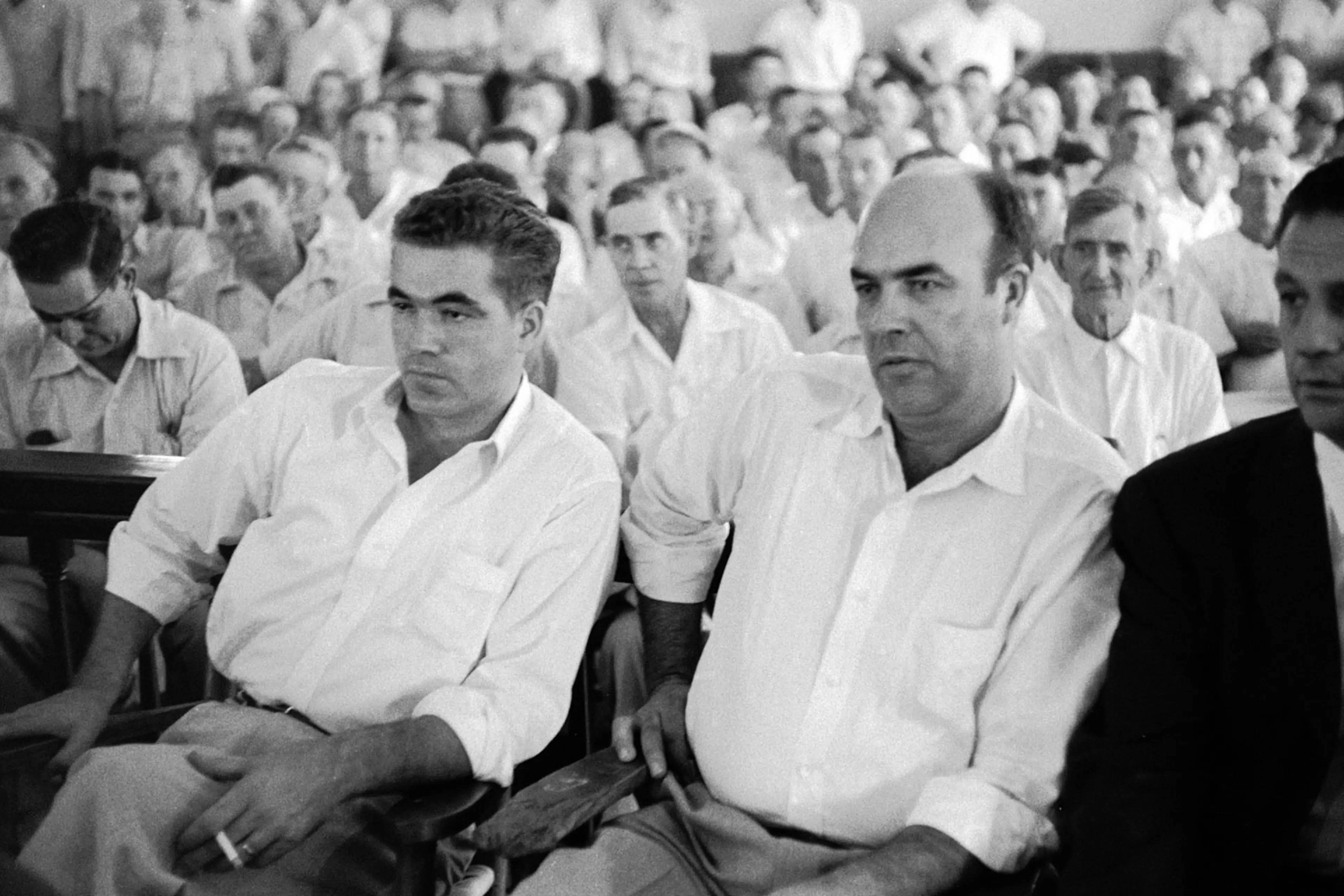
They were Roy Bryant and his half-brother J.W. Milam.
They abducted the teenager.
The house belonged to Moses Wright, Till's great-uncle.
Wright was a Black man in the Jim Crow South.
He later testified in court.
He pointed to Bryant and Milam.
It was a rare act for a Black man to do that in that place, at that time.
He stood in front of a white jury and identified the two men.
The tension was there before the trial.
It was there in the night of the abduction.
It was there in the silence that followed.
The mundane errand had become a death sentence.
The courage of the witness stood against it.
THE OPEN CASKET AND THE TRIAL
She insisted on an open casket.
The mother wanted the world to see what had been done to her son.
Tens of thousands of mourners filed past the body in Chicago.
The photographs ran in Jet magazine.
The images moved across the country and across the ocean.
The trial began on September 19, 1955, in Sumner, Mississippi.
The courtroom was segregated.
The prosecution called witnesses.
The great-uncle stood and pointed at the two men accused of taking his nephew.
The all-white, all-male jury listened.
They deliberated for 67 minutes.
One juror reportedly said the deliberation would have been shorter if they hadn't stopped for soda.
That comment is reported, not confirmed by any official record.
It remains a story told about the verdict, not a fact of the record.
The verdict was acquittal.
Roy Bryant and J.W. Milam walked free.
The speed of the decision stood against the weight of the grief.
It was 67 minutes for a life.
It was 67 minutes for a body pulled from a river.
It was 67 minutes for a mother's open casket.
The acquittal sparked international outrage.
Newspapers abroad condemned the verdict.
The outrage did not change the outcome.
The men were not retried.
The case was not closed in the public mind.
It was only beginning.
THE CONFESSION AND THE REOPENING
In January 1956, *Look* magazine published a paid interview in which Roy Bryant and J.W. Milam admitted to the killing.
They described how they beat Emmett Till and shot him.
The confession was public, detailed, and printed for the nation to read.
It carried no legal weight.
The two men could not be retried due to double jeopardy.
The acquittal stood, and so did the confession, side by side.
For nearly fifty years, that was where the record stalled.
In 2004, the FBI reopened the case.
The reopening came after a documentary filmmaker located a 1955 arrest warrant for Carolyn Bryant that had never been served.
The warrant was for her role in the abduction; it had sat unexecuted for decades.
That year, the FBI also exhumed Till's body and conducted an autopsy.

The autopsy confirmed the cause of death as a gunshot wound to the head.
The gun itself was never recovered.
That remains not established in the record.
In 2007, a grand jury in Greenwood, Mississippi, heard testimony.
It declined to indict anyone.
In 2017, the FBI announced it had found no new evidence to support charges.
Each investigation ended the same way: no prosecution, no indictment, no charges.
The men who confessed were dead by then, Milam in 1980 and Bryant in 1994.
A confession without consequence is a strange kind of justice.
It is also a strange kind of closure.
AND THE STORY STILL ISN'T OVER
Roy Bryant died in 1994.
J.W. Milam died in 1980.
Both unpunished, both acquitted by a jury that deliberated for 67 minutes.
Carolyn Bryant died in 2023, the woman at the center of the whistle.
The Department of Justice closed the case in 2018, stating it could not prosecute anyone.
A final time, they said.
In 2022, an unserved 1955 arrest warrant for Carolyn Bryant was discovered.
No charges were pursued.
The warrant sat unserved for sixty-seven years, longer than the trial lasted.
It is a document without an ending.
It is also a question without an answer.
Whether any future legal action is possible is not established; the case is officially closed.
That would require evidence the Department of Justice says does not exist.
The Emmett Till Interpretive Center stands in Sumner, Mississippi, where the trial was held.
The Emmett Till and Mamie Till-Mobley National Monument was established in 2023.
The memory is monumental.
The case is closed.
The ache is not.
A ring identified him.
A cotton gin fan held him down.
A confession bought by a magazine brought no retrial.
The men who confessed were dead by then, Milam in 1980 and Bryant in 1994.
What remains is the record.
What remains is the open casket.
What remains is the mother who insisted the world look.
She died in 2003.
The monument carries her name.
The center carries his.
Two men admitted the killing in print and died free.
One woman never faced the warrant found in a file.
The story is told in stone and glass and preserved paper.
It is also told in what was never done.
Advertisement
You may also like
The viral manhunt that turned a missing travel blogger into a national obsession — before her body was found
The white Ford Transit van had its own internet presence before Gabby Petito did. Petito, 22, and her fiancé Brian Laundrie were documenting a…
Why two girls' testimony went unheard for weeks in Polly Klaas search
She was on the ground below. On the night of October 1, 1993, twelve-year-old Polly Klaas was having a slumber party with two friends…
The Polaroid photos that made Milwaukee police stop the car — but what did they show?
The handcuff was loose. That was the detail Tracy Edwards would repeat, later, to reporters and in testimony: one cuff, not fully closed, on…
The therapy confession that turned Lyle and Erik Menendez from grieving sons into accused killers
It was 10:13 p.m. when the call came in. Lyle Menendez, 21, told the dispatcher his parents had been shot. His brother Erik, 18,…
The secret non-prosecution deal that let Epstein avoid federal charges for years
In 2005, a mother in Palm Beach, Florida, walked into a police station and reported that her 14-year-old stepdaughter had been sexually abused by…
Boston women bought locks and guard dogs as 11 stranglings went unexplained
The locks sold out first. Then the guard dogs. Between June 1962 and January 1964, a series of murders of women in the Boston…