The videotapes found in Luster's home that prosecutors said showed a pattern
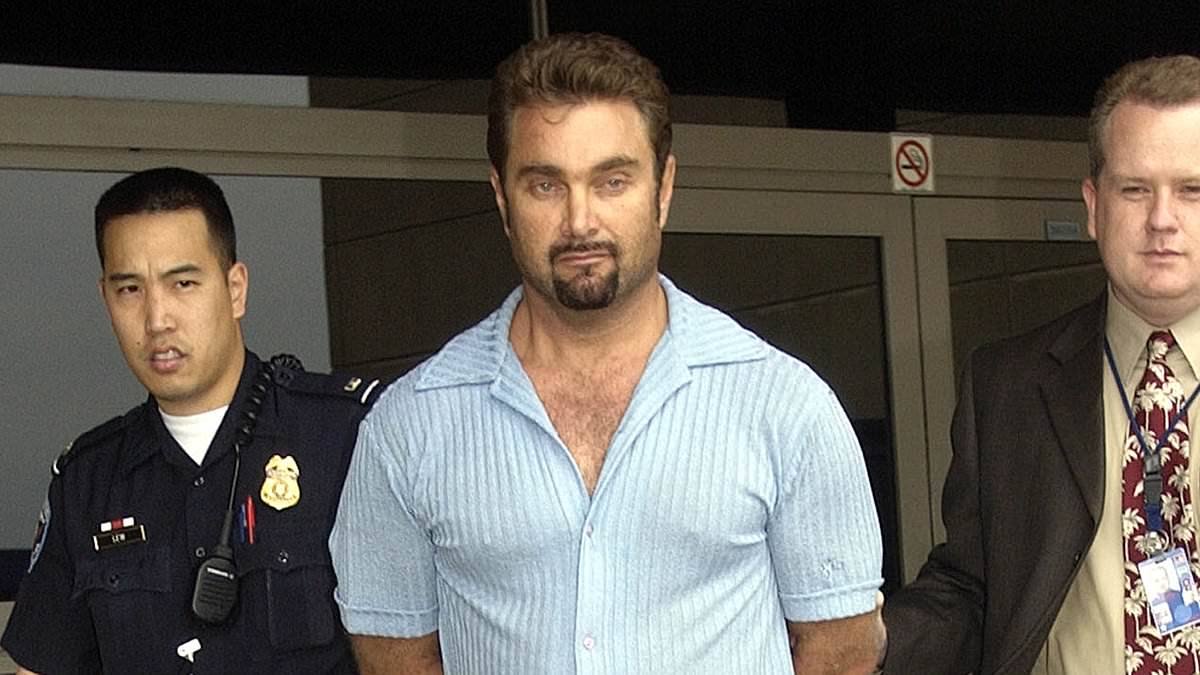
🚨 THE TAPES THAT SHOWED WHAT PROSECUTORS CALLED A PATTERN…
In early 2002, Andrew Luster, a wealthy heir to the Max Factor cosmetics fortune, was accused of sexually assaulting three women he met in local bars in Santa Barbara, California.
The case came to light in March 2002, when one woman reported to police that she had been raped after being given a drink at Luster's house.
Investigators later found videotapes in Luster's home that appeared to show him assaulting unconscious or incapacitated women.
Prosecutors argued the footage demonstrated a pattern of drugging and assault.
That argument is the prosecution's claim, not an established fact.
The exact contents of the tapes are not described in the source.
The tapes led to additional charges involving two other victims.
Before the tapes, there was one report.
After the tapes, there were three alleged victims.
What exactly is on those tapes?
How did they come to light?
The record does not say what was on them, only that they appeared to show assault.
The interpretation of a pattern belongs to the prosecution.
MARCH 2002 — THE FIRST REPORT
It was March 2002 when the first report reached the Santa Barbara police.
A woman in her early twenties said she had been raped after being given a drink at Luster's house.
She had met him at a local bar.
That single report set the investigation in motion.
The record does not give the exact date of the report.
The record does not give the woman's name.
What is documented is this: a woman walked into a police station and described a night she could not fully account for.
She said she had been given a drink at his home.
She said she had been raped.
That was enough for investigators to seek a search warrant for Luster's home.
The warrant was the hinge.
Everything that followed — the videotapes, the additional charges, the trial, the flight — traced back to that first report.
Not because the report was proof.
But because it was the beginning.
The exact date of the report is not established.
The victim's identity is not established.
What remains is the weight of a single allegation, made in March 2002, that opened a door.
THE SEARCH WARRANT AND THE VIDEOTAPES
Police obtained a search warrant for Luster’s home following the first victim’s report.
During the search, they found a collection of videotapes.
The tapes showed Luster with women who appeared to be unconscious or barely responsive.
Prosecutors argued the footage demonstrated a pattern of drugging and assault.
The tapes led to additional charges involving two other victims.
Not because the women were awake. Because the women were not.
The exact number of tapes is not specified in the source.
The identities of the women on them are not specified either.
What the record does establish is that the tapes existed, that police seized them, and that prosecutors built a case on what they showed.
The first victim’s report opened the door.
The tapes widened it.
Prosecutors said the footage was not one incident but a sequence, a habit, a method.
The defence would later say the tapes were simply sexual recordings.
That argument would come in court, with the women testifying they had no memory of parts of the evening and felt ill after drinking.
For now, in the search of a wealthy man’s home, the evidence sat in a collection of tapes.
A private archive, allegedly documenting crimes.
That would require a jury to decide.
THE VICTIMS' TESTIMONY
They were women in their early twenties who met Luster at bars in the Santa Barbara area.
They took the stand in 2003.
Each testified that she had no memory of parts of the evening.
Each testified that she felt ill after drinking.
That was the prosecution's case: the gaps and the sickness were the pattern.
Deputy District Attorney Janice Maurizi built the argument on those gaps.
The defence saw the same testimony differently.
Steven Cron, Luster's attorney, argued the women were conscious and consenting.
He claimed the videos were simply sexual recordings.
The specific details of each victim's testimony are not in the source.
What remains is their word against what the tapes show.
The tapes show women who appeared to be unconscious or barely responsive.
The women describe memory that stops and starts.
Neither side disputes the drinking.
Neither side disputes the bar.
What happened after the drink is the trial.
One woman remembered the beginning of the evening.
She remembered meeting him.
Then nothing.
That nothing was the evidence.
That nothing was also the defence's opening.
That nothing would require a jury to decide.
THE DEFENCE'S CLAIM: CONSENT
Steven Cron, Luster’s defence attorney, argued that the encounters were consensual.
The women were conscious and consenting, he said.
The videos were simply sexual recordings, not evidence of a crime.
That was the defence’s reading of the same tapes the prosecution called a pattern.
A pattern of drugging, prosecutors argued, shown in footage of women who appeared unconscious or barely responsive.
Two readings of one collection of tapes.
In one, women could not say yes.
In the other, they did.
The defence claimed the women were awake and willing, and that the cameras captured ordinary intimacy.
The prosecution saw incapacitation.
The defence saw performance.
The same frames, the same women, the same night.
Not because one side was honest and the other was not.
Because the tapes themselves did not speak.
They showed bodies and faces, but they did not show a mind.
Was she unconscious?
Was she acting?
That would require evidence beyond the image.
The source does not describe the defence’s evidence or witnesses.
It does not say what Cron put forward to support the claim of consent.
That part of the record is not established.
So the jury was left with the footage and the testimony.
The victims said they had no memory of parts of the evening and felt ill after drinking.
Cron said they were fine.
The same night, remembered and forgotten.
The same night, agreed and imposed.
A jury would have to choose which version the tapes showed.
That was the defence’s claim.
That was also the contradiction at the centre of the case.
THE TRIAL BEGINS — 2003
The charges were filed, and the case moved toward trial.
Luster was charged with multiple counts of rape, sexual assault, and drugging with intent to commit a felony.
The trial took place in 2003.
The lead prosecutor was Deputy District Attorney Janice Maurizi.
She would have to make the jury see what the tapes showed.
The defence would have to make them see something else.
The courtroom was crowded because of the name Luster.
He was the heir to a cosmetics fortune.
The case was widely covered because of that wealth.
It was also widely covered because of what the tapes contained.
The source does not specify the exact trial start date.
The source does not specify the exact number of counts.
That is not established in the record.
What is established is that the trial happened.
What is established is that the prosecution argued a pattern.
What is established is that the defence argued consent.
The jury would weigh the videotapes.
They would weigh the testimony of the three women.
They would weigh the claim that the women had no memory of parts of the evening.
They would weigh the claim that the women were conscious and consenting.
The anticipation hung over the proceedings.
The case was about what the tapes showed.
It was also about what they did not show.
Justice was the question.
The answer would come from the jury.
MAY 2003 — THE FLIGHT
The jury was deliberating.
The verdict was close, the room was quiet, the answer almost ready.
Then Andrew Luster did not appear in court.
It was May 2003, and he was gone.
The judge issued a warrant for his arrest.
He had fled to Mexico.
The trial continued in his absence.
Not because the law allowed it lightly. But because the proceedings had to move.
The courtroom emptied of its central figure, and still the question of his guilt went forward.
How does a man vanish in the middle of a trial?
That is what the public asked.
How does a wealthy heir slip away while twelve people decide his fate?
That is what the coverage asked.
How does a case built on videotapes end with an empty chair?
The exact circumstances of his flight are not detailed in the source.
No route, no method, no moment of departure is documented.
What is documented is the disappearance itself.
What is documented is the warrant.
What is documented is the trial moving on without him.
The dramatic turn became a major part of the public narrative.
It was no longer only about the tapes.
It was about the man who ran.
Justice was the question.
The answer would come from the jury.
But the accused was not there to hear it.
THE VERDICT AND SENTENCE
The jury deliberated, and the answer came back.
Convicted on all counts.
The courtroom heard the verdict read aloud, and the man it named was not in the room.
He was in Mexico, a fugitive, and the trial had continued without him.
The judge then pronounced the sentence.
One hundred twenty-four years in prison.
That number — 124 years — was the figure that appeared in report after report, a constant across the coverage.
The exact number of counts against him varied in those same reports.
The source does not specify the number.
Not because it was secret.
But because the records that might settle it are not part of what is documented here.
What is documented is the sentence itself, delivered in his absence.
He appealed, arguing that trying him without him was unfair.
The conviction was upheld on appeal.
Justice, then, was done — in a courtroom where the accused had chosen not to sit.
It was a verdict reached despite the flight, not because of it.
The victims had testified in that room.
They had described the nights they could not remember.
The tapes had been played.
The pattern the prosecution argued was laid out for the jury.
And the jury believed it.
Not because the defence had failed.
But because the evidence, in the prosecution's telling, pointed one way.
The sentence stood.
The man would serve it.
That would require him being caught, of course.
But that is the next part of the story.
THE CAPTURE IN MEXICO
In June 2003, Duane "Dog" Chapman and his son tracked Luster to a resort town in Mexico.
They turned him over to authorities.
Luster was extradited to the United States to serve his sentence.
The specific details of the capture are not in the source.
Not the beach, not the bar, not the hour.
The record shows the result, not the chase.
Chapman's role became a major part of the public narrative.
It was a story of a wealthy fugitive and a bounty hunter with a camera-friendly name.
It later led to Chapman's own reality television career.
The man who fled the courthouse was now in custody in another country.
The jury had convicted him in his absence.
The judge had sentenced him to 124 years.
The capture made the flight a complete arc: he ran, he was found, he was returned.
It is a dramatic climax.
It is also a strange celebrity footnote.
Luster was back in California to serve the sentence.
The trial had ended without him.
The manhunt had ended with him.
AND THE STORY STILL ISN'T OVER
He is still in California state prison.
The name was reported again at parole hearings. Denied each time.
His earliest parole eligibility date has been reported as 2056. That date is reported, not confirmed.
He would be over ninety years old.
The victims have largely stayed out of the public eye. Their current whereabouts and status are not in the record.
That is not a gap in the reporting. That is a choice, or a silence, the record does not explain.
The case prompted discussion in California about date-rape drugs. It prompted discussion about how sexual assault evidence is handled.
The discussions happened. The laws did not change because of this case alone.
The Max Factor name came up in coverage often. The family wealth came up too.
No family members were publicly involved in the legal proceedings. That is what the record shows.
The trial ended. The manhunt ended. The capture ended.
What does not end is the sentence.
The story is not closed. It is still serving time.
The victims' voices are not in the public record. That would require them to come forward, and they have not.
The tapes are in evidence. The conviction stands.
The parole date sits in the future, reported but unconfirmed, like a number on a wall.
He waits. The record waits with him.
The unease is not in the prison. It is in what remains unsaid.
Advertisement
You may also like
The DNA under her fingernails that cracked a 17-year cold case — but left one question open
🚨 THE NEIGHBOR'S CALL THAT OPENED A 17-YEAR WAIT… A neighbor in Bellaire, Texas, called police about a break-in at a home on June…
The 4-day gap between a 5-year-old's abduction and a suspect's arrest in her murder
🚨 THE 4-DAY GAP July 15, 2002, in Stanton, California: a man asks a five-year-old for help finding a lost dog. The friend runs…
The grandmother's 911 call that started it all — and the family story that never fit
🚨 THE 911 CALL THAT DIDN'T MATCH THE FAMILY'S STORY The 911 call came on July 15, 2008, from a grandmother named Cindy Anthony.…
The missing boy's ring found in a crawl space — 27 bodies later
🚨 THE RING IN THE CRAWL SPACE The ring was small, gold, and it belonged to a missing 15-year-old boy. Police found it on…
The 2005 Aruba nightclub exit that left three men with stories that never matched
🚨 THE EXIT THAT STARTED EVERYTHING The club was called Carlos'n Charlie's, a bar and nightclub in Oranjestad, Aruba. Natalee Holloway, 18, from Mountain…
The tarot card message that turned a random killing spree into a hunt for 'God'
🚨 THE TAROT CARD THAT READ 'CALL ME GOD' The card was a piece of evidence, found at a crime scene during the investigation…