Why the FBI manhunt missed Andrew Cunanan in Miami for weeks
The bicycle was found first, abandoned against a wall a few blocks from the Casa Casuarina.
On July 15, 1997, Gianni Versace was shot twice at close range on the steps of his Miami Beach mansion, at 28 Ocean Drive.
The shooter fired a .40-caliber pistol and fled on that bicycle.
Ocean Drive was busy that morning.
Tourists, joggers, early commuters — the street was the kind of crowded Miami Beach scene that never sleeps.
Yet the escape was clean.
The killer on the bicycle vanished.
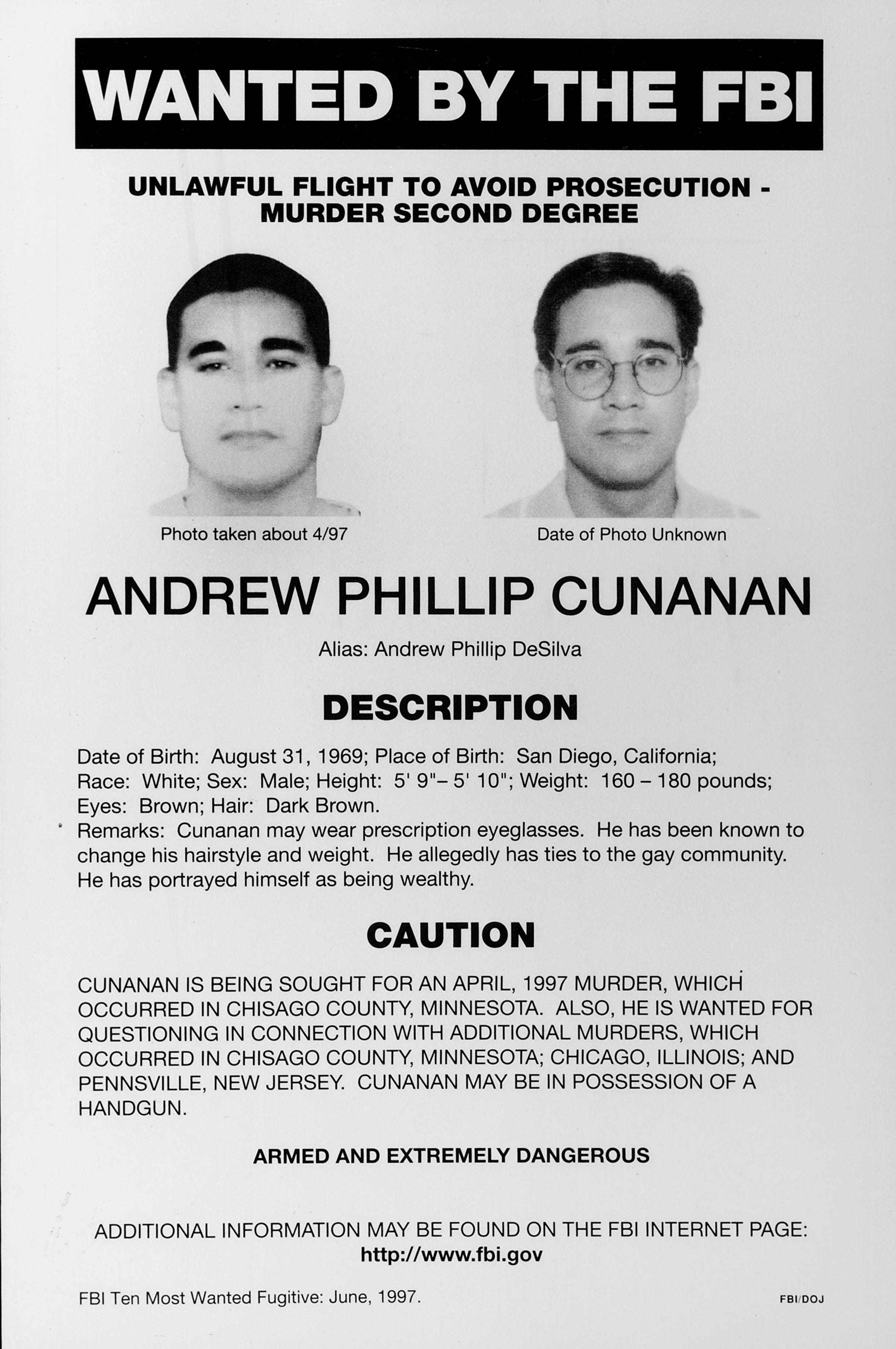
Andrew Cunanan was already on the FBI's Ten Most Wanted list when he pulled the trigger.
The public did not know his name yet.
They knew the designer, the steps, the blood on the marble.
They did not know the man on the bicycle.
How does a wanted man, hunted nationwide, disappear on a bicycle from a crowded street?
How does he pedal away from the most photographed doorway in Miami?
How does he simply cease to exist for eight days?
The exact route of the bicycle escape is not in the record.
The record shows the shots, the bicycle, the abandoned frame against the wall.
It shows a .40-caliber pistol, later recovered from a houseboat.
It does not show the path between them.
That would require evidence.
The street was full of witnesses who heard the shots.
No one saw the route.

The manhunt was already weeks old when Versace fell.
Cunanan had killed four others before him.
He was wanted, named, photographed.
He was still on a bicycle, and he was gone.
THE MANHUNT
He had been on the FBI’s Ten Most Wanted list since June 12, 1997.
The Versace murder came on July 15, 1997 — more than a month after he was already wanted.
By then, the record shows, Cunanan had killed four people: Jeffrey Trail and David Madson in Minnesota, Miguel Contreras and Lee Miglin in Chicago.
The FBI and Miami Beach Police led a multi-jurisdictional manhunt.
It was criticized for its slow pace.
It was criticized for missing Cunanan in Miami weeks before Versace was shot.
What the record does not establish is why the manhunt moved so slowly.
The specific reasons are not detailed anywhere in the case file.
Was it too many agencies sharing too little information?
Was it a suspect who kept moving, kept changing appearance, kept blending in?
Was it simply a city that did not know what it was looking at?
That would require evidence the record does not provide.
The timeline is plain: wanted on June 12, killing on July 15.
A month in between, and a man on a bicycle still free.
The frustration is in the gap, not in the explanation.
The public and the media at the time focused on the failures.
/Gianni-and-Donatella-Versace-at-a-Versace-fashion-show-28-23011993-4ec56864bcf1405a8c9acdd66c1b9101.jpg)
The record only confirms the dates — and the silence around what happened in between.
THE HOUSEDOAT
Eight days after the murder, on July 23, 1997, the manhunt ended not with an arrest but with a discovery.
A caretaker found Andrew Cunanan dead on a houseboat in Miami Beach.
The houseboat was owned by Fernando Carreira, a local man who was not charged.
The wound was self-inflicted, a gunshot to the head.
The weapon was there with him: a .40-caliber pistol.
Ballistics matched that pistol to the Versace shooting.
Ballistics matched it to the earlier killings in Minnesota and Chicago.
The FBI confirmed the match, and the nationwide search was over.
The killer was found only after he was dead.
Relief came first, then the anger.
The anger was about the gap: the days, the weeks, the missed chances.
How long Cunanan had been on that houseboat before his death is not specified in the record.
It is not established, and the record does not say.
The media asked how a man on the Ten Most Wanted list hid in plain sight for so long.
The media asked why the houseboat was not checked sooner.
The media asked what the manhunt had actually been doing.
The record only confirms the dates — and the silence around what happened in between.
The houseboat itself was later destroyed by fire.
No trial occurred.
No charges were ever formally filed.
The Miami-Dade State Attorney's Office was preparing charges of first-degree murder at the time of his death, but the case was closed without a conviction.
Cunanan was buried in San Diego.
The manhunt that had failed to find him alive was over, because there was no one left to find.
THE PUBLIC VERSION
The case became a story before it was a closed file.
Books, documentaries, and a 2018 television series, "The Assassination of Gianni Versace," have all dramatized the events.
The Versace family criticized the series for inaccuracies.
What those inaccuracies were, specifically, is not enumerated in the record.
That is not established.
At the time, the public and the media focused on the manhunt's failures.
The record confirms the timeline: Cunanan was on the FBI's Ten Most Wanted list, and the manhunt missed him in Miami for weeks.
It does not explain why.
The houseboat where Cunanan died was later destroyed by fire.
That adds to the mystery.
Was it an act of closure?
Was it a coincidence?
Was it something else?
That would require evidence.
The record shows Cunanan was buried in San Diego.
The case was closed without a conviction.

The criticism stands, but the reasons remain unproven.
It is a documented failure. It is also an unexplained one.
AND THE STORY STILL ISN'T OVER
The Miami-Dade State Attorney’s Office was preparing charges of first-degree murder when Cunanan died.
No charges were ever formally filed.
The case was closed without a conviction.
No trial occurred because the accused was already dead.
The record ends where the prosecution would have begun.
Gianni Versace’s body was cremated, and his ashes were placed in the family mausoleum near Lake Como, Italy.
Donatella Versace took over as creative director of the Versace brand.
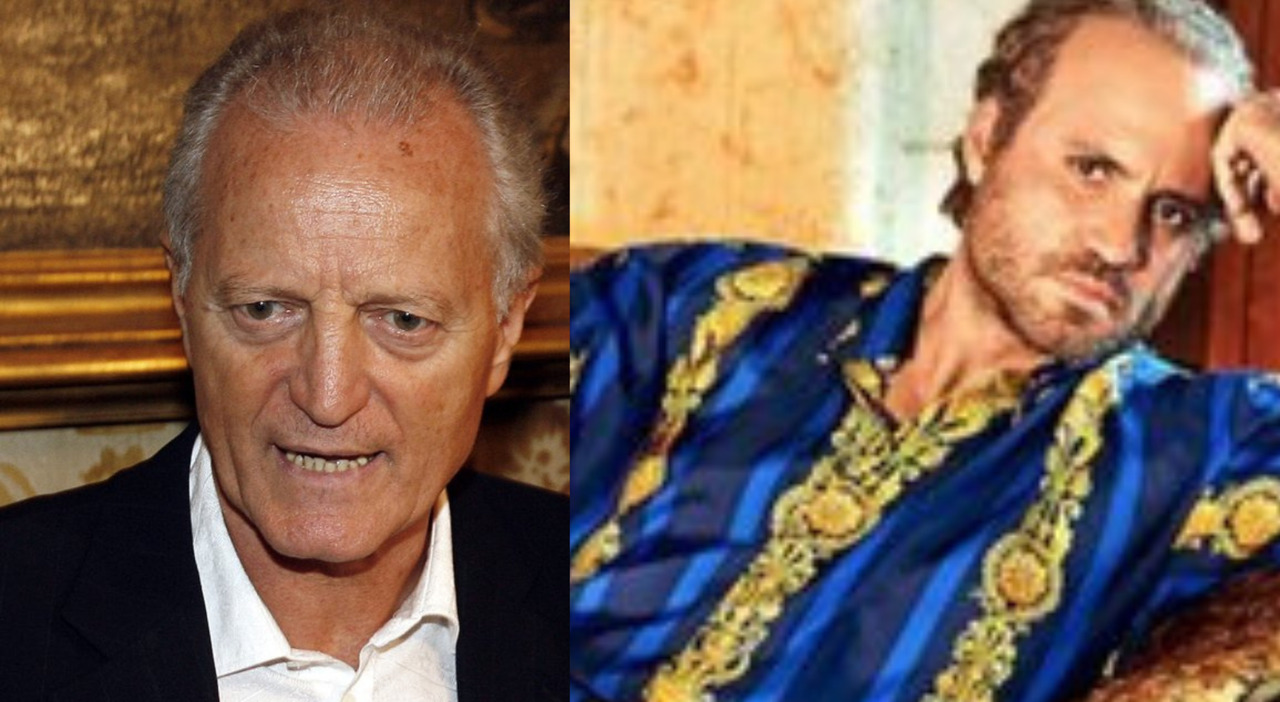
Santo Versace became CEO.
Casa Casuarina was later sold and operated as a boutique hotel.
The houseboat where Cunanan died was later destroyed by fire.
The manhunt itself became the story the public argued over.
Was it slow?
Was it careless?
Was it something worse?
That would require evidence the record does not contain.
The exact reasons the manhunt failed remain unestablished.
The criticism stands, but the reasons remain unproven.
It is a documented failure. It is also an unexplained one.
The case is closed. The questions are not.
Advertisement
You may also like
The glove that fit one hand in court but not the other — O.J. Simpson's trial
In June 1995, in a Los Angeles courtroom, O.J. Simpson struggled to pull on a pair of leather gloves. One appeared to fit. The…
The confession Amityville killer recanted, then the haunting story that followed
Six bodies, each in a bed, in a house on Ocean Avenue. The morning was November 13, 1974, in Amityville, New York. The dead…
The crawl space on West Summerdale Avenue that held 26 bodies — what police found when they dug
Robert Piest was 15 years old, and on December 11, 1978, he told his mother he was going to meet a contractor about a…
The 2013 DNA match that finally tied DeSalvo to Mary Sullivan's murder — 49 years later
She was found in her Beacon Hill apartment on January 4, 1964. Mary Sullivan was the last of the thirteen. For 49 years, no…
The cellphone video that captured Alex Murdaugh's voice near the kennels
The video was recorded at 8:44 p.m. on June 7, 2021. Paul Murdaugh's cellphone captured it near the dog kennels where the bodies were…
The notebook confession that ended the Gabby Petito case — and the questions left behind
The search lasted thirty-four days. It ended on October 20, 2021, in the Carlton Reserve in Florida. Brian Laundrie's remains were found there, in…