The 1954 murder Dr. Sam Sheppard said an intruder committed — and the courtroom it ignited
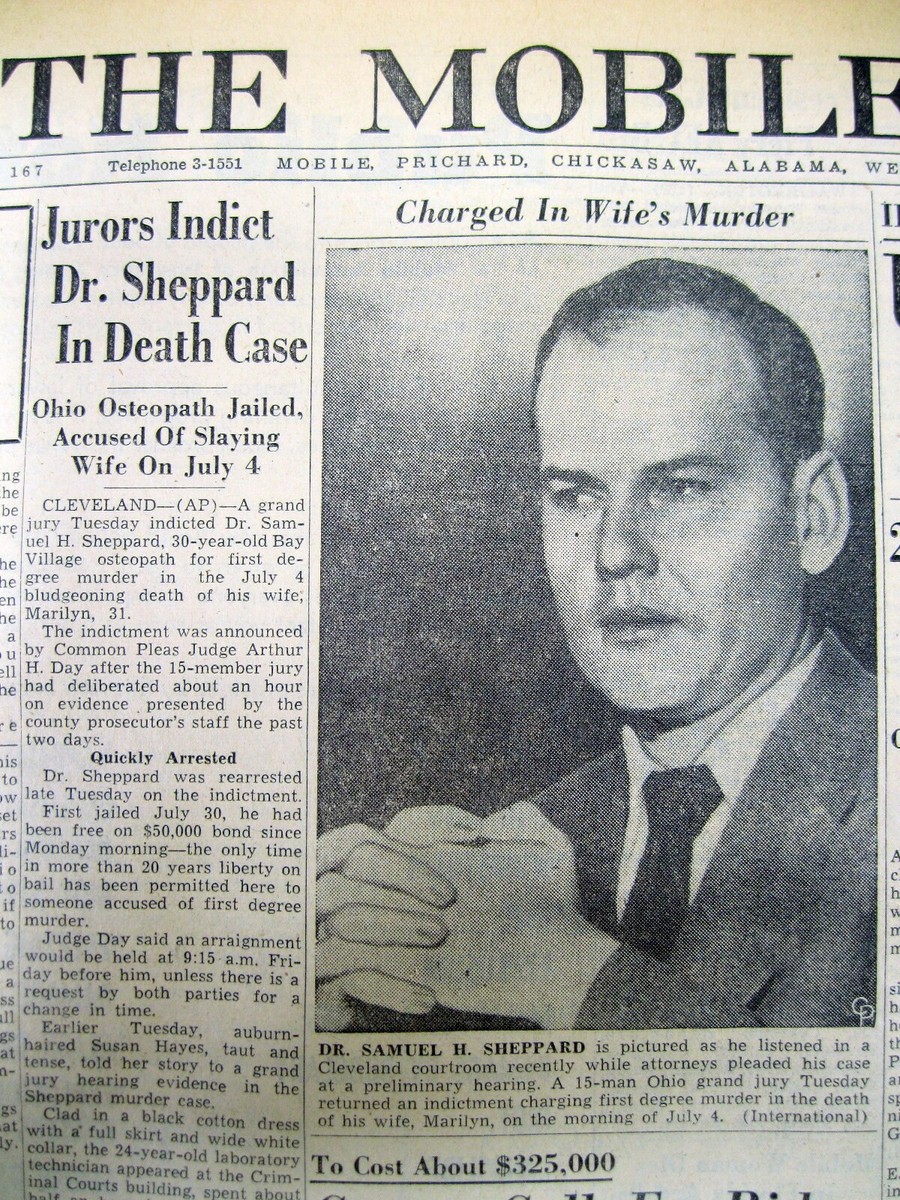
It was a holiday weekend, and the doctor said he had been asleep on the downstairs couch.
Dr. Sam Sheppard reported that an intruder broke into his lakefront Bay Village, Ohio, home on July 4, 1954.
He said the intruder fatally beat his wife, Marilyn, upstairs while he slept.
Sheppard claimed he chased the intruder, struggled, and was knocked unconscious.
When he came to, he said, he found his wife dead in their upstairs bedroom.
The murder was discovered when a neighbor, alerted by the Sheppards' seven-year-old son, entered the home.
The doctor's account was the only account.
Whether an intruder actually existed is not established; it is Sheppard's claim.
No weapon was ever found.
The couple were prominent, and the killing was violent.
The case became a national sensation.
Who was the man with the bushy hair Sheppard described?
Why did the intruder leave the son unharmed?
Why did no one else see him leave?
The record does not answer those questions.
It offers one man's word, given after he said he was knocked out cold.
She was on the ground below, in the bedroom above the couch where he slept.
The story was strange from the first telling.
It would not stay strange for long.
THE INVESTIGATION
The Bay Village police chief led the investigation.
The coroner shaped it more.
The coroner conducted the autopsy himself.
The coroner testified that Marilyn Sheppard had been beaten with a blunt instrument.
He reconstructed the scene for the jury, suggesting the killer was left-handed.
Sam Sheppard was left-handed.
A bloody surgical instrument was entered into evidence.
So was a bloody shirt belonging to Sheppard.
The murder weapon was never found.
That is not established by the record.
The record does not establish who killed Marilyn Sheppard.
The crime scene was not secured properly.
The investigation was criticized for that failure.
Evidence was contaminated, critics said.
The Cleveland Press ran editorials demanding Sheppard's arrest before trial.
Other papers followed.
The pretrial publicity was intense.
It was loud.
It was everywhere.
The coroner speculated publicly about the crime scene before the trial began.
He did not present a weapon.
He presented a theory.
The identity of the killer is not established.
The weapon is not established.
The story was strange from the first telling.
The investigation made it stranger.
THE TRIAL
The indictment came in August 1954, charging Sam Sheppard with first-degree murder.
The trial opened in October before a judge, a prosecutor, and a defense attorney.
It was a media circus before the first witness was sworn.
Newspapers had already printed their verdicts.
The jury was sequestered only after the defense objected to the atmosphere.
The prosecution argued Sheppard killed his wife in a rage over an affair with a nurse.
He admitted the affair on the stand.
The defense contended an intruder committed the murder, possibly the "bushy-haired" man Sheppard said he chased that night.
The courtroom heard the claims and the counter-claims.
The publicity filled the gaps the evidence left open.
The absence of a murder weapon was noted.
The weapon was never found.
On December 21, 1954, the jury returned.
They found Sheppard guilty of second-degree murder, not first-degree.
He was sentenced to life in prison.
The verdict is recorded.
What the verdict does not establish is whether Sheppard killed his wife.
The jury's decision is a fact of the record.
The guilt or innocence behind it is not.
THE OVERTURN
The conviction was upheld on appeal.
Then, in 1964, the U.S. Supreme Court overturned it.
The ruling was specific: the trial judge had failed to control pretrial publicity and the courtroom atmosphere.
That failure, the Court held, violated Sheppard's right to a fair trial.
The case became a foundational precedent for media and trial procedure.
It is cited still, whenever cameras and headlines crowd a courtroom.
The story did not end with the reversal.
Sheppard was retried in 1966, with a new defense team led by F. Lee Bailey.
The second trial was quieter. The jury was sequestered.
On November 16, 1966, the verdict came back: not guilty.
Acquittal is not innocence.
It is a finding that the prosecution failed to prove guilt.
That is all the record establishes.
The intruder story remains Sheppard's claim, not a fact the record confirms.
The conviction was reversed on process, not on proof of who killed Marilyn Sheppard.
The second jury did not say an intruder did it.
It said the state did not meet its burden.
What the verdict does not establish is whether Sheppard killed his wife.
The acquittal is a fact of the record.
The guilt or innocence behind it is not.
That would require evidence the case never produced.
AND THE STORY STILL ISN'T OVER
The acquittal is a fact of the record.
The guilt or innocence behind it is not.
That would require evidence the case never produced.
Sam Sheppard returned to medicine after the acquittal.
He struggled with alcoholism.
He struggled with legal troubles.
He died on April 6, 1970, of liver failure at age 46.
His son, Sam Reese Sheppard, spent decades campaigning to clear his father's name.
He filed a wrongful imprisonment lawsuit in 1999.
In 2000, a civil jury found that Sam Sheppard had not been wrongfully imprisoned.
That verdict effectively upheld the original conviction's factual basis.
Not because the jury found him guilty.
But because the record did not prove he was innocent.
DNA testing in the 1990s on crime-scene evidence was inconclusive.
Inconclusive means no answer.
No answer on the identity of the killer.
No answer on Sheppard's actual innocence.
Both remain unestablished.
That is what the record does not establish.
The case inspired books, films, and television series.
The 1993 film *The Fugitive* was loosely based on it.
The Sheppard family continues to assert innocence.
They say the intruder story was true.
The record says he claimed it.
Those are different things.
The son spent decades.
The son filed the suit.
The son lost the suit.
Sheppard died at 46.
He was free for less than four years.
The case still divides opinion.
Some see a man destroyed by a media circus.
Some see a man who got away.
The DNA could not settle it.
The civil jury could not settle it.
The criminal jury in 1966 acquitted him.
The civil jury in 2000 said he was not wrongfully imprisoned.
Two juries, two decades apart, two different answers.
That would require evidence the case never produced.
The identity of the killer remains unknown.
The innocence of Sam Sheppard remains unproven.
Those are the facts.
Everything else is a story told after.
Advertisement
You may also like
The bloody glove found at O.J. Simpson’s estate that split a nation
A single glove lay on the walk outside Nicole Brown Simpson’s condominium on Bundy Drive. Police found it on the night of June 12,…
A 12-year-old girl was among the victims — and her parents kept coming to court
The youngest name on the list was twelve years old. Between October 1977 and February 1978, ten young women and girls were abducted, sexually…
Why a therapist's tape recording changed the Menendez brothers' murder case
The 911 dispatcher logged the call at 11:47 p.m. on August 20, 1989. Lyle Menendez told the operator his parents had been shot. He…
The confession that named 11 victims — but never made it to trial
In 1965, a man already in custody for other crimes gave a detailed confession to a series of murders that had terrorized Boston since…
The plea deal that let Epstein walk — and the 2018 report that changed everything
In 2018, the Miami Herald published a series by Julie K. Brown on Jeffrey Epstein’s 2008 plea deal. The series documented what federal prosecutors…

The fingerprint on a pillowcase that sealed a killer's fate — and the appeals that keep him alive
The pillowcase was ordinary. It sat in Polly Klaas's mother's home in Petaluma, California, on the night of October 1, 1993. Twelve-year-old Polly was…