The 1980 Columbia River cash that tied a stranger to Cooper's jump
The boy was walking the bank of the Columbia River near Vancouver, Washington, in 1980.
He was not looking for anything.
He found a bundle of cash, rotting and waterlogged, half-buried in the sand and mud.
The bills were stuck together, decayed, barely readable.
He turned them over to authorities, who ran the serial numbers.
The numbers matched the ransom money from the 1971 hijacking.
The $200,000 delivered to a man who called himself Dan Cooper.
The find was accidental.
It was not the result of the decade-long manhunt, not the product of FBI dragnets or aerial searches or thousands of tips.
A child, playing along a river, found what the largest investigation in Bureau history could not.
This is the only confirmed physical trace of Cooper after the jump.
No parachute, no body, no bag — just this decaying stack of cash.
What the record does not establish: who the boy was.
What the record does not establish: exactly where on the riverbank he stood.
What the record does not establish: how the money got there.
The cash confirms one thing only — Cooper survived the jump.
It does not say where he went.
It does not say who he was.
It does not say why the money was abandoned, or when, or by whom.
The river gave back a fact.
The manhunt gave back nothing.
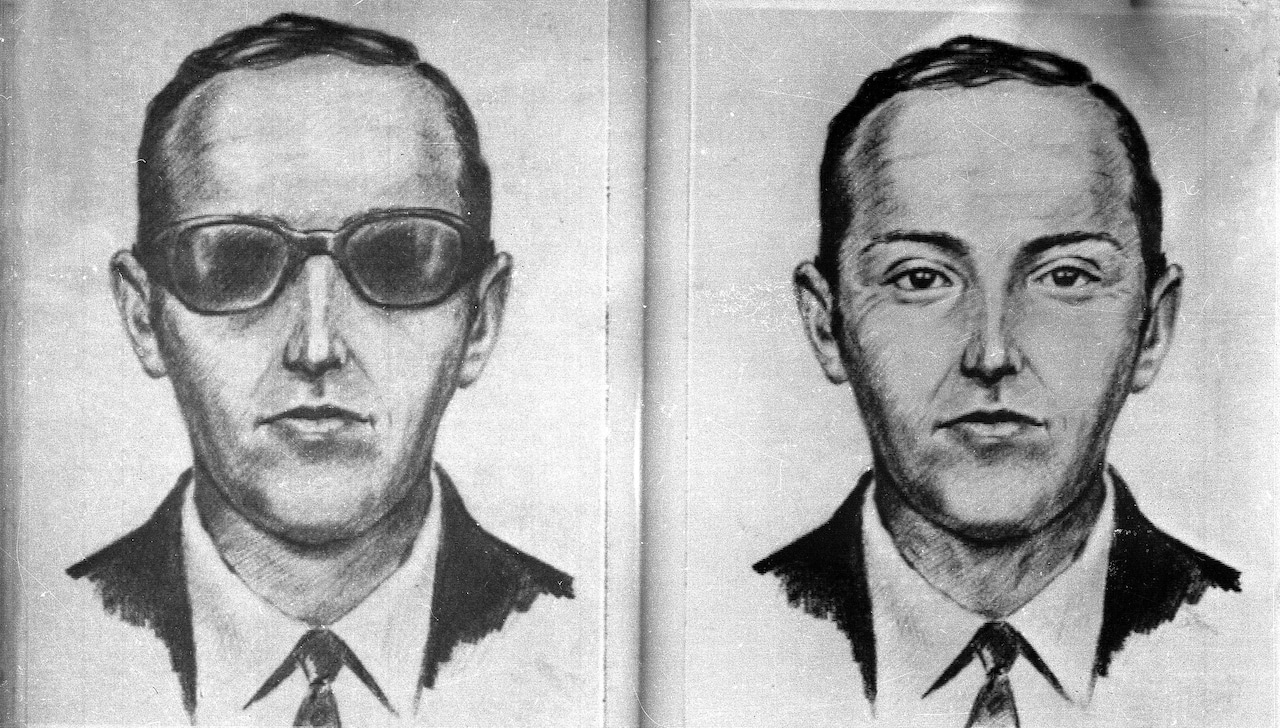
THE NOTE AND THE TIE — NOVEMBER 24, 1971
The man called himself Dan Cooper.
He bought a one-way ticket on Northwest Orient Airlines Flight 305, Portland to Seattle, on November 24, 1971.
Shortly after takeoff, he handed a flight attendant a note.
The note claimed a bomb in his briefcase.
He demanded $200,000, four parachutes, and a fuel truck waiting in Seattle.
The plane landed in Seattle.
Passengers were released.
The ransom and parachutes were delivered.
Cooper then ordered the crew toward Mexico City.
Somewhere between Seattle and Reno, likely over southwestern Washington, he opened the aft stairway.
He jumped into the night.
The plane landed in Reno with Cooper gone.
The FBI recovered the note.
They also recovered his clip-on tie, which he removed before jumping.
The tie became the most significant piece of physical evidence.
It is not in the record whether the bomb was real.
It was never proven.
The exact jump location is not in the record either.
The case record places it somewhere between Seattle and Reno, likely over southwestern Washington.
That is a range, not a point.
The tie held what the manhunt could not.
The river gave back a fact.
The manhunt gave back nothing.
THE DNA AND THE DEATHBED CLAIM
The tie held what the manhunt could not.
It held DNA.
The FBI processed that DNA from the tie and the parachute harness over decades.
No match was ever made to a suspect.
In 2007, the FBI announced a partial DNA profile from the tie.
It did not match any known suspect.
In 2008, the FBI examined a suspect whose widow claimed he confessed on his deathbed.
The DNA did not support the claim.
Other evidence did not support the claim.
The suspect was cleared.
Another man, convicted of a similar hijacking in 1972, was investigated too.
He was never tied to the Cooper case.
His name is not confirmed in the record.
He was cleared.
The investigation was hampered from the start.
No one saw the jump.
The terrain where Cooper likely landed was remote and heavily forested.
The FBI suspended the active investigation in 2016.
It continued to review tips.
What the record establishes is narrow: a partial profile, a cleared suspect, a cleared suspect.
What the record does not establish is an identity.
That would require a match.
The deathbed confession was a claim.
The similar hijacking was a lead.
Neither resolved the case.
The tie remained physical evidence.
The DNA remained partial.
The suspect remained unnamed.
WHAT THE RECORD DOES AND DOESN'T PROVE
The 1980 cash is the only confirmed physical trace of Cooper after the jump.
The serial numbers matched the ransom money.
That match confirmed Cooper survived the jump, according to the FBI evidence record.
It did not confirm who he was.
It did not confirm where he landed.
It did not confirm how the bundle ended up on a riverbank near Vancouver, Washington.
That last part is not established.

What the record does establish is narrower.
There was no trial.
Cooper was never captured, so no charges were formally filed, per the case outcome.
The FBI classified the crime as air piracy and extortion.
In 2016, the FBI closed the active investigation, stating all credible leads were exhausted.
The statute of limitations has long passed.
Cooper could not be prosecuted even if identified today.
That is the case status.
Several suspects were proposed over the years.
A former Northwest Orient employee was named.
A man named Kenneth Christiansen was named.
None were confirmed, according to the case record.
Was the bomb real?
Was the note a bluff?
Was the money a payoff or a loss?
That would require evidence.
The record does not establish Cooper's identity.
The record does not establish whether the bomb was real.
The record does not establish how the cash got to the riverbank.
The record establishes the serial numbers.
The record establishes the survival.
The record establishes the closure.
The rest is theory.
AND THE STORY STILL ISN'T OVER
In 2016, the FBI suspended the active investigation.
The case remains open for new tips, the case status states.
The evidence is still held in the FBI's archives.
The tie is there. The recovered cash is there.
The 1980 cash remains the only confirmed physical trace of Cooper after the jump, the case status states.
No one else was ever charged or convicted in connection with the Cooper hijacking, the case outcome states.
There was no trial. There was no verdict.
The case remains one of the most famous unsolved crimes in American history, the case status states.
It is a cold case. It is also a cultural landmark.
Whether any new tip will ever lead to an identification is not established in the record.
That would require a name. That would require a match.
The statute of limitations has long passed, so even a confession today would not bring charges.
Still, the tips come. The theories persist.
The money is real. The jump is real.
The man remains a name on a ticket, an alias with no face.
The record establishes the cash. The record establishes the survival.
The rest is theory.
The story still isn't over.
Advertisement
You may also like
The tarot card left at a D.C. sniper crime scene that said 'Call me God'
The card was on the ground at a crime scene in Montgomery County. A tarot card, face up, with a message written across it:…
The cell phone records that placed a suspect near Leakin Park — but one witness kept changing his story
January 13, 1999, was a school day. Hae Min Lee, an 18-year-old senior at Woodlawn High School in Baltimore County, Maryland, was last seen…
The parole agent who saw a sketch and stopped a car — then Polly Klaas's killer led police to her body
The parole agent saw the car first. A sketch, a tip, and a car on the road — that was the break. On November…
The cellmate tip that cracked the Clutter case after investigators ignored a footprint
The footprint was there on the night of November 15, 1959, inside the farmhouse near Holcomb, Kansas. Four members of the Clutter family were…
The cell tower records that placed Adnan Syed at Leakin Park — and the witness who changed his story
The phone call came on February 12, 1999. Baltimore County police picked up an anonymous tip that day, and the voice on the line…
The jailhouse informant's testimony that could not save Casey Anthony
She sat in the witness box and testified that Casey Anthony had made incriminating statements while in jail. Her name was Robyn Adams, a…