The $5,800 in D.B. Cooper ransom cash a boy found on a riverbank
The boy was eight years old, playing on a sandbar along the Columbia River in Washington in 1980.
He pulled three bundles of cash from the mud, about $5,800 in rotting twenty-dollar bills.
The serial numbers matched the list the FBI had recorded before handing over the ransom.
It was the money from the hijacking.
The boy kept a portion of the find, and later sold some of the bills at auction.
How the cash came to rest on that riverbank is not established.
No one has ever explained it.
The hijacker's briefcase was never found.
No explosive device from that briefcase was ever found or confirmed.
The boy found the money nine years after the man calling himself Dan Cooper jumped from the back of a Boeing 727 into the night.
He was never seen again.
The bills were real, physical proof that the hijacking happened, that the plane landed, that the money was delivered.
But proof of the money is not proof of the man.
The identity of the hijacker remains unknown.
What else might be buried in that stretch of river?
What else might still surface?
What else is left to find?
That would require evidence.
THE HIJACKING
It was the day before Thanksgiving, 1971.
A man using the alias "Dan Cooper" bought a one-way ticket on Northwest Orient Airlines Flight 305 from Portland, Oregon, to Seattle, Washington.
Shortly after takeoff, he handed a flight attendant a note.
The note claimed he had a bomb in his briefcase.
He demanded $200,000 in cash, four parachutes, and a fuel truck standing by in Seattle.
The bomb was claimed, not confirmed.
No explosive device was ever found.
After the plane landed in Seattle, the money and the parachutes were delivered.
He released the passengers and most of the crew.
Then he ordered the pilots to fly toward Mexico City at a low altitude.
Somewhere between Seattle and Reno, Nevada, he opened the rear stairway.
He jumped into the night over southwestern Washington.
It was raining.
The wind was cold.
He was never seen again.
The note was a demand.
The briefcase was a prop, or a threat, or both.
That would require evidence.
THE INVESTIGATION AND THEORIES
The FBI called it one of its longest and most expensive investigations.

They chased parachutes first.
The chutes were military-style, which narrowed the suspect pool.
It produced no match.
They interviewed thousands of people over the decades.
Several men confessed on their deathbeds.
None of the confessions were verified.
No physical evidence had ever conclusively linked any suspect to the hijacking.
No suspect was ever identified, charged, or cleared.
That is what the record shows.
The name stuck anyway.
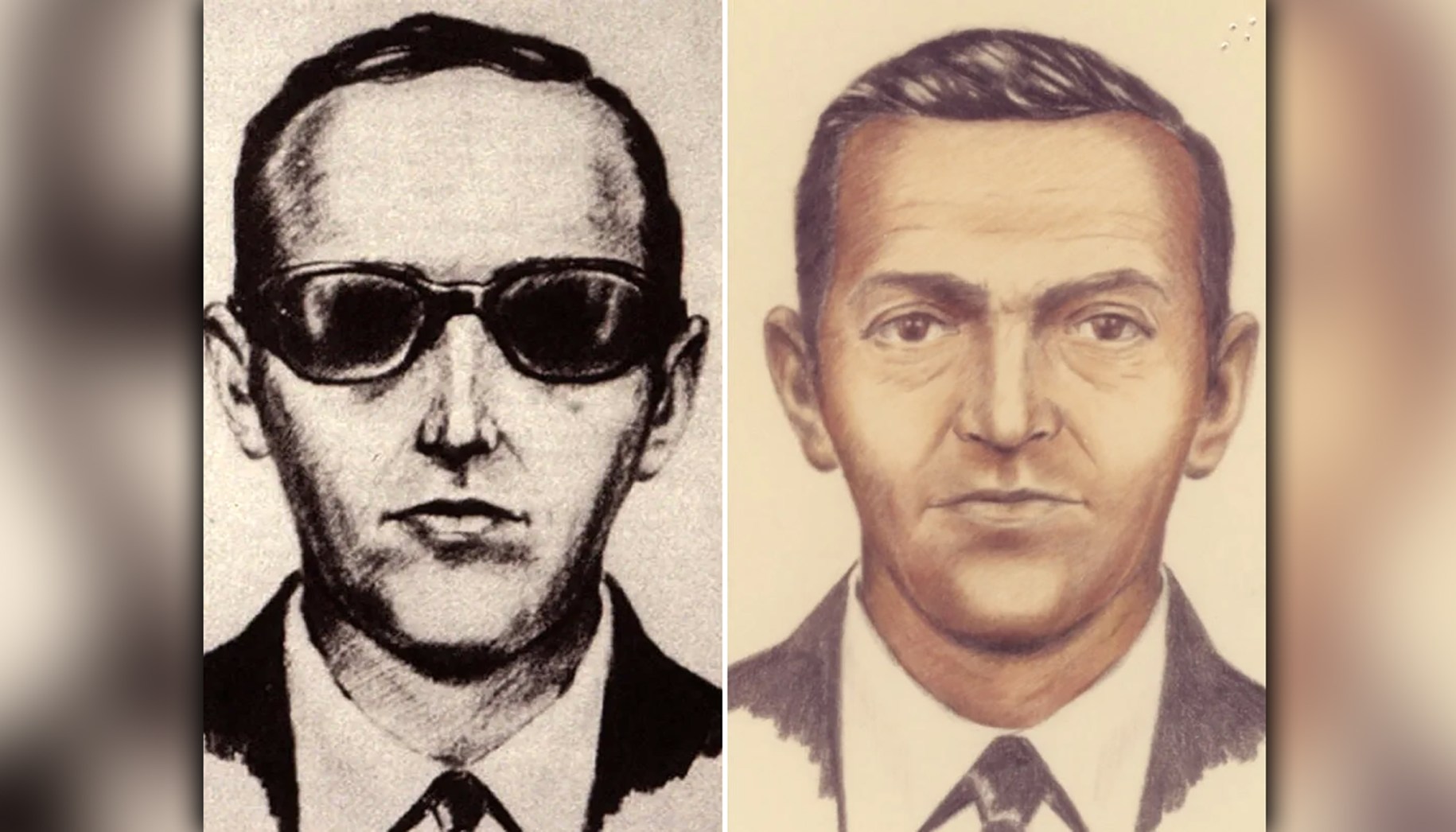
"D.B. Cooper" became the public label after a reporter misidentified him from an early suspect.
Not because the record established it.
But because the legend needed a name.
The theories multiplied.
A trained paratrooper.
A disgruntled employee.
A man who did not survive the jump.
Each theory had a story.
Each story lacked proof.
What was examined?
The chutes, the bills, the flight path, the confessions.
What was found?
About $5,800 in ransom cash on a riverbank in 1980.
What remains?
Everything else.
The FBI interviewed thousands, and the case produced no arrest, no charge, no trial.
The statute of limitations for prosecution expired in 1976.
In 2016, the FBI suspended its active investigation, citing a lack of new leads.
The agency stated the case remains open to new evidence.
The case remains open in the sense that no one has been ruled out.
It is not open in the sense that anyone is being pursued.
The hijacker's identity remains unknown.
No family has ever come forward publicly claiming to be related to him.
That would require evidence.
THE RECORD VS. THE LEGEND
The $5,800 in bills the boy found on the riverbank were confirmed as part of the ransom through recorded serial numbers.
That part of the record is settled.
The rest of the $200,000 has never been recovered in full.
Only about $5,800 of the bills were found.
The case has become a cultural legend, with books, documentaries, and films exploring it.
It is a story told and retold.
It is also a case with no definitive answer.
The hijacker's identity is not established.
The case remains officially unsolved.
In 2016, the FBI announced it was suspending active investigation, citing a lack of new leads.
The agency stated that no physical evidence had ever conclusively linked any suspect to the hijacking.
The FBI has stated that it remains open to new evidence.
But as of now, the case is inactive.
The legend asks who he was.
The legend asks where he landed.
The legend asks what happened to the money.
The record answers none of that.
The record shows a note, a jump, a bundle of cash on a sandbar.
That would require evidence.
AND THE STORY STILL ISN'T OVER
There was no trial.
No suspect was ever arrested, charged, or indicted.
The statute of limitations for prosecution expired in 1976.
The FBI formally closed its active investigation in 2016, though it continues to receive tips.
The agency said no physical evidence had ever conclusively linked any suspect to the hijacking.
The case remains open in the sense that no one has been ruled out.
But no legal proceedings ever occurred.
No family has ever come forward publicly claiming to be related to the hijacker.
Not a widow, not a child, not a colleague who recognized a jacket.
That silence is part of the record too.
The ransom itself is mostly unaccounted for.
The $200,000 has never been recovered in full; only about $5,800 of the bills were found on a riverbank in 1980, and a portion of those were later sold at auction.
The rest of the cash has never surfaced.
Did it burn? Did it bury itself in the mud? Did someone spend it, one bill at a time, hoping nobody checked the serial numbers?
That would require evidence.
The FBI has said it remains open to new evidence.
Tips still arrive.
They are reviewed, compared, filed.
The hijacker's identity remains unknown.
The case is inactive but not closed; there are no pending legal proceedings, and none are expected.
It is a story without a verdict.
It is a story without an ending.
The man who called himself Dan Cooper jumped into the night over southwestern Washington, and the night kept him.
Fifty years on, the file sits with a question mark where a name should be.
Advertisement
You may also like
The tarot card left at a D.C. sniper crime scene that said 'Call me God'
The card was on the ground at a crime scene in Montgomery County. A tarot card, face up, with a message written across it:…
The cell phone records that placed a suspect near Leakin Park — but one witness kept changing his story
January 13, 1999, was a school day. Hae Min Lee, an 18-year-old senior at Woodlawn High School in Baltimore County, Maryland, was last seen…
The parole agent who saw a sketch and stopped a car — then Polly Klaas's killer led police to her body
The parole agent saw the car first. A sketch, a tip, and a car on the road — that was the break. On November…
The cellmate tip that cracked the Clutter case after investigators ignored a footprint
The footprint was there on the night of November 15, 1959, inside the farmhouse near Holcomb, Kansas. Four members of the Clutter family were…
The cell tower records that placed Adnan Syed at Leakin Park — and the witness who changed his story
The phone call came on February 12, 1999. Baltimore County police picked up an anonymous tip that day, and the voice on the line…
The jailhouse informant's testimony that could not save Casey Anthony
She sat in the witness box and testified that Casey Anthony had made incriminating statements while in jail. Her name was Robyn Adams, a…