The bloodstain pattern that didn't match Sam Sheppard's story
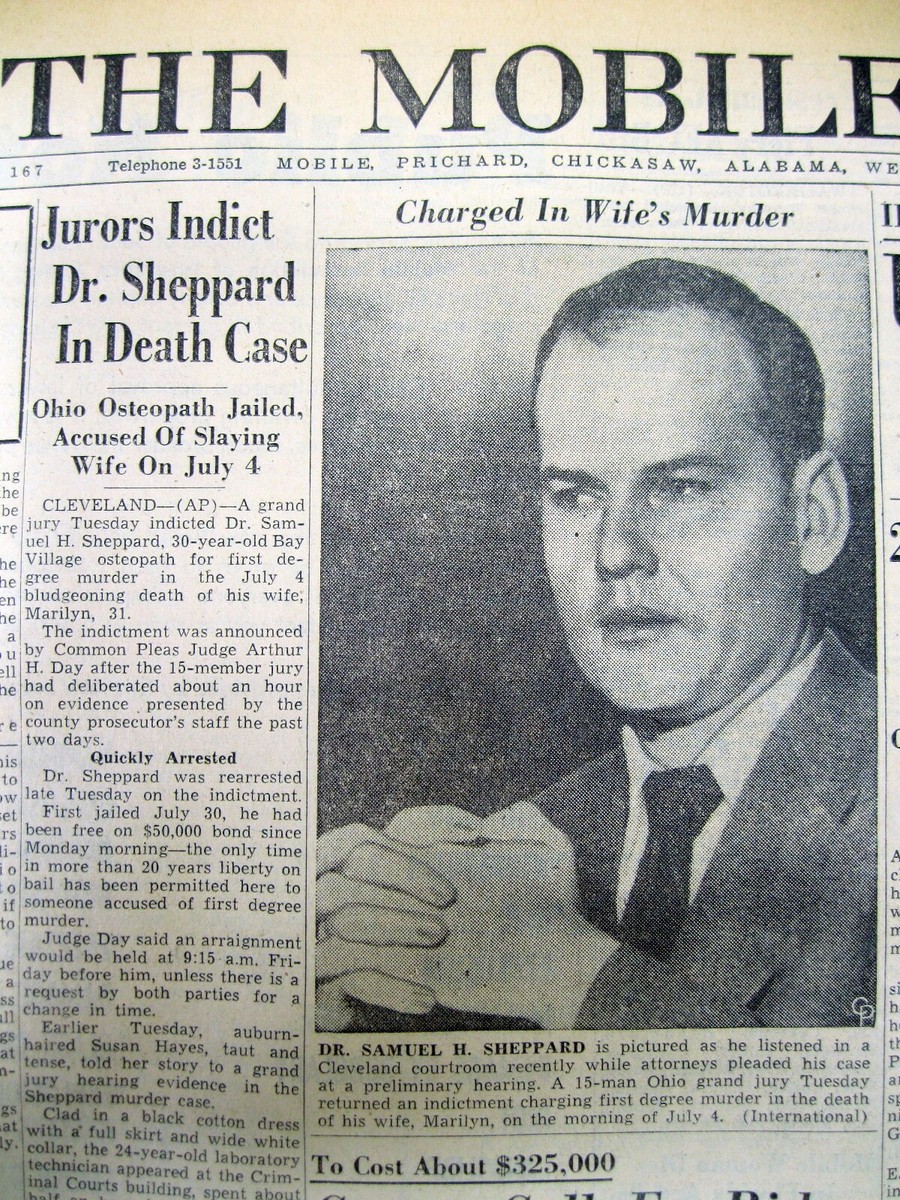
On July 4, 1954, Dr. Sam Sheppard told police an intruder beat him unconscious and killed his wife, Marilyn, in their Bay Village, Ohio, bedroom.
She said it happened in the bedroom.
Marilyn suffered more than 25 blows to the head from a heavy object.
The murder weapon was never found.
Sheppard said the intruder attacked him from behind.
He said he woke on the floor.
He said he found her dead.
The bloodstains on the wall and floor told a different story.
Years later, a forensic scientist re-examined the bloodstains.
He found they did not match Sheppard's story of being attacked from behind.
The pattern suggested the killer stood over the victim.
It suggested the killer was not struck the way Sheppard claimed.
The bloodstain pattern is the detail that still draws scrutiny.
It is not proof of who swung the weapon.
It is not established that the bloodstains identify the killer.
They only contradict Sheppard's version.
That contradiction became the hinge of the case.
How can a blood pattern undo a man's account?
How can dried stains on plaster say who stood where?
How can they say who held the object?
That would require evidence.
The record shows the stains did not match.
The record does not show who made them.
THE 911 CALL AND THE UNGUARDED HOUSE
He reported the intruder attack on July 4, 1954.
Police found no sign of forced entry.
The investigation focused on Sam Sheppard almost immediately.
He was arrested and charged with first-degree murder.
The crime scene was not secured.
Neighbors and family members moved through the house, disturbing key evidence.
The couple's 7-year-old son was asleep in another room and was unharmed.
The coroner made public statements suggesting Sheppard's guilt before trial.
The statements came before any trial.
They came before the evidence was tested.
They came before the scene was even properly documented.
The lack of forced entry became the prosecution's opening argument.
It is not established that the lack of forced entry proves Sheppard was the killer.
The scene was contaminated.
The record does not show what the killer left behind.
It does not show what the neighbors moved.
It does not show what the family touched.
That would require a secured scene.
The investigation narrowed to one man while the house still held the answers.
The room where Marilyn Sheppard died was walked through, handled, and altered.
The weapon was never found.
The record does not show who carried it out.
THE TRIAL AND THE BLOODSTAIN TESTIMONY
The trial opened in October 1954, and the courtroom became a spectacle.
Jurors were not sequestered; they read the papers, heard the radio, and watched the cameras.
The prosecution built its case on what was not there: no forced entry, no consistent story, no weapon.
Sheppard had admitted to an affair with a nurse, and the state leaned on that admission.
The coroner took the stand and pointed at the blood.
He testified that the stains in the bedroom showed the killer was not injured as Sheppard claimed.
The stains, he said, did not match a man who had been beaten unconscious and then stumbled to find his wife.
But the weapon was never found.
The bloodstains alone did not prove guilt; the record does not establish that.
The defense answered with an intruder, a sloppy investigation, and a house left open to anyone.
The jury heard the circumstantial weight, and it pressed down.
In December 1954, Sheppard was convicted of second-degree murder.
He was sentenced to life in prison.
The conviction was upheld on appeal.
The blood on the wall had spoken, but it had not said everything.
THE FORENSIC RE-EXAMINATION
Years passed. The case went quiet.
Then a forensic scientist reopened the blood evidence.
He was not part of the original investigation. He came to it cold, looking at photographs and reports that had sat in boxes for a decade.
What he found did not match the story told at trial.
The bloodstains in the bedroom were inconsistent with the prosecution's theory. They did not show a killer who had been attacked from behind and had fought back in self-defense.
The patterns suggested something else. They suggested the killer had stood over the victim, striking downward, unhurt.
That was not the man Sam Sheppard said he was. That was not the man the prosecution said he was, either.
The findings were used to push for a new trial. The legal fight moved slowly, the way these fights always do.
In 1966, the U.S. Supreme Court ruled the original trial was fundamentally flawed. The media frenzy had poisoned it. The Court ordered a new trial.
At the retrial, the prosecution's case was thinner. The blood evidence had shifted. The old certainty was gone.
On November 16, 1966, Sam Sheppard was acquitted.
He had served about ten years.
The blood on the wall had not named an intruder. It had only undone the prosecution's version of events.
That is what the record establishes. It does not establish that the stains prove an intruder killed Marilyn Sheppard. That would require evidence no one has ever produced.
AND THE STORY STILL ISN'T OVER
She returned to medicine with him, but the return was not a recovery.
He practiced again, but the practice was shadowed by alcoholism and legal troubles that followed the acquittal.
He died on April 6, 1970, at age 46, of liver failure.
The murder of Marilyn Sheppard has never been solved.
No other suspect was ever charged.
The record is closed, and it does not establish who killed her.
That is not a mystery the court resolved; it is a question the file keeps.
The case outlived him.
It inspired *The Fugitive* on television and later in film, though those dramatizations changed many details.
His son, a child asleep in another room that night, grew up to become a physician.
The son spent years trying to clear his father's name further, though the acquittal already stood.
The bloodstain pattern remains a point of debate among those who study the old photographs.
It is a debate without a verdict.
What the stain shows, what the stain hides — the record does not settle either.
It is not established that an intruder killed Marilyn Sheppard.
It is not established that her husband did.
The evidence was disturbed, the weapon never found, the trial a spectacle.
The forensic re-examination undid the prosecution's story, but it did not write a new one.
He had served about ten years.
He was free for fewer than four.
The house on the lake is gone from the news, but the question stays open.
That is the weight of it: a case that became a landmark in legal history, and a death that never found its author.
The story still isn't over.
Advertisement
You may also like
The tarot card left at a D.C. sniper crime scene that said 'Call me God'
The card was on the ground at a crime scene in Montgomery County. A tarot card, face up, with a message written across it:…
The cell phone records that placed a suspect near Leakin Park — but one witness kept changing his story
January 13, 1999, was a school day. Hae Min Lee, an 18-year-old senior at Woodlawn High School in Baltimore County, Maryland, was last seen…

The parole agent who saw a sketch and stopped a car — then Polly Klaas's killer led police to her body
The parole agent saw the car first. A sketch, a tip, and a car on the road — that was the break. On November…
The cellmate tip that cracked the Clutter case after investigators ignored a footprint
The footprint was there on the night of November 15, 1959, inside the farmhouse near Holcomb, Kansas. Four members of the Clutter family were…
The cell tower records that placed Adnan Syed at Leakin Park — and the witness who changed his story
The phone call came on February 12, 1999. Baltimore County police picked up an anonymous tip that day, and the voice on the line…
The jailhouse informant's testimony that could not save Casey Anthony
She sat in the witness box and testified that Casey Anthony had made incriminating statements while in jail. Her name was Robyn Adams, a…