Flight attendant who took the note from D.B. Cooper still haunted by his calm
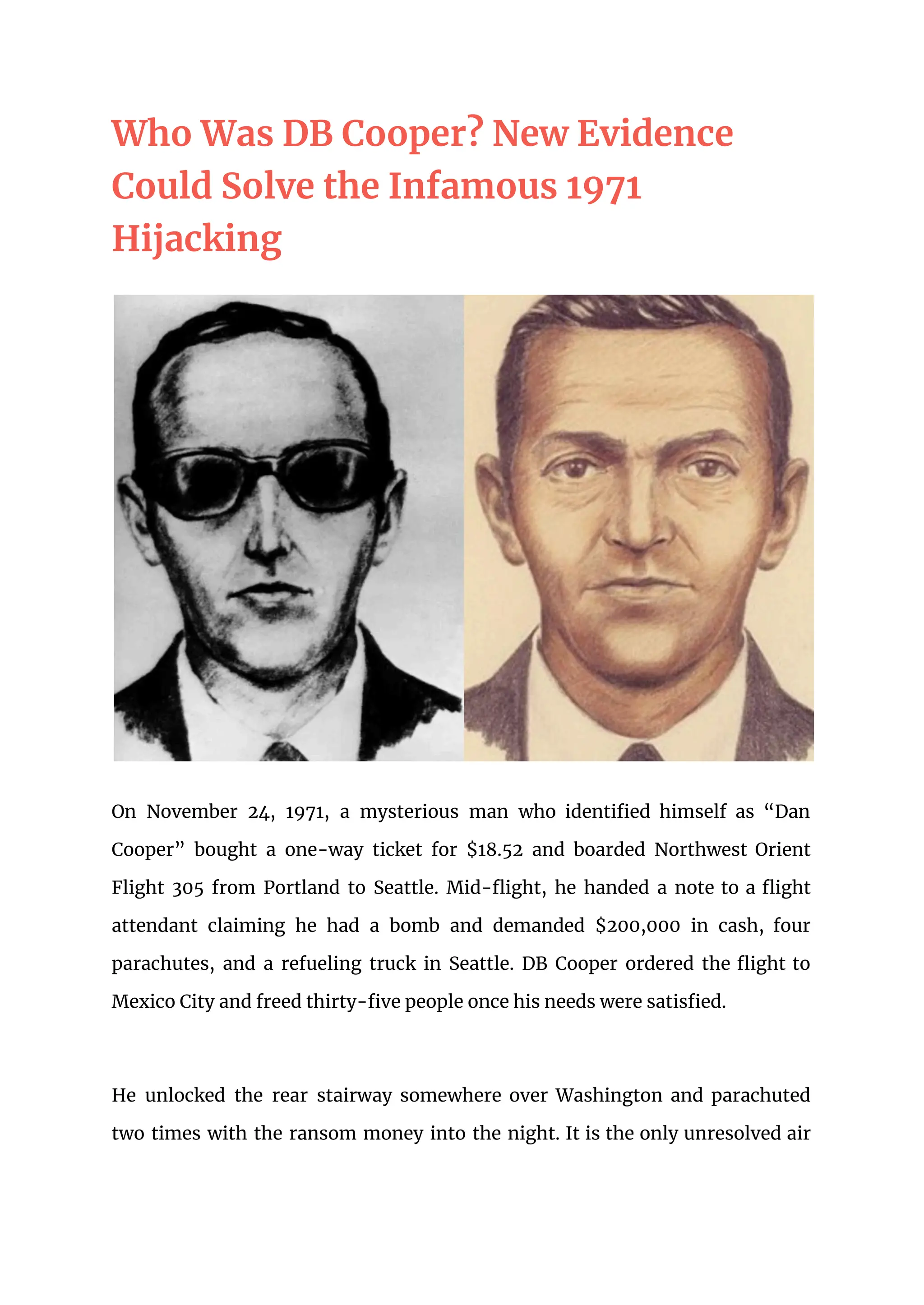
She was the one who took the note.
It was November 24, 1971, and the man had just handed her a folded piece of paper on Northwest Orient Airlines Flight 305, bound from Portland to Seattle.
She opened it, and the note said he had a bomb in his briefcase.
It demanded $200,000 in cash, four parachutes, and a fuel truck waiting on the tarmac in Seattle.
He gave his name as Dan Cooper.
The flight attendant who received the note later described him as calm and polite.
Calm and polite, she said, as if he were ordering a drink.
That calm is the detail that has haunted her for decades.
Not the demand. Not the bomb. The calm.
The man's true identity has never been established.
The name "D.B. Cooper" was a journalist's error, not his own.
No explosive device was ever found or confirmed.
But the threat was enough to command the crew's compliance.
What was in the note beyond the bomb claim and the demands?
That is not in the record.
What did she think, reading it at 30,000 feet?
What does she think now, all these years later?
That would require evidence the case does not hold.
He was polite. He was calm.
She was on the ground below, forever after.
THE FLIGHT
She sat with him for much of the flight.
She sat across the aisle, watching him. She watched his hands, his face, the way he ordered a drink. The flight attendant who took the note observed a man who did not raise his voice. He was calm. He was polite. He was, she later said, not like a man holding a bomb.
The plane landed in Seattle. The passengers were released. The ransom and the parachutes were delivered.
Tina Mucklow carried the money to the plane. She was the other flight attendant. She was the last crew member to see Cooper before he jumped. She handed him the $200,000 in cash. She watched him count it.
Captain William Scott flew the plane under Cooper's instructions. He turned south. He dropped to low altitude. He kept the cabin unpressurized so the rear stairway could stay down.
Somewhere over southwestern Washington, likely near the Columbia River, Cooper jumped. He jumped from the rear stairway of the Boeing 727 into the night. The exact location of the jump is not confirmed. It is described as likely near the Columbia River. That is what the record holds, and nothing more.
No one was physically harmed. The passengers walked off the plane. The crew landed the aircraft. The hijacker vanished into the dark.
But the flight attendants carried something after. The one who took the note said she was traumatized by the experience. She described his calm again and again, as if the calm was the wound. Tina Mucklow spoke publicly on occasion, then retreated. The trauma was not physical. It was the memory of a polite man with a bomb. It was the weight of sitting beside him for hours.

She was on the ground below, forever after.
THE AFTERMATH
The FBI launched a massive manhunt immediately after the hijacking.
Agents fanned out across the Pacific Northwest.
They checked airports, roads, and the rugged terrain below the flight path.
The ransom money's serial numbers were recorded and distributed to banks and businesses nationwide.
Every teller had a list.
Every bill was a lead.
The parachutes were never recovered.
Neither was the man.
The FBI interviewed hundreds of suspects over the decades.
They chased men with grudges, men with debts, men with the right build.
One suspect stood out: Richard Floyd McCoy Jr.
McCoy committed a nearly identical hijacking in 1972, jumping from a plane with ransom money and parachutes.
He was later killed in a prison escape attempt.
But he was never conclusively linked to the Cooper case.
The investigation came close, but it never closed.
In 1980, a young boy found a rotting bundle of cash along the Columbia River near Vancouver, Washington.
The serial numbers matched the ransom.
It was $5,800 of the $200,000.
The discovery suggested Cooper had survived the jump.
It suggested he had landed, alive, and walked away.
But the FBI never confirmed this.
Whether Cooper survived the jump is not established.
The FBI believes he died shortly after, given the weather and terrain.
That belief is unproven.
The bills were real.
The survival was not.
The case remains officially unsolved and open, though inactive.
The statute of limitations has long since expired.
If Cooper were found alive today, he could not be prosecuted for the hijacking itself.
The trail went cold in the mud of the Columbia River.
The money rotted in the ground.
The man did not.
THE TWO STORIES
Two stories have grown around the same night.
One is the story the flight attendant told. She said Cooper was calm, polite, almost gentle. That detail has carried the case for fifty years. It is documented. She said it, and she said it again in interviews.
The other story belongs to Ralph Himmelsbach. He was the FBI's lead investigator. He worked the case for nearly a decade and kept working it after retirement. He believed Cooper did not survive the jump. He said the weather and the terrain made it near certain. He held that belief until his death in 2012.
The 1980 cash find complicated things. A boy found $5,800 in rotting bills along the Columbia River. The serial numbers matched the ransom. It suggested Cooper made it down. The FBI never confirmed it. The FBI also said it believed Cooper died shortly after the jump. Neither claim has ever been proven.
What actually happened to Cooper after he left the plane is not established.
The books came anyway. The documentaries came. Amateur investigators spent decades chasing names and fingerprints and parachute riggings. No definitive identification has ever been made.
There was no trial. No suspect was ever charged. The statute of limitations for air piracy expired long ago, so even a confession would not bring a prosecution.
The FBI closed its active investigation in 2016. It still accepts tips.
Survival or death. The man was calm, or the man was doomed. Both stories persist because neither can be finished.
The flight attendant carried the memory of his voice. Himmelsbach carried the memory of the night sky over Washington. The truth of what happened between those two memories remains unproven.
AND THE STORY STILL ISN'T OVER
The case is officially unsolved. It is also officially open, though inactive.
The FBI closed its active investigation in 2016. It still accepts tips.
The $200,000 ransom has never been spent or recovered in full. Aside from the small bundle found in 1980 along the Columbia River, none of it has surfaced.
The flight attendant who took the note has largely retreated from public life. Her account of Cooper's calm has never wavered.
She was calm, she said. He was polite, she said. That description has outlived every theory built on it.
The pilot died in 1995. The FBI's lead investigator, Ralph Himmelsbach, died in 2012, still convinced Cooper did not survive the jump.
Neither lived to see the case closed. Neither lived to see it solved.
No definitive identification of Dan Cooper has ever been made. The case remains the only unsolved hijacking in U.S. history.
What happened to the man who called himself Dan Cooper is not established. That he survived is not established. That he died in the woods is not established.
The note is real. The calm is real. The money is real, at least the $5,800 of it.
The rest is a story that refuses to end because no one can write the final line.
Himmelsbach carried the night sky over Washington. The flight attendant carried his voice. Both are gone now, and the question remains where they left it.
Answers may never come. That is the documented part.
Advertisement
You may also like
The 51-day standoff that ended with 76 deaths, including more than 20 children
The search warrant was signed, and the plan was to arrest David Koresh. The raid was meant to be a routine execution of that…
The fishing trip alone at the marina that unraveled Scott Peterson's alibi
He told police he had gone fishing alone at the Berkeley Marina that morning. December 24, 2002. That evening, Laci Peterson, his 27-year-old pregnant…
The 1981 mall abduction that ended with a severed head in a canal — and a confession that kept changing
The drainage canal ran beside the Florida Turnpike in Vero Beach, a hundred miles north of where the boy vanished. On August 10, 1981,…
The ransom gold certificate that led police to a Bronx gas station — and a carpenter's door
A man stopped for gasoline in the Bronx in September 1934. He paid with a gold certificate, a bill the U.S. Treasury Department had…

Three men, one night in Aruba, and a beach sighting that never added up
The beach was near the Kalpoe brothers' home. A witness said they saw Natalee Holloway there with the three men. The record does not…
The ice pick and club that ended a Green Beret's family — and the story he told MPs
The telephone in the bedroom was off the hook. Army Captain Jeffrey MacDonald, a Green Beret physician, was found alive in his home at…