The Grease-Pencil Message on a Victim's Shirt That Baffled Zodiac Investigators
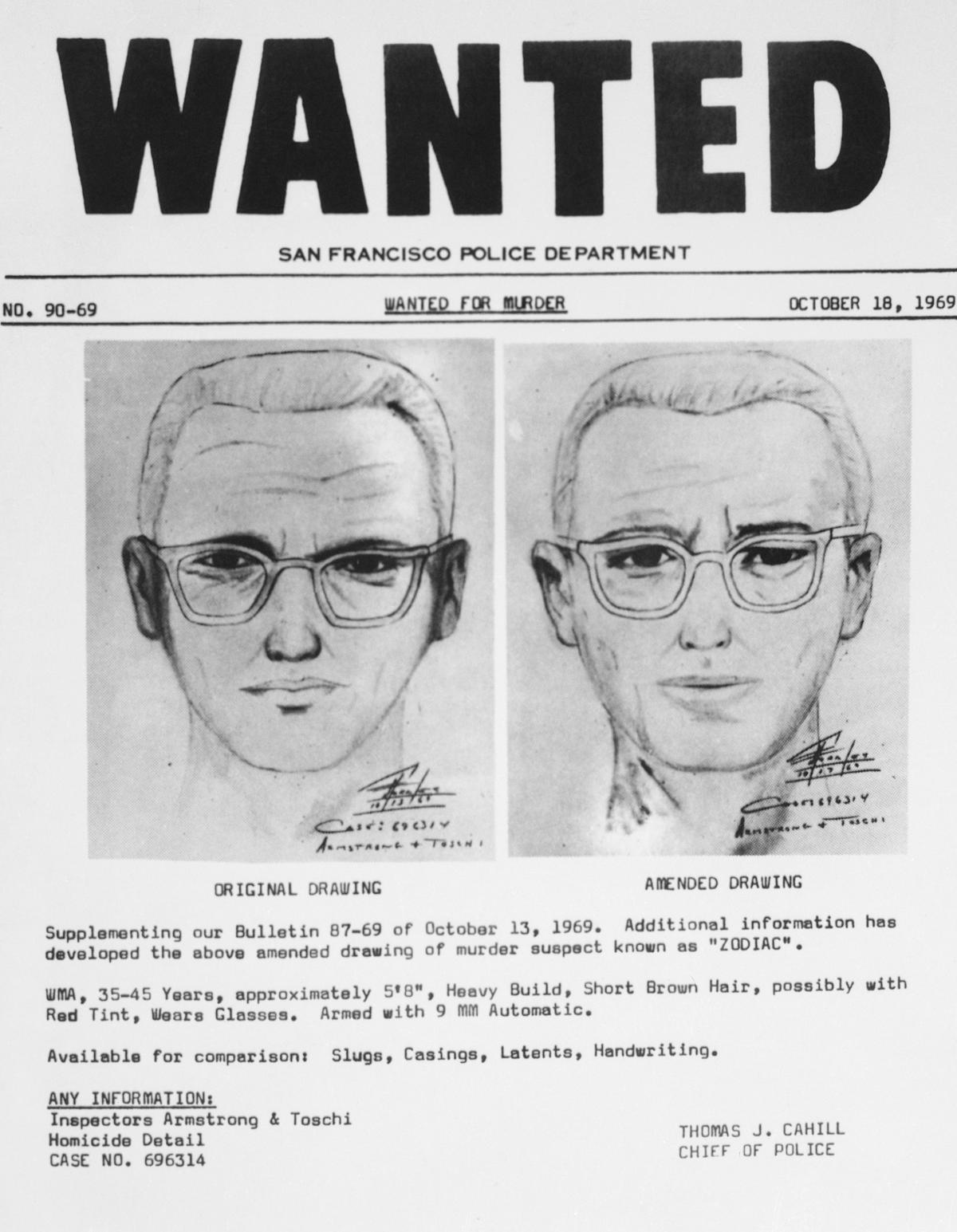
The cab stopped on a dark street in San Francisco, and the driver was shot.
October 11, 1969.
The case summary places the killing there, on that night.
Investigators found bloody fingerprints on the cab door.
They found something else on the driver's shirt.
A message, written in grease pencil.
The killer left it there, according to the investigation evidence.
It was a line of text, scrawled on fabric.
Investigators photographed it, documented it, tried to read it.
They could not decipher it.
The content of the message is not established.
Its meaning is not established.
Whether the killer wrote it at all is not established.
The record holds only the fact of the marks.
What the letters said, what they were meant to say, what they named — that would require evidence.
The fingerprints were clearer.
They were lifted from the cab door, preserved, compared.
They matched no suspect.
They matched no one.
The grease pencil sat in the file, a question without an answer.
It was evidence.
It was also a wall.
Investigators had a dead man, a cab, a set of prints, and a scrawled note.
They had jurisdiction spread across counties, lost evidence, poor coordination.
They had a message they could not read.
The case summary is plain on this point: the meaning remains unknown.
The cab door held the prints.
The shirt held the words.
Neither one spoke.
THE FIRST SHOTS
December 20, 1968. Two teenagers parked at a lovers' lane in Benicia, California.
They were shot and killed. The case summary records the date and the place.
The weapon was a .22-caliber pistol. No suspect was identified at the scene.
The identity of the attacker is not established.
July 4, 1969. A young couple was shot at Blue Rock Springs Park in Vallejo.
The man survived. The woman did not.
Again, a .22-caliber pistol. Again, the attacker left no name.
The identity of the attacker is not established.
September 27, 1969. Three young people were attacked at Lake Berryessa.
Two were stabbed. One died.
The weapon was a knife now, not a pistol.
The attacks escalate. The weapon changes. The killer adapts.
The identity of the attacker is not established.
Not because no one looked. Because no one could prove it.
The first attacks were scattered across jurisdictions — Benicia, Vallejo, Napa County. Each police force worked its own patch.
The case summary lists the dates. It lists the weapons. It lists the dead.
It does not list a name.
The man survived the July shooting, and the man survived the stabbing at the lake. Their testimony would matter later.
But at the time, there was only the pattern: a lovers' lane, a park, a lake. A pistol, a pistol, a knife.
Something was moving north. Something was getting closer to the city.
THE CAB AND THE CIPHERS
October 11, 1969: a cab driver was shot in San Francisco.
The killer left bloody fingerprints on the cab door.
The killer wrote in grease pencil on the victim's shirt.
What the grease-pencil message said, or whether the killer wrote it at all, is not established by the record.
The fingerprints were physical. The message was a puzzle.
Then the letters began arriving.
The killer sent cryptograms and letters to the *San Francisco Chronicle*, the *San Francisco Examiner*, and the *Vallejo Times-Herald*.
The letters coined the name "Zodiac."
They took credit for the murders.
They promised more.
The first cipher was solved in 1969 by a Salinas high school teacher and his wife.
They cracked it in days.
That message was plain enough, or plain enough once decoded.
The second cipher sat unsolved for decades.
In 2020, a team of amateur codebreakers from the United States, Australia, and Belgium deciphered it.
The message contained no name.
No identity. No confession. No address.
It was a puzzle with an answer and no solution to the case.
The grease pencil and the cipher were the same kind of evidence: something left behind, something meant to be read.
Both were read. Neither closed the file.
The fingerprints were compared to suspects.
They matched no one charged.
Handwriting experts compared the letters to samples from suspects.
The comparisons produced suspicions, not charges.
The cab door held a print. The shirt held a phrase. The letters held codes.
None of it held a name the law could arrest.
THE SUSPECT AND THE EVIDENCE

The primary suspect was Arthur Leigh Allen, a Vallejo schoolteacher and convicted child molester.
The press and law enforcement widely reported his name. He was investigated after a former student reported suspicious statements.
A search of his home found bloodstained knives and a flashlight. The blood was not matched to any victim.
The fingerprints from the cab door did not match Allen. The grease-pencil message on the shirt yielded no comparison.
In 2002, a DNA test was run on saliva from the envelope flaps of the Zodiac letters. The sample was compared to Allen's DNA.
It did not match.
Not because the evidence cleared him. Because the evidence never connected him.
No suspect was ever charged. Allen died in 1992 of a heart attack.
The suspicion was heavy. The physical proof was light.
The cab door held a print. The shirt held a phrase. The letters held codes.
None of it held Allen's name.
Investigators later acknowledged the case had been compromised by lost evidence and poor coordination between agencies. That is what the record shows.
Was Allen the killer? That would require evidence.
No physical evidence has ever linked him to the crimes. The case remains unsolved.
AND THE STORY STILL ISN'T OVER
The case remains officially open in multiple jurisdictions.
The San Francisco Police Department re-opened it in 2007.
They re-opened it again in 2018, submitting evidence for DNA testing.
In 2020, the second Zodiac cipher was solved by a team of amateur codebreakers from the United States, Australia, and Belgium.
The message contained no name.
No new suspect has been named.
The grease-pencil message on the cab driver's shirt remains undeciphered.
That is not established by the record.
The families of the victims have continued to press for answers.
They have pressed for decades.
The case has been the subject of numerous books, films, and documentaries.
Arthur Leigh Allen remains the most discussed suspect in those stories.
No physical evidence has ever linked him to the crimes.
The fingerprints from the cab did not match him.
The DNA from the envelope flaps did not match him.
Was the grease-pencil message the killer's handwriting?
Was it a taunt, a signature, a mistake?
Was it even written by the killer at all?
That would require evidence.
The record does not provide it.
Investigators acknowledged the case had been compromised by lost evidence and poor coordination between agencies.
That is what the record shows.
The story still isn't over.
It remains open.
It remains unsolved.
Advertisement
You may also like
The phone calls a mistress recorded that shattered a husband's alibi
She was eight months pregnant, and she was reported missing from her home in Modesto, California, on December 24, 2002. Her husband, Scott Peterson,…
The confession that cracked the case: What Moseley told detectives about the night Kitty Genovese died
He was arrested for burglary. Winston Moseley was a 29-year-old business machine operator when police picked him up on March 19, 1964 — six…
The memoir admission that revived a 27-year-old murder case
It starts with a book. In 2018, Duane "Keffe D" Davis — a self-described gang member — published a memoir and gave interviews describing…
The Ryder truck VIN that led FBI agents to a rental clerk — and a name
The first report came within minutes. Not as an explosion. As a gas leak, a utility accident, something breaking. At 9:02 a.m. on April…
The friend who called police because Shanann Watts missed her OB-GYN appointment
The appointment was a checkup, the kind that fills a Tuesday morning and is forgotten by lunch. Shanann Watts, 34, was fifteen weeks pregnant…
The surgical cut that pointed LAPD to a doctor's skill — but never to a name
The morning of January 15, 1947, began with a child’s walk through a vacant lot in Leimert Park, Los Angeles. The nude body of…