The Ryder truck VIN that led FBI agents to a rental clerk — and a name
The first report came within minutes.
Not as an explosion. As a gas leak, a utility accident, something breaking.
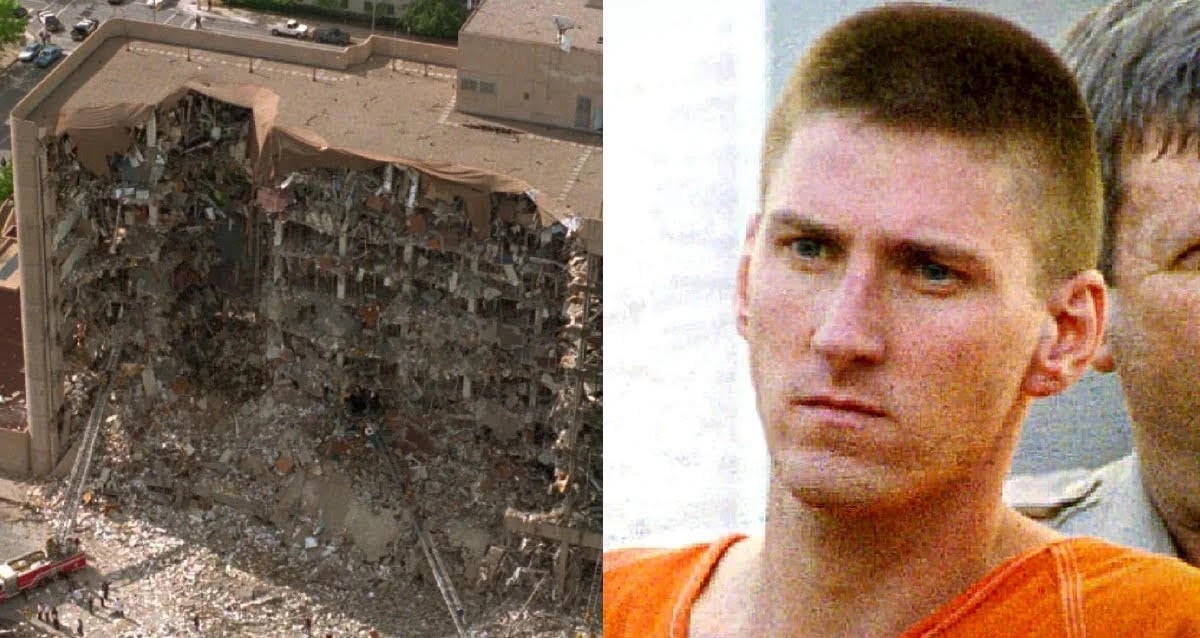
At 9:02 a.m. on April 19, 1995, a rented Ryder truck blew up in front of the Alfred P. Murrah Federal Building in Oklahoma City, Oklahoma.
The blast tore off the building's north face.
Floors collapsed. Hundreds of workers and visitors were trapped in the rubble.
Then the reports changed.
Within hours, the FBI took charge of the scene, and the investigation stopped looking like an accident.
They found a vehicle identification number on the truck's rear axle.
One number, stamped into metal that had just been ripped apart by an ammonium nitrate and fuel oil bomb.
That VIN led to a Ryder rental agency in Junction City, Kansas.
That is where the record points. Not to a theory, not to a guess.
The axle survived. The number survived. The paper trail at the rental counter survived.
What the record does not yet establish: who signed for the truck.
At this point in the timeline, that name is still unknown.
The FBI has a number. They have a location. They do not yet have a renter.
How does a single number on a destroyed axle unravel a massive attack?
That is the question the agents asked themselves as they worked the scene.
That is the question the rental clerk would answer.
THE TRAFFIC STOP
About 90 minutes after the blast, a trooper pulled over a Mercury Marquis on Interstate 35.
Oklahoma Highway Patrol Trooper Charlie Hanger stopped the car because it had no license plate.
The driver was Timothy McVeigh, 27, a Gulf War veteran.
McVeigh was not arrested for the bombing.
He was arrested for driving without a license plate and for carrying a concealed weapon.
He was in custody when the FBI matched the VIN on the truck's axle to a Ryder agency in Junction City, Kansas.
The rental clerk would later identify McVeigh from a sketch.
But there was a near-miss buried in the timeline.
McVeigh's car was impounded, yet it was not fully searched for several days.
The exact reason for that delay is not specified in the record.
Not because the investigation was careless.
Because no one yet knew the man in the traffic stop was connected to the explosion.
That connection would come from the axle, not the arrest.
When agents finally searched the car, they found a note referencing the "Turner Diaries," a novel about anti-government violence.
The note was evidence of motive, not the reason he was stopped.
He was stopped because a trooper saw a missing plate.
He was held because the gun was concealed.
He was linked because a clerk remembered a face.
The irony is plain: a routine stop caught him, and a delay nearly lost him.
If the car had been searched that day, the note would have surfaced sooner.
If it had been searched later, the trail might have gone cold.
The record does not say why the search waited.
It only says that it waited.
THE RENTAL CLERK'S LOOK
The VIN from the truck axle led to a Ryder rental agency in Junction City, Kansas.
The clerk behind the counter looked at a sketch and recognized the face.
He identified McVeigh from that drawing.
The record names the clerk as a key witness; his name is not in the record for this article.
The identification narrowed the investigation from a nation to a single man.
Investigators had initially suspected Middle Eastern terrorists.
The evidence pointed elsewhere.
Bomb residue was found on McVeigh's clothing.
A receipt for ammonium nitrate was among the evidence.
The receipt matched the bomb-making material.
A third man testified about the planning of the attack.
That testimony came from a man who pleaded guilty to lesser charges and testified for the prosecution.
His name is not in the record for this article; his testimony is described only by role.
The record does not establish his name here.
The case was built on the VIN, the sketch, the residue, the receipt.
It was built on what the clerk saw.
McVeigh was already in custody when the FBI linked him to the rental.
He had been stopped about 90 minutes after the bombing.
The trail that began on an axle ended at a face.
THE TRIAL IN DENVER
The trial judge moved the case from Oklahoma City to Denver.
He moved it to ensure a fair jury.
McVeigh was charged with 11 counts of conspiracy and first-degree murder.
The prosecution, led by Joseph Hartzler, presented over 100 witnesses.
They detailed the planning, the purchase, the rental.

They detailed the bomb residue on McVeigh's clothing.
They detailed the receipt for ammonium nitrate.
The trial judge's name is not in the record for this article.
He is referred to by role.
On June 2, 1997, the jury convicted McVeigh on all counts.
He was sentenced to death.
The legal process ran its course.
It ran despite the horror of what was described in that courtroom.
It ran despite the 168 empty chairs that would later stand in Oklahoma City.
McVeigh was executed by lethal injection on June 11, 2001.
That is the documented record.
The trail that began on an axle ended at a face.
The face was identified.
The face was tried.
The face was convicted.
The face was executed.
Not because of any viral theory.
But because a clerk looked at a sketch, and a jury looked at the evidence.
AND THE STORY STILL ISN'T OVER
The third man testified for the prosecution.
He pleaded guilty to lesser charges. He was sentenced to 12 years. The record does not specify his current status.
Terry Nichols was tried separately.
He was convicted of conspiracy and involuntary manslaughter. He was sentenced to life in prison without the possibility of parole. He remains in federal prison.
The Murrah Building site is now the Oklahoma City National Memorial.
It was dedicated in 2000. There are 168 empty chairs, one for each victim. Nineteen of those chairs are smaller than the rest.
Bud Welch lost his daughter.
He became an advocate for victims' rights. He also spoke against the death penalty. He is not alone among the families.
The legal case ended. The memory did not.
The case remains a defining moment in American domestic terrorism history. It is cited in training, in policy, in memorials. It is a name that still carries weight.
The chairs sit empty. The site is a place for visitors. The families carry the date with them.
What was found in the rubble became a lesson. What was learned became procedure. What was lost cannot be replaced.
The trial is over. The appeals are over. The execution is over.
The story continues in the families, in the memorial, in the record. The viral theories do not change what the clerk saw or what the jury found.
The record traces the case from a VIN on an axle to a name. It does not trace it from any theory.
The chairs remain.
Advertisement
You may also like
The phone calls a mistress recorded that shattered a husband's alibi
She was eight months pregnant, and she was reported missing from her home in Modesto, California, on December 24, 2002. Her husband, Scott Peterson,…
The confession that cracked the case: What Moseley told detectives about the night Kitty Genovese died
He was arrested for burglary. Winston Moseley was a 29-year-old business machine operator when police picked him up on March 19, 1964 — six…
The memoir admission that revived a 27-year-old murder case
It starts with a book. In 2018, Duane "Keffe D" Davis — a self-described gang member — published a memoir and gave interviews describing…
The friend who called police because Shanann Watts missed her OB-GYN appointment
The appointment was a checkup, the kind that fills a Tuesday morning and is forgotten by lunch. Shanann Watts, 34, was fifteen weeks pregnant…
The surgical cut that pointed LAPD to a doctor's skill — but never to a name
The morning of January 15, 1947, began with a child’s walk through a vacant lot in Leimert Park, Los Angeles. The nude body of…
The Grease-Pencil Message on a Victim's Shirt That Baffled Zodiac Investigators
The cab stopped on a dark street in San Francisco, and the driver was shot. October 11, 1969. The case summary places the killing…