The inmate tip that cracked the Clutter farm murders — and what the killers found instead
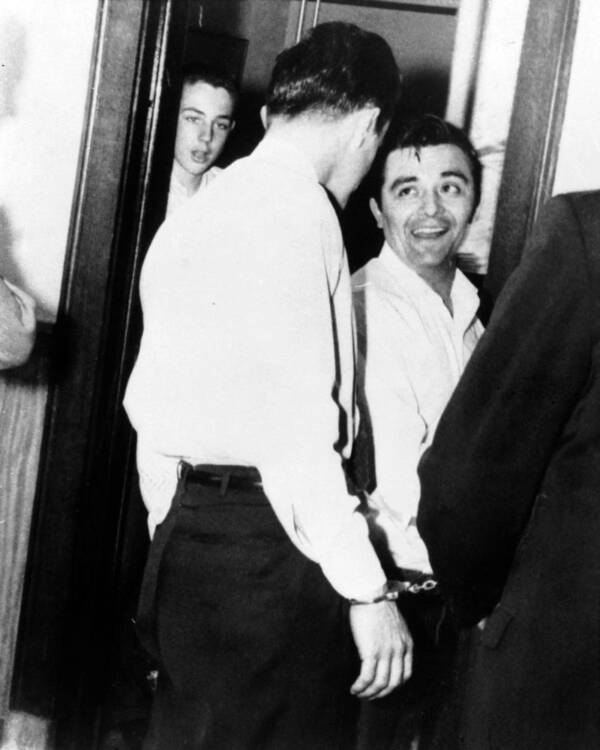
The safe was not there.
Four members of the Clutter family were murdered at their farmhouse in Holcomb, Kansas, on the night of November 15, 1959.
The victims were bound and shot at close range with a shotgun.
No forced entry.
No fingerprints.
No signs of a struggle.
Nothing of significant value appeared to have been taken.
The killers later confessed they had gone to the Clutter home expecting to find a safe containing cash.
They found none.
The exact contents of the safe, if any, are not in the record.
That absence is the detail that would come to define the case.
Not a robbery gone wrong.
A robbery that never happened.
The crime was planned.
It was also pointless.
The killers came for a safe that was never there.
They killed four people anyway.
They killed to eliminate witnesses, the confession said.
A 12-gauge shotgun was used.
It was never recovered.
The farmhouse stood silent that night, and the morning after, family friends came to the farm.
They found the bodies.
Herbert Clutter, a wealthy farmer.
His wife, Bonnie.
Their teenage children, Nancy and Kenyon.
No obvious motive.
Nothing taken.
No struggle.
Just four people bound and shot at close range.
The killers would be caught, tried, and executed.
But on that night, they stood in a house where the safe was not.
They found nothing.
They left nothing but the dead.
NOVEMBER 16, 1959 — THE DISCOVERY
The morning of November 16, 1959, family friends arrived at the Clutter farmhouse.
They found the bodies.
The victims were Herbert Clutter, a wealthy farmer and former state official; his wife Bonnie, who suffered from chronic illness; their 16-year-old daughter Nancy; and their 15-year-old son Kenyon.
Two older daughters, Eveanna and Beverly, were married and living away from home.
The exact time of death is not in the record.
The crime scene showed no obvious motive.
Nothing of significant value appeared to have been taken.
There were no signs of a struggle.
No forced entry.
.jpg?format=2500w)
No fingerprints.
A family of four, bound and shot at close range with a shotgun, and the house gave up nothing.
The case quickly drew national attention.
The family was well regarded.
The killings seemed inexplicable.
Why would anyone do this to the Clutters?
Why leave nothing taken, nothing disturbed, nothing but the dead?
Why a shotgun at close range in a house that held no safe?
The investigators had questions.
The community had questions.
The answers would not come for weeks.
THE INMATE'S STORY
The investigation initially produced few leads.
No forced entry.
No fingerprints.
The killer or killers had apparently left nothing behind.
The answers would not come for weeks.
Then a fellow inmate at the Kansas State Penitentiary spoke to authorities.
The inmate said that Richard Hickock had once described a plan to rob the Clutter farm.
He said he had given Hickock information about the family's wealth.
The exact date the inmate first spoke to authorities is not in the record.
What is in the record is the turn it produced.
Hickock and Perry Smith were arrested in Las Vegas, Nevada, on December 30, 1959.
The tip came from a former cellmate of Smith's.
Under interrogation, both men confessed.
They admitted they had gone to the Clutter home expecting to find a safe.
A safe containing cash.
They found none.
There was no safe. There was no cash.
They killed all four family members to eliminate witnesses.
That was the rationale they gave.
Not robbery gone wrong.
Not panic.
Witness elimination.
The confession turned a dead end into a case.
It is also what makes the crime stranger.
The men who planned the robbery were wrong about what was in the house.
The killers found nothing worth taking.
They left with nothing but the act itself.
THE TRIAL
The trial opened in March 1960 in Finney County District Court in Garden City, Kansas.
Both men were tried together.
Each faced four counts of first-degree murder.

The prosecution presented the confessions.
The prosecution presented the testimony of the inmate who had linked one of the defendants to the crime.
The defense argued the confessions were coerced.
The defense argued the defendants were not responsible for their actions due to mental illness.
The specific evidence of that mental illness is not detailed in the source.
The jury heard the case.
The jury found both men guilty on all counts.
The judge sentenced each to death.
The weight of the verdict settled over the courtroom.
The case did not end there.
The convictions were appealed to the Kansas Supreme Court.
The court upheld them.
Further appeals went to federal courts.
Those appeals were unsuccessful.
The legal road stretched on for years.
The verdict stood.
The sentence stood.
The record shows a trial, a conviction, and an appeal.
It does not show the details of the psychiatric evidence.
It does not show what the jury weighed beyond the confessions and the inmate's words.
The men who expected a safe had found nothing in the house.
In the courtroom, they found the law.
AND THE STORY STILL ISN'T OVER
The two men were hanged on April 14, 1965, at the Kansas State Penitentiary in Lansing.
The farmhouse was later demolished.
Truman Capote turned the case into *In Cold Blood*, published in 1966, built on extensive interviews with the killers and the community.
The book made the case famous.
It is considered a pioneering work of true crime literature.
The surviving daughters, Eveanna and Beverly, lived private lives after the murders.
The murder weapon was a 12-gauge shotgun.
It was never recovered.
Its current location is unknown.
That is not established.
Not because the record is careless.
But because the shotgun simply vanished.
The house is gone.
The men are gone.
The case endures.
It remains one of the most studied in American criminal history.
A book stands where a house once stood.
A question stands where a weapon once was.
What else is left to find?
That would require evidence.
Advertisement
You may also like

The truck painter who led detectives to 49 Green River victims — and the DNA that closed in on him
He painted trucks for a living. Gary Leon Ridgway lived in Auburn, Washington, a suburb south of Seattle. He was married multiple times. He…
The 1939 tip that put a suspect behind bars — but the murder charge never came
1939. A tip. A tip put a former bartender and carnival worker behind bars in Cleveland, Ohio. He was the most prominent suspect in…
The Zodiac cipher that cracked open a killer's boast — but not his name
In August 1969, a cipher arrived at the offices of the *San Francisco Chronicle*. It was not the first taunting letter, and it would…
The smiley-face letter that made a sister call police on her own brother
The letter arrived at the Oregonian with a claim of responsibility for a murder and a mocking of police. It was signed with a…
The 2005 massage-table complaint that opened Epstein's case, and the detective who kept digging
A mother called Palm Beach police in 2005. She said her 14-year-old stepdaughter had been recruited by an older girl to give a man…
The 13-day trial that hinged on a dress burned in a stove — and a timeline no one could explain
The dress was burned in a stove on the third day after the bodies were found at 92 Second Street. The prosecution called it…